Signature
The Book of MirrorsSignature was a well-regarded New York literary magazine with limited circulation, and for Richard Flynn it became the venue of a brief, consequential literary opening. The magazine accepted all three stories he submitted, yet the issue appeared while he was changing his address under pressure from detectives and reporters; he did not see his contribution until fifteen years later. Its arrival in his life was also its near-immediate disappearance from view.
Identity and Editorial Opportunity
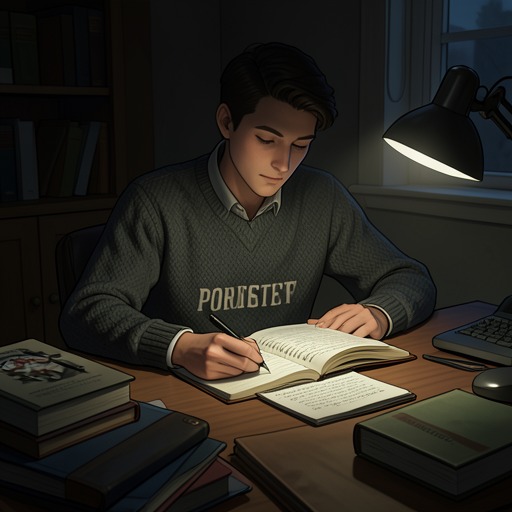
In early December, Lisa Wheeler, a librarian at Firestone Library and a friend of Richard Flynn, told him that an editor from Signature would lecture at Nassau Hall. The magazine was based in New York and, though its circulation was limited, was well regarded at the time. Knowing Flynn wanted to publish, Wheeler secured him an invitation and urged him to approach the editor after the lecture with his stories.
Flynn hesitated for three days, uncertain how far to press his case. At Laura Baines’s insistence, he chose three short stories, enclosed them with a résumé, and brought the package to the lecture. A week later, while eating pizza with Baines at an Italian restaurant on Nassau Street, he called the magazine’s office using the editor’s business card. The editor, Mr Hartley, told him that all three stories would appear in the next issue, scheduled for January. Because the pieces were short, they would occupy five pages together; the magazine also requested a black-and-white portrait and a brief biography.
Publication and Missed Issue
The acceptance gave Flynn an immediate prospect of being read. Hartley described the forthcoming issue as a strong one, noting that readership increased after the holidays, and praised the stories. Flynn was overwhelmed by the news and thanked him. Hartley also proposed meeting after the holidays, offering the prospect of further contact between the young writer and the editor.
Flynn had a portrait taken at a small downtown studio and sent two photographs to the magazine, keeping two others: one for Baines and one for his mother. He intended to give Baines her copy but forgot the photographs in his shoulder bag before leaving for the holidays. Later, in Ithaca, he discovered that they had vanished. By the time the issue appeared at the end of January, he had changed his address because detectives and reporters were harassing him. The complimentary copies Signature mailed therefore never reached him.
Aftermath and Significance
Flynn did not see the issue until fifteen years later, when a friend gave him a copy found in a second-hand bookstore on Myrtle Avenue in Brooklyn. He never spoke to Hartley again. Only by chance, in the early 2000s, did he learn that the editor had died in a car accident on the West Coast in the summer of 1990.
The magazine’s publication of Flynn’s stories remained an opportunity he could not experience when it first occurred: the acceptance was real, but the mailed evidence of it went astray amid the upheaval surrounding him. Flynn later regarded the way Signature and his literary career slipped out of his grasp as a possible sign. Although he continued writing for a while, he never published anything again. Signature thus marks both a concrete early success and the point at which that promise became, in his account, a lost beginning.