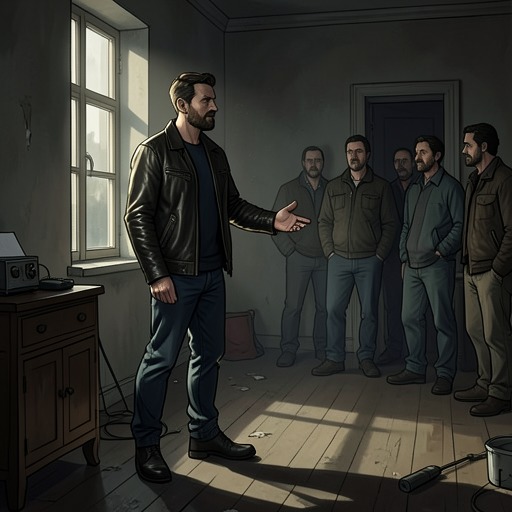
The Unreliability and Reconstruction of Memory
The Book of MirrorsThe Unreliability and Reconstruction of Memory is the book’s central challenge to the idea that a vivid recollection is necessarily an accurate record. Memories can absorb stories heard from others, acquire details through suggestion, and conflict with a person’s own earlier account. The consequences reach beyond private uncertainty: memories become testimony, identity, and narrative, yet their felt certainty does not by itself establish what happened.
Memory as Reconstruction
Laura explains the idea to Richard through images of an edited film reel and mouldable gelatine. Rather than recording everything like a camera, she argues, memory selects fragments of experience and assembles them into a coherent scene. A person may retain an event while losing track of how it became known, or mistake something heard for something personally witnessed. Richard resists the theory at first, but recognizes its force in a memory he had long treated as his own: he thought he had watched the 1970 Super Bowl and seen the Kansas City Chiefs defeat the Minnesota Vikings. He was only four at the time; the scene came from his father’s repeated stories about the game.
A memory of a major public event provides a related distinction between knowing about an occurrence and remembering it directly. Richard knows that his parents watched the moon landing because they talked about it for years. He can also recount a family anecdote from that day: his father returned from the dentist, his mother made chamomile tea for him to gargle with, and he scalded his mouth. But Richard does not remember watching Neil Armstrong on the moon; he saw that footage later. The repeated story gives him access to the day’s family narrative without making him an eyewitness to the televised event.
Suggestion and False Memory
Wieder’s experiment makes reconstruction more than a metaphor. He studied students born during the period when the spread of shopping malls had made the fear of losing a child in a crowd familiar to many families. None initially remembered getting lost in a mall. Under hypnosis, however, Wieder suggested that they had. Three-quarters later described such an episode, including fear, being found by clerks, being taken to their mothers, and announcements over the speakers naming a child who had been found near the cafe.
The detail and confidence of these accounts did not make the suggested events genuine memories. Many participants rejected the explanation that hypnosis and childhood fears had produced them. Wieder’s contrast with an invented alligator attack in New York City clarifies the mechanism he proposed: a suggestion is more readily elaborated when it fits a person’s existing fears and cultural experience. In this account, memory is neither wholly fabricated at will nor a neutral archive. What can be made to feel remembered depends partly on what already seems plausible.
The experiment also sharpens the difference between a recollection’s vividness and its reliability. The students could describe how they felt, who found them, and what they heard, but those particulars were products of a suggested scenario rather than proof that the underlying event occurred. The gap between the experience of remembering and the historical truth of a memory is therefore one of the book’s most consequential questions.
Conflicting Accounts and the Past
Laura connects the problem to eyewitness testimony. People questioned about the same hit-and-run may confidently give incompatible descriptions of a car’s colour; the eventual answer may be yellow, despite witnesses insisting it was red or blue. Her example shows how small, apparently obvious details can divide accounts. If recollection is an active reconstruction, confidence and agreement cannot simply be treated as substitutes for independent confirmation.
The same uncertainty enters the investigation of Joseph Wieder’s murder through Richard Flynn’s account of his visit to Wieder’s house. At the end of his manuscript, Flynn places his departure about twenty minutes after Timothy Sanders’s visit, at roughly six in the evening. The journey would have taken about twenty minutes each way, perhaps longer in the weather. Yet Flynn told investigators that he went to the house at around nine, spoke with Wieder about the library before Christmas break, returned home at ten, and went to bed soon afterward. The discrepancy leaves several possibilities open: Flynn may have lied in the investigation, misrepresented events in the manuscript, or remembered the timing incorrectly. The available accounts do not resolve which explanation is true.
A similar problem arises when Roy Freeman asks Derek Simmons to compare his old statement with what Frank Spoel had told him. Simmons remembers making the statement, but his account places him hiding in Wieder’s backyard at nine alongside Spoel, who separately claimed to have been hiding there. Their descriptions also differ over whether Laura Baines was present and whether Richard argued with Wieder. The disagreement does not itself establish which witness is mistaken or deceptive. It makes the act of remembering and reporting part of the evidence that must be assessed.
Memory, Identity, and Recovery
For Derek, the return of a specific recollection begins with a television news item. In March 1987, while channel-surfing, he sees a report about a man from Bergen County who had died by suicide and recognizes him as Stan Marini, a former member of the maintenance crew at Siemens. Derek understands that nobody had told him about Marini’s death and that he had not read about it. The recognition therefore feels different from a detail supplied by someone else: it signals to him that something from his own past is resurfacing. He compares the experience to oil bursting through the ground after a lid is lifted, and describes memories coming back at a speed beyond ordinary viewing.
The moment does not make memory a simple, complete recording recovered intact. It shows instead how a cue can make a previously inaccessible connection available, while leaving open the accuracy and completeness of what returns. Elsewhere, Richard’s conflicting times and the witnesses’ incompatible accounts show that recollection may remain unstable even when people sincerely report what they believe they remember.
Narrative Significance
The concept governs both the characters’ understanding of psychology and the reader’s approach to the murder’s competing accounts. A manuscript, an investigative statement, and a witness’s later recollection can each present a version of the past without automatically settling it. The book’s examples repeatedly ask the reader to distinguish the event described from the route by which a person came to remember it: direct experience, a family story, later viewing, cultural fear, hypnotic suggestion, or an uncertain reconstruction.
This uncertainty does not mean that every account is equally accurate or that facts are unknowable. The experiment demonstrates how suggestion can create a compelling recollection; Richard’s Super Bowl memory reveals a specific confusion between hearing and witnessing; and Flynn’s differing timelines supply a concrete inconsistency to investigate. Together, these cases make memory both indispensable and fallible: it is how characters recover and narrate their pasts, but also a source of error that prevents confidence alone from serving as proof.