Trenton mental hospital
The Book of MirrorsTrenton mental hospital is the institution where psychiatric assessments became consequential in two criminal cases: Derek Simmons was committed there after Joseph Wieder challenged his earlier diagnosis, and Frank Spoel was sent there after Wieder judged him to have bipolar disorder. For Simmons, the hospital became the site of an assault that severed his access to his past; for Spoel, it was the place he expected to leave quickly but did not.
Commitment and Treatment
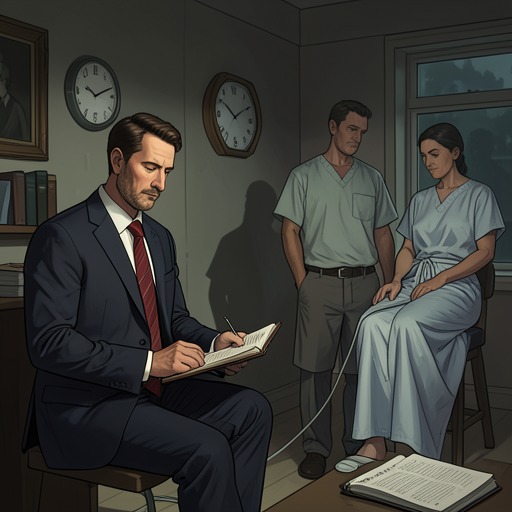
After examining Derek Simmons several times, Joseph Wieder concluded that Simmons had a rare dissociative disorder and had been wrongly diagnosed with schizophrenia when young. Wieder believed Simmons might experience fugue states in which self-awareness, memory, and identity disappeared. On that account, Simmons might not have remembered his actions on the night of the crime. His report persuaded the court, and a judge ordered him committed to Trenton mental hospital, among patients considered potentially dangerous.
With the institution’s agreement and the consent of Simmons’s lawyer, Wieder continued treating him there. The treatment combined hypnosis with an experimental mixture of anticonvulsant drugs. The hospital thus served not only as the place of Simmons’s confinement but also as the setting for Wieder’s attempt to reach and treat the condition he had identified.
After several months, another patient attacked Simmons and inflicted a serious head wound. His condition worsened: he lost his memories and could not recover them, although he remained able to form new ones. Laura Baines identifies this loss as retrograde amnesia. The distinction is central to Simmons’s later life: the assault at the hospital did not erase every capacity, but it cut him off from the personal history that would have explained how he acquired his skills and identity.
Spoel’s Commitment and a Different Outcome
Frank Spoel entered Trenton mental hospital after a street-level robbery case, not the homicide for which he would later become notorious. In the fall of 1985, he had sold cigarettes for French perfume, discovered that many bottles were counterfeit, and gone to demand his money back. A fight followed; he beat one of the men and took the cash from his pockets. A passing patrol arrested him for mugging. Spoel concealed the cigarette transaction, which he believed would have made his situation worse.
His public defender, Terry Duanne, presented Spoel with a choice between trial as an adult, carrying a possible five-to-eight-year prison sentence, and a finding of temporary insanity. Duanne suggested that the psychiatric route might lead to discharge within a few months and was preferable to Bayside Prison. Joseph Wieder examined Spoel, diagnosed bipolar disorder, and recommended commitment. Spoel arrived at Trenton expecting a brief stay; instead, the hospital became a prolonged passage in his life, and the public account of his later crimes would identify him as having spent two years there after an earlier arrest and insanity ruling.
That history makes the institution a point of convergence between two cases with sharply different records. Wieder’s assessment of Simmons led to confinement followed by a long effort to support him after his memory loss; his assessment of Spoel began with a non-homicide arrest and the expectation of temporary hospitalization. Spoel later said that Wieder was the only friend he had, even as the hospital experience frustrated his expectation of release. Years afterward, while facing execution in Missouri, he decided to disclose his history after a California professor visited him to ask how he had become a killer. The institution’s significance therefore extends beyond treatment: its evaluations and decisions shaped the paths by which both men entered the criminal record, while the memories and testimony surrounding those decisions remained contested.
Records, Transfer, and Institutional Memory
The surviving case file gives the hospital a second identity: not only the place where Simmons was attacked, but a stage in a documented sequence of confinement, transfer, and supervised release. Simmons never admitted to the murder; the judge instead ruled him not guilty by reason of insanity after an examination by Joseph Wieder. He was held first in New Jersey State Prison and then committed to Trenton mental hospital, where the accident that caused his amnesia occurred. After recovering physically, he was transferred to Marlboro mental hospital a year later. Wieder wrote the expert assessments that supported the transfer and, two years afterward, Simmons’s release. The file’s final entry was a 1994 order lifting supervision, again following an expert assessment.
That paper trail sits uneasily beside the human dependence it records. Laura Baines had visited the hospital with Wieder for fieldwork and considered a mental hospital perhaps the most sinister place on earth; the official language of reports and rulings registers decisions, while leaving the lived reality of confinement largely out of view. In Simmons’s case, the institution’s record preserves the steps by which he was judged and moved, but not the personal memories the head wound made inaccessible. Trenton therefore marks both an administrative passage through the mental-health system and a break in the continuity of a life.
Memory’s Return and Conflicting Accounts
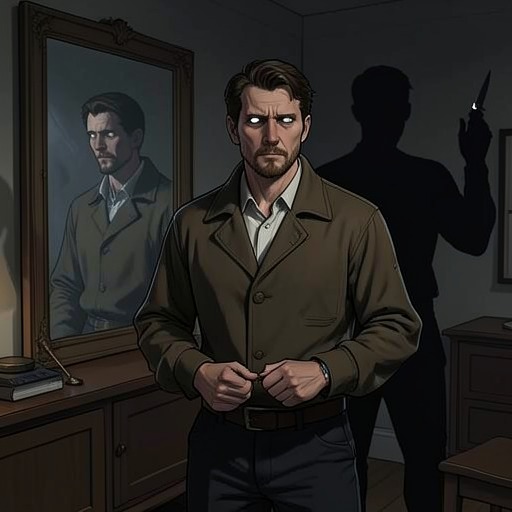
The head injury at Trenton mental hospital initially seemed to have closed off Simmons’s past, but the novel later complicates that conclusion. In March 1987, he watched a report on the NY1 television station about Stan Marini and recognized him as a former member of the maintenance crew at Siemens, where Simmons himself had once worked. He understood that this was not knowledge supplied by someone else or encountered in a book. The recognition opened a way back into memories that had seemed inaccessible, which he experienced as a sudden rush of material emerging from behind a sealed barrier. The episode makes the hospital’s consequence more than a lasting blank: the loss of memory and the possibility of its return become competing realities in Simmons’s life.
That uncertainty also shadows the accounts of the night Joseph Wieder was killed. Simmons recalled hiding in the backyard and placed Laura Baines and Richard Flynn at the house, including an argument and Baines’s departure; Frank Spoel’s account put him in the same hiding place at the same time but described Flynn with Wieder and made no mention of Baines or a disagreement. Simmons acknowledged that the accounts did not fit together, while saying that Wieder had been the only friend he had. The contrast does not by itself establish which account is true, but it makes the hospital’s history of disrupted memory relevant to how the case is reconstructed: testimony, like recollection, remains vulnerable to gaps and contradiction.