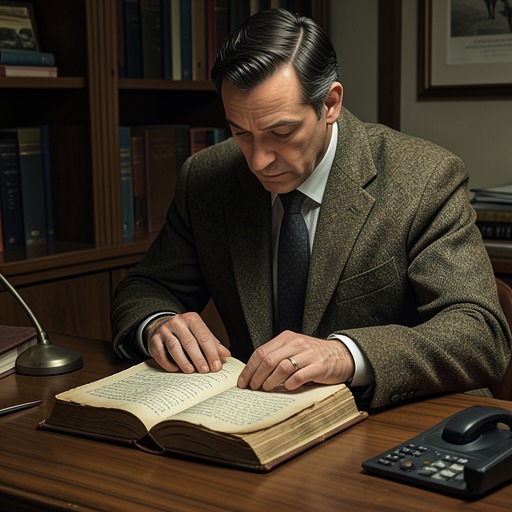
Wieder Submits a Book Proposal to Allman & Limpkin
The Book of MirrorsJoseph Wieder’s July 1987 submission to Allman & Limpkin set in motion a publishing arrangement whose documentary trail would later sharpen, rather than settle, questions about a missing manuscript and the ownership of its ideas. The proposal included the book’s first chapter and represented the full manuscript as complete and ready for submission. A contract followed, but the promised book never arrived. Years later, the proposal’s surviving copy became evidence in an investigation that placed Wieder’s claims beside Laura Baines’s account of how her research had been used.
Submission and Contract
According to information an editor supplied to Roy Freeman, Wieder sent the proposal in July 1987 with the first chapter enclosed. In the proposal, he stated that the manuscript was complete and ready to submit. This was not merely an expression of interest: the publisher sent him a contract the following month, in August, establishing a concrete next stage for the project.
The contract called for Wieder to begin revising the text with the editor in November. When that point arrived, Wieder asked for a few more weeks, explaining that he wanted to polish the manuscript once more over the holidays. The publisher agreed to the delay. The account of the schedule therefore records a project that had progressed from proposal to contract and planned editorial work, but also distinguishes that formal progress from the delivery of the actual book.
That distinction proved decisive. The full manuscript never reached the publisher. The editor’s account says that tragedy intervened after Wieder had received permission to postpone the revision, leaving the project without the complete text its proposal had promised. The proposal and its enclosed chapter survived as documents; the promised finished manuscript did not enter the publisher’s records described in the investigation.
The Document in Freeman’s Investigation
The editor sent Freeman a scan of the original typewritten proposal. It was almost fifty pages long. Freeman printed the pages, watched them collect in the printer’s tray, fastened them with a paperclip, and set them aside to read. The physical scale of the document mattered: the investigation had not produced a vague recollection of a publishing plan, but a substantial surviving proposal that could be examined against other accounts.
The discovery did not immediately make the surrounding events coherent. Freeman had begun by trying to establish whether Wieder’s proposal existed, whether he had submitted a complete manuscript, and why the book had never been published. The editor’s answers settled some of those questions: the proposal existed, it was sent, and it described a manuscript as complete. They also exposed a gap between what Wieder had represented to the publisher and what the publisher ultimately received. The document gave the inquiry a firm point of reference without resolving who had originated the work it described.
Disputed Authorship and Later Accounts
The proposal acquired a second significance when Keller’s investigation connected its subject to Baines’s first book. In a later exchange with Freeman, Keller described Wieder’s projected book as concerning the connections between mental stimuli and reactions, and said that this was also the subject of Baines’s first book, published five years later. Baines acknowledged the shared subject and said that the opening chapter of her book was identical to the chapter Wieder had sent to the publisher.
Baines disputed Keller’s conclusion that she had taken Wieder’s manuscript and published it under her own name. She said the manuscript Freeman was asking about had never existed as a finished book. According to her account, she had given Wieder an outline for her dissertation and its opening chapters; he had encouraged the idea and supplied additional materials. Over time, she said, the work became confused in his mind with his own, and his proposal combined her chapters with excerpts from his older books. She maintained that what he had submitted was not a complete, coherent book project.
These accounts leave the proposal’s central contradiction visible. Its language, as reported by the editor, presented a completed manuscript, while Baines later described the submitted material as her work joined to fragments of Wieder’s earlier writing. The reported identity between the enclosed chapter and the opening of her book supports the existence of a substantial textual overlap, but the proposal by itself does not establish how that overlap arose or settle competing claims of authorship.
Significance
The submission is a key turning point in the documentary investigation because it converts an uncertain publishing rumor into a dated sequence: proposal and first chapter in July, contract in August, planned revision in November, an agreed delay, and no delivery of the full manuscript. Its significance lies as much in what it cannot prove as in what it confirms. It establishes that Wieder made a formal claim about the state of his book and that the publisher acted on that claim, while leaving the proposed work’s origins and final form contested.
The surviving proposal thus stands between two versions of the missing book: the publisher-facing account of a completed manuscript and Baines’s account of unfinished dissertation material appropriated and mixed with older excerpts. In Freeman’s inquiry, it provides concrete evidence but not a final verdict. The document makes the dispute more precise, while the absent manuscript keeps its most consequential question open.