
Anonymity and Social Recognition
The Box ManThe novel links hidden identity to both personal freedom and the public failure to recognize vulnerable people.
increasing Bearing strength in each event
 decreasing
Bearing strength in each eventdecreasingThe Stranger Everyone Avoids

The Box Man in Public
A figure in plain sight
The narrator insists that readers have probably seen box men, even if they deny it. Their visibility does not lead to recognition because observers instinctively avert their eyes.
The social bargain
The box man’s concealment attracts suspicion, yet ordinary people prefer not to investigate him. The opening establishes anonymity as something produced jointly by the hidden person and the surrounding crowd.
The Arrested Vagrants

Order Against the Unhoused
A public clearance
Police arrest 180 people living in railway passages and park areas under minor-offense and traffic provisions. They are photographed, fingerprinted, and briefly processed.
Return to the same places
Most are released, and many return to their former haunts almost immediately. The episode shows law enforcing visibility without solving the conditions of homelessness.
The Dead Man Unnoticed
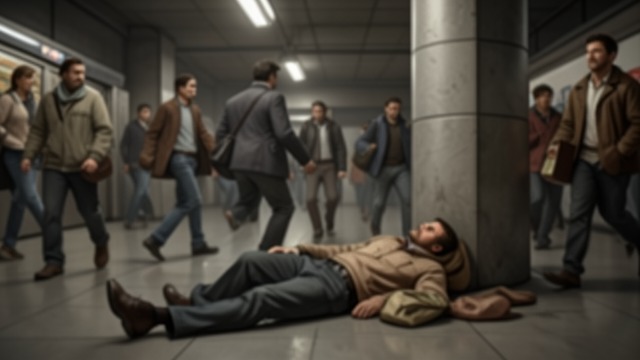
A Death Among Commuters
A body beside the pillar
A vagrant dies in a busy underground passage while passengers pass by for hours. Even an officer stationed nearby says the man was not visible from his position.
Recognition comes too late
Only after death is the man described and counted. His case makes the social invisibility of the living vagrant concrete and anticipates the narrator’s argument about box men.
The Box as Chosen Erasure

Life Outside the Record
Refusal of ordinary credentials
The narrator describes box men as lacking fixed address, work, and public identity. He portrays the box as a way to withdraw from systems that demand identification.
Freedom with a cost
The chosen anonymity protects the wearer from some forms of scrutiny but also removes ordinary routes to recognition and assistance. The narrator’s freedom is inseparable from a heightened vulnerability.
The Nameless City Ideal

A City Without Judgment
A promise of acceptance
The narrator imagines a city where inhabitants can sleep, sing, and move without being condemned. Namelessness becomes a positive social ideal rather than merely the absence of records.
An unresolved contradiction
The dead vagrant and the arrested residents show how anonymity can conceal neglect as easily as it grants freedom. The novel does not decide whether the nameless city exists beyond desire.
During the narrator’s opening reflections
The predawn hours of the twenty-third
The evening of the twenty-third
During the narrator’s reflections on law
After A’s conversion
