A
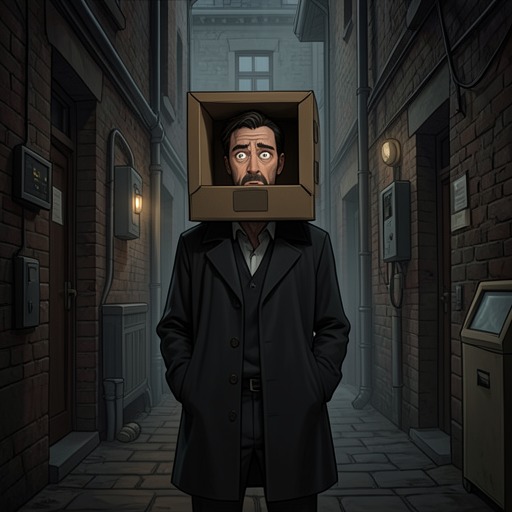
The Box ManA begins as an apartment resident who notices a Box man beneath his window and tries to make the stranger leave. When ordinary appeals fail, A fires an air rifle at the box; soon afterward, a refrigerator carton in his own home becomes an invitation he cannot simply discard. Within a week, he goes out into the streets with a box over his head and does not return. His brief trajectory turns the observer of an unwanted presence into someone who chooses the anonymity he had encountered at close range.
Identity and Initial Encounter
A lives in an apartment and travels to work, ordinarily using a shortcut to the station. His account begins when a Box man settles directly below his window. A tries not to look, but remains acutely aware of the figure’s presence. He experiences the occupation as an intrusion into his territory, and initially waits for someone else to resolve it, expecting a neighborhood busybody to intervene.
No one does. A complains to the building janitor, without result: the Box man is visible only from A’s window, and other people appear able to avoid seeing him. Their shared pretense leaves A alone with the problem he has been watching. At the police box, an officer tells him to complete a damage report. A’s exchange with the officer brings him, for the first time, close to fear; it also leaves no practical remedy in view except taking action himself.
The Air-Rifle Encounter
On his way home from the police box, A borrows an air rifle from a friend. Back in his room, he smokes and tries to calm himself before looking directly out the window. The Box man turns the observation slit toward him. Only three or four yards separate them, and the box tilts as its occupant watches A through the divided curtain.
A opens the window and takes aim, but hesitates over where to shoot. He does not want to cause lasting trouble or leave blood behind; at first, he hopes the threat alone will make the stranger move. His finger grows numb as he considers the other person’s position inside the box. Anger eventually overtakes that hesitation, and he fires. The box leaps, then settles; A hears neither the cries nor the jeers he had anticipated, only a slow movement from within. He cannot be sure what happened, but the reaction unsettles him.
When the Box man flees, A sees discarded cigarette ends, a bottle, and other rubbish where the box had stood. He also notices three dark stains, which he supposes are not blood. The uncertain traces give him a small measure of reassurance: he concludes that he hit his target. Yet the encounter does not end with the stranger’s departure. For roughly half a month A nearly forgets him, but avoids the narrow lane on his way to the station and continues checking the view from his window each morning and whenever he returns home.
The Carton and A’s Withdrawal
A’s attention is rekindled by the corrugated-cardboard carton that comes with a new refrigerator. It is the right size. Rather than dispose of it immediately, he remembers the sound of the shot and imagines the bullet ricocheting inside his head, disturbing his thoughts. He closes the curtains and cautiously crawls into the carton. The brief trial feels unexpectedly homelike, though he cannot grasp the recollection it almost brings to mind. He leaves the box for the time being.
The next day, A cuts an observation window into it and tries it over his head, but removes it at once. He kicks the carton into a corner, forcefully but not hard enough to destroy it. This retreat is temporary. On the first Sunday after he begins spending time in the box, with no visitors expected and nowhere to go, he remains inside for much of the day. He eventually realizes that he needs supplies and goes into town to buy a chamber pot, flashlight, thermos, picnic set, tape, wire, hand mirror, poster colors, and food that requires no preparation.
Back home, A reinforces the carton with tape and wire and arranges the supplies inside. He hangs the mirror on the inner wall, uses the flashlight while painting his face with poster color, and traces the colors of the rainbow around his eyes. Looking at his reflection, he thinks of himself as becoming contents suited to the container. He sleeps with the box over his head. These practical adjustments mark a change from trying on an object and recoiling from it to preparing a small, provisioned life within it.
Departure and Significance
The following morning, exactly a week after his first sustained move toward the box, A goes stealthily into the streets with it over his head. He does not come back. The narrative records no further destination or account of what happens to him; his departure is the decisive ending of his known life in the apartment, not a fully described new life elsewhere.
A’s story is framed as an example of how a seemingly slight motive can lead someone to become a Box man. The narrator cautions against laughing at A, linking his choice to the possibility of an Anonymous City: a place imagined for nameless inhabitants, where people can move among strangers without constant defensiveness and are not blamed for living outside ordinary expectations. A had been unusually conscious of Box men, but that heightened awareness exposes how close the condition already was to his own life. His transformation also reverses the opening encounter: first he watches a concealed person and tries to remove him; finally he covers himself and leaves. The episode’s closing warning that it is seldom wise to point a gun at a Box man gives A’s failed attempt at control a broader significance without explaining his later fate.