Anonymous City
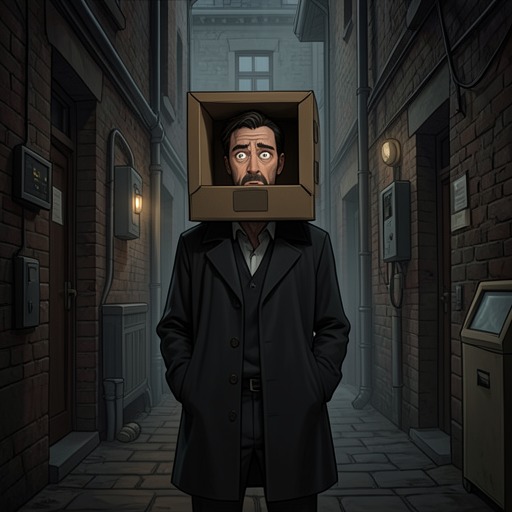
The Box ManAnonymous City is an imagined refuge for nameless inhabitants, where strangers can live without defensiveness and move between solitary freedom and the crowd. Its promise is sharply double-edged: urban anonymity can shelter a person from scrutiny, but it can also make that person’s presence—and even death—easy for everyone to overlook.
The Imagined City
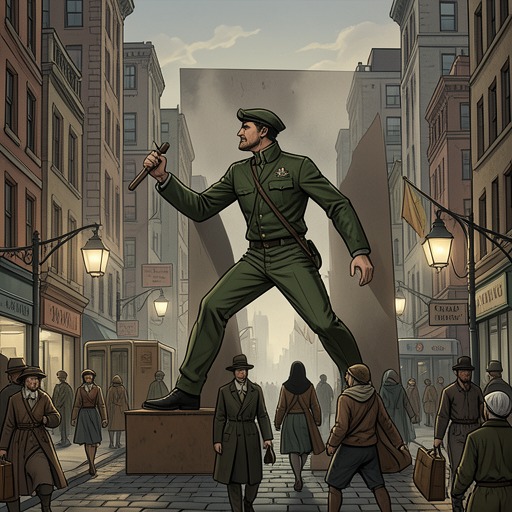
The city appears as a place its inhabitants have dreamed of or described in thought, rather than as a mapped destination. Its doors open to anyone; among strangers, no one needs to remain on guard. A person may walk on their head, sleep beside the road without blame, or sing openly if proud of their ability, and afterward mix again with the nameless crowds. Freedom here means not permanent isolation but the ability to leave and return without having to account for oneself.
That imagined welcome contrasts with the silence surrounding Box men. The account suggests that many live concealed around the country, yet they are not discussed. A Box man may be physically present in public and still be treated as something people instinctively refuse to acknowledge. The imagined city promises a social world without that defensive refusal; the silence around its hidden inhabitants shows how far ordinary urban life falls short of the ideal.
Invisibility in Public Space
The city’s anonymity has a harsher counterpart in the report of a forty-year-old vagrant found dead in the underground passage at the West Exit of Shinjuku Station in Tokyo. The passage served hundreds of thousands of passengers a day. The man had sat by a pillar since noon, near public telephones and less than ten yards from a police box, yet no one noticed him or reported him during the six or seven hours before police found him. Even the officer on duty said the pillar had hidden him from view.
The episode makes anonymity more than a condition of freedom: it can become social nonrecognition. The man’s few possessions—125 yen in change and several sheets of newspaper—did not establish his identity, address, or name. In a crowded passage, the absence of a recognized identity and the accident of a pillar combined to leave him unseen. The city can therefore conceal a person without offering the imagined protections of acceptance or freedom from blame.
Making a Life in the City
For the Box Man Narrator, the city is also a place navigated through practical routines. Under a bridge crossed by Prefectural Highway Three, he writes notes while rain falls over canal-side fishery warehouses and lumber sheds; there are no homes nearby, no passersby, and truck headlights do not reach his shelter. This marginal setting is not the welcoming city of the imagined ideal. It is a temporary refuge whose drawbacks—including windblown drizzle and poor light—must be managed.
The equipment of box life turns ordinary objects into means of occupying that urban environment. A radio, mug, thermos, flashlight, towel, and small bag are among the limited effects to be hung inside the box; intact rubber boots and canvas wrapped around the waist help make it possible to move and manage bodily needs. A milky-white plastic board, sixteen by eighteen inches, serves as a writing pad, table, chopping board, rain shutter, seat, fan, and work surface for preparing discarded cigarette butts. These adaptations do not transform the city into a secure home. They let a person make use of its overlooked edges with what can be carried.
Food-seeking likewise draws the Box Man into busier districts. Once the food on hand is gone, he must go out; foraging among leftovers offers a way to obtain food without paying or causing trouble, though mixed odors and tastes remain difficult to accept. The account adds that food can also be obtained from store counters, while foraging helps him become accustomed to town. Anonymous life is thus not simply withdrawal from society: it depends on learning its routes, resources, and rhythms while remaining at its margins.
Crowds and Urban Time
As the Box Man becomes accustomed to town, the city’s passing movement acquires a distinctive rhythm. Time describes concentric circles around him: the background moves swiftly, the foreground slowly, and the center remains still. The crowd is at once the setting through which he travels and a moving backdrop against which his own position seems fixed. The city’s density does not guarantee contact; instead, it allows a person to pass through other lives without being recognized, while giving the hidden observer room to watch and persist.
Anonymous City therefore holds together two possibilities that the narrative does not resolve into one. Anonymity can make room for unguarded action and a return to the crowd on one’s own terms. In actual public space, the same anonymity can enable neglect, leaving a living Box man or a dead vagrant outside the attention of passersby. The concept gives that contradiction a form: the city is both a hoped-for refuge for nameless people and the setting in which namelessness can become abandonment.