Box Dweller's Notes
The Box ManBox Dweller's Notes is the record the box man writes from inside and around his cardboard shelter, but it is more than a private chronicle: the notebook becomes evidence, a possible object of exchange, and a text whose authorship and chronology are repeatedly unsettled. Its concrete notes about weather, materials, and planned actions sit beside competing documents and a later account that appears to copy its opening, making the act of recording part of the story’s central uncertainty.
Form and Opening
The record identifies itself as the chronicle of a box man and begins with its writer under a cardboard box that reaches to his hips. The narration’s first-person form makes the writing seem immediate: the person recording events presents himself as the subject of the record. At the same time, the repeated formulation that the box man is the writer himself ties identity to the act of writing, rather than establishing a stable identity outside the notebook.
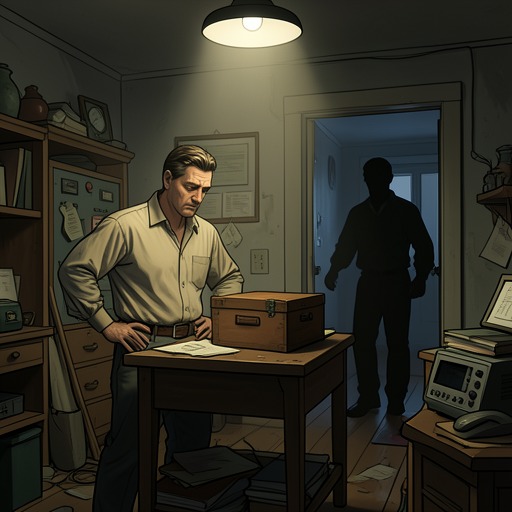
The notes are composed in a specific, precarious setting. The writer takes shelter from rain beneath a bridge where Prefectural Highway Three crosses a canal. He describes fishery warehouses and lumber sheds, the absence of nearby homes and passersby, and a flashlight suspended above the page. His watch is not very accurate, and the writing has already occupied him for more than two hours. These details make the account feel anchored to a present moment while also emphasizing how little ordinary infrastructure or certainty surrounds the writer.
A Record Made for Survival
The notebook is itself an improvised piece of equipment. The box man reflects that using an electric flashlight merely to write is an extravagance for someone living on the road, who normally depends on things recovered from the streets. In another note, he anticipates needing fresh ballpoint pens and identifies a school service entrance as a likely place to find some with ink remaining. Practical concerns—light, writing materials, shelter—recur alongside the larger problem of how to preserve the account.
That problem becomes urgent because the box has a prospective buyer. The writer says it has been sold for fifty thousand yen and that he is waiting beneath the bridge to complete the transaction, even as he admits that the proposed sale seems difficult to believe. The notebook is therefore written during an interval of waiting: the box that shelters its writer is also the object about to change hands, and the writing documents a moment when neither the exchange nor its implications have been settled.
The notes also record a contingency for protecting themselves. If the approaching figure is not the expected buyer, the writer plans to seal the papers in a vinyl bag, attach a fist-sized stone, and throw the package into the canal. He estimates that the preparation would take about thirty seconds and reasons that the person coming down the stone steps would need several minutes to reach him. The plan depends on the current, whirlpools, and the expectation that the package will ultimately drift out to sea. Recording this calculation turns the notebook into something the writer is prepared to abandon in order to keep it from a suspected pursuer.
Evidence and Documentary Neighbors
The writer presents the notes as evidence of an attempted killing. He says that a black-and-white negative is taped inside the cover and identifies the pictured figure as a middle-aged man hurrying away with an air rifle concealed under his arm. The description attends to clothing, hands, and shoes, and the writer argues that enlargement might make the man’s features easier to distinguish. The claim is forceful, but it remains a claim made by the notebook’s own narrator; the asserted photograph is offered as corroboration rather than independently verified within the account.
A supplemental note acknowledges that the timing of the photograph is uncertain: it was taken one evening about a week or ten days earlier, an imprecision attributed to the box man’s impaired sense of time. The location is specified as the mountainside end of the long black wall of a soy sauce factory. The combination of an exact landmark and an uncertain date illustrates the notebook’s mixed evidentiary character: it can be precise about visible circumstances while conceding that its chronology is unreliable.
The book places this record among other documentary forms. A newspaper item titled Ueno Homeless Sweep reports that 180 people were arrested in and around Ueno during a predawn operation, photographed and fingerprinted, and then mostly released; almost all were reportedly back at their former haunts an hour later. Elsewhere, marginal addenda are described as nearly indistinguishable from the main text in handwriting and ink. An affidavit concerning a corpse at T Seaside Park is also presented as a formal deposition. These different forms—news report, notebook, photograph, marginal note, and affidavit—supply different kinds of apparent proof without making their authorship or reliability interchangeable.
Repetition and Unsettled Authorship
The record’s identity becomes especially unstable when a later passage stages a question about who is writing and where. One voice asks whether the notes were written in a box beside a bare bulb in a dressing room by the sea; the reply avoids a definite answer, suggesting that explanation might reveal the characters as products of imagination. The passage makes the notebook’s location and writer matters of dispute within the narrative, not merely background facts.
A further turn presents someone preparing to write in a box shortly before midnight on the last Saturday in September. This figure opens a notebook whose first lines closely reproduce the original record’s declaration and description of the box, then begins taking notes with a flashlight and a plastic board used as a table. The new notes announce an account of events said to occur on the following Monday, before those events have taken place in the surrounding narration. The sequence reverses the expected relation between record and event: the account appears to anticipate the action it claims to summarize, while its writer seems to know more about the outcome than the reader does.
Exchange and Afterlife
The expected payment eventually appears in a letter dropped from the top of the bridge, with fifty thousand yen covering the cost of the box. The letter says that no receipt is required and leaves disposal of the box to the writer, directing that it be torn up and thrown into the sea before the tide goes out. The box man reads the letter repeatedly and tries to interpret it, but the wording does not resolve his uncertainty. Its faint disinfectant smell gives him a material detail to examine, not an explanation of the buyer’s intent.
The notebook thus remains suspended between practical record and uncertain testimony. It preserves the box man’s calculations, the evidence he says he has attached, and the changing circumstances of the box’s sale; yet the repeated opening, disputed writing situation, and future-dated account make the record’s authority difficult to fix. Its defining tension is that writing promises to preserve what happened, even as the text repeatedly unsettles who wrote it, when its events occur, and what the record can finally prove.