C
The Box ManC is an army-trained medical orderly who became a practicing doctor without a medical license, using the identity of the Army Medical Captain he had served during the war. In his affidavit, he describes his practice as the product of care and acquired skill, but also acknowledges that he knowingly deceived the public and violated the law. His account is consequential not only as a confession: he identifies the corpse under discussion as the captain’s, connecting C’s professional impersonation to the captain’s illness, dependence on drugs, and death.
Identity and Public Standing
C gives his birth date as 7 March 1927 and his profession as a doctor’s assistant, or orderly. He says that C is his real name, while the full name under which he practices and is registered with the Bureau of Public Health belongs to the Army Medical Captain who was his superior during the war. The captain permitted him to use it. Thus C’s professional identity rests on a borrowed name that began with the consent of the man whose authority it represented, but that permission does not make C a licensed doctor.
C presents himself as someone without a prior criminal record: he says he has never been sentenced to penal servitude or questioned as a suspect by police or a prosecutor. He also says that he has never been a public servant and has received no decoration, relief funds, or pension. These details distinguish his claimed social and legal standing from the authority implied by his medical registration. In the same account, he emphasizes that patients trusted him and that he had not sought instruction or assistance from a regularly licensed physician. His narrative therefore places practical competence and public confidence alongside the credential and legal authorization he lacked.
From Wartime Orderly to Practitioner
In the year before the war ended, C was assigned to a field hospital as an orderly to the Army Medical Captain. The captain was absorbed in research into producing sugar from wood, and C says he consequently took over about half the examinations and treatment of patients. Under the captain’s guidance, C learned to perform complicated operations. He recalls the wartime scarcity of sugar as the impetus for the research: the captain reasoned from goats eating paper, made from wood, and worked to isolate an intestinal agent that might break down cellulose. The account makes C’s later confidence in his surgical ability part of a specific apprenticeship, rather than presenting it as formal medical education.
The captain then developed an illness that C could not explain. He describes three days of high fever followed by recurring three-day cycles of muscular cramps, spasms, and nervous disorders. Neither the captain nor his colleagues could diagnose it. C says that, unable to bear the captain’s suffering and responding to his persistent pleas, he began giving him drugs daily. By the end of the war, the captain showed signs of addiction. C remained with him through demobilization, and the pair later opened a clinic together.
The Clinic, the Borrowed Identity, and Nana
After the war, C worked with the captain in managing and practicing at the clinic. The captain’s illness did not improve; he became personally unable to examine or treat patients and instead instructed C through medical charts. C describes his continued practice as having several causes. He supplied drugs because he regarded the captain’s dependence as exceptionally difficult to treat and felt unable to abandon him, while acknowledging that administering drugs amounted to euthanasia over time. He also recognizes that working under the captain’s qualifications secured his livelihood, even as he denies exploiting the captain’s drug habit for that purpose.
Nana, who had originally been the Army Medical Captain’s legal wife, handled the clinic’s accounts and helped C as a nurse. C says he and Nana became intimate only later, and that he lived with her as her common-law husband while remaining unmarried. He describes their arrangement as having the captain’s understanding and approval. After C hired Toyama Yoko as a nurse apprentice, however, Nana was unhappy and proposed that she and C live apart. He agreed; they had been living separately by the time of his account. The shift in their household followed the arrival of a new apprentice, while Nana’s earlier involvement had joined domestic life to the clinic’s daily work and finances.
Practice, Concealment, and Growing Confidence
C says that his willingness to continue practicing also came from the reputation he developed among patients and his growing interest in medicine. He describes diligent study of medical books and specialist reviews, and claims that twelve years of experience had given him confidence in his abilities beyond the question of whether he possessed a license. He says that his particular strength lay in surgery, including appendectomies, and that patients referred from other hospitals sometimes had been given diagnoses he considered irresponsible or mistaken. He qualifies these judgments, conceding that there is no objective measure by which a physician’s technique can be precisely assessed and that perceived shortcomings among licensed doctors do not excuse his own offense.
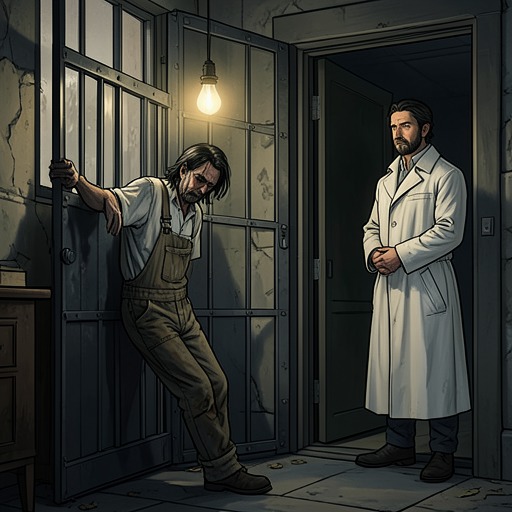
A decisive change came in the clinic’s eighth year. C had previously left outside contacts, such as attending medical meetings, to the captain. As the captain’s speech and conduct became increasingly abnormal, people began to abuse and defame him and to suggest that he was mad. The clinic was also under investigation because of its excessive drug use, and C says he felt exposed to danger. After discussing the situation with the captain, they closed the clinic and moved to another city. The captain’s mental state then worsened, and his inclination to suicide became more pronounced. At Nana’s suggestion, C stopped allowing him to appear publicly and registered himself under the captain’s identity. C says the captain agreed to this arrangement and that patients in the new city trusted him as they had before.
Admission and Responsibility
C’s affidavit identifies the corpse he has been asked about as the Army Medical Captain. He explains that he habitually called him the doctor captain, a title that had stuck after years of half-joking use. C expresses regret that he failed to prevent the captain’s suicide, while also setting out the history of illness and drug dependence that, in his account, preceded it. The identification changes the weight of C’s story: the man whose name made C’s medical career possible is no longer merely an incapacitated partner in the clinic but the dead person at the center of the inquiry.
By the time of the affidavit, C says the captain had long ceased to need him, so C no longer had an obligation to continue what he calls deceiving the world through illegal practice. He rejects the captain’s view that there was no crime if no claimant came forward. In C’s view, pretending to be a doctor was itself criminal, whether or not patients knew they had been harmed or sought compensation. He says he is willing to reconsider using another person’s name, make amends, and give up medical work. This ending does not erase the care, competence, or patient trust he has described; instead, it places those claims beside his admission that skill and good intentions cannot confer a license or settle the legal and ethical consequences of impersonation.