C's Testimony, Written in Advance, About the Boxed Seaside Corpse
The Box ManC's Testimony, Written in Advance, About the Boxed Seaside Corpse is a legal deposition drafted before the death it purports to explain. Its forecast of a Box man’s body washing ashore at T Seaside Park first creates suspense about a future event; a later continuation names the dead man as the Army Medical Captain whose identity C had borrowed to practice medicine. The testimony therefore does more than report a corpse: it exposes how a formal account can arrange events in advance while leaving the writer’s responsibility unsettled.
The affidavit in the dark room
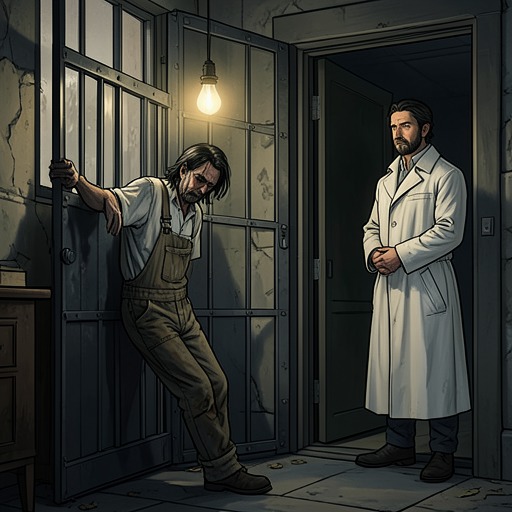
The document is introduced through a nighttime writing scene. In a dark room, with perhaps only the worktable lamp on, C raises his head from the affidavit and listens. A narrow line of corridor light lies beneath the door; he waits several seconds for a passerby’s shadow, but none appears. His attention shifts to the window and a movable cardboard house modeled on the box worn by the Box man on the nearby bed. Footsteps prompt speculation about whether the real Box man has arrived, before C decides they may belong to a thin, sickly hen that wanders in search of food. The scene places the act of testimony amid uncertainty and watchfulness: even the sounds outside the room resist a settled explanation.
C identifies himself by name in the deposition and presents it as a voluntary, truthful account that conceals nothing. Yet the narrative makes the act of writing less secure than that formal claim suggests. C turns through more than ten pages, opens a clean one, and prepares to record what has not yet happened. The frame narration observes him writing a chronology in the past tense about events scheduled for the following Monday, while it is still the last Saturday in September. The gap is small but decisive: the testimony treats the future as an already completed sequence.
A death entered into the record ahead of time
C’s proposed account places an unidentified body at the edge of a little-frequented seaside park. The corpse wears a packing-cardboard box secured around the waist with a cord, and the statement identifies him as a Box man who supposedly fell into a canal and was carried by the tide to the beach. Apart from the box, he has no possessions. An autopsy is said to place the time of death about thirty hours earlier. These particulars give the imagined report the compact authority of a police or medical finding, even as its early composition makes the certainty troubling.
The estimate of thirty hours also brings the predicted death close to the moment of writing. If the autopsy occurs early on Monday, the time calculated backward falls around the present Saturday night. The frame narrator reads C’s haste as evidence that C has already formed a plan to face death, and interprets the chronology as having a purpose beyond mere record keeping. When C abruptly shuts the notes, slips from the bed, and clutches the box after its contents make a noise, the scene registers fear without resolving what he intends to do. His forecast can thus be read both as an attempt to establish a future account and as a sign that the writer may be drawing himself toward the fate he describes.
The seaside deposition also sits beside a separate report of an anonymous death at Shinjuku Station. That newspaper-style account describes a forty-year-old vagrant found dead beside a pillar in the West Exit underground passage, where hundreds of thousands of passengers pass daily. He had 125 yen, several sheets of newspaper, and no means of establishing his name or address; witnesses said he had sat there unnoticed for hours, less than ten yards from a police box. This is not the corpse C’s affidavit describes, but the juxtaposition makes public reporting’s limits part of the context: one dead man disappears into an official description of anonymity, while C’s document claims to identify another.
The identity disclosed in the continuation
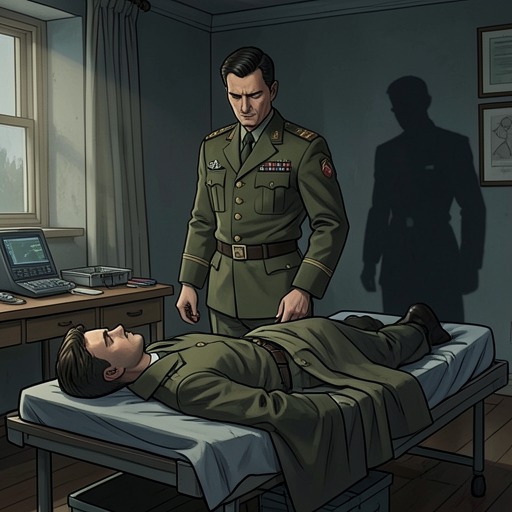
The later section, marked as a continuation of the affidavit, changes the meaning of the predicted corpse. C states that the body washed up at T Seaside Park is the Army Medical Captain, and explains that he uses that title because he had borrowed the man’s name to practice medicine for so many years that the name became habitual. C also says that the Army Medical Captain had been at risk of suicide for some time and expresses regret that he failed to prevent what happened. The deposition supplies an identity and a history, but it presents C’s responsibility through the language of remorse and omission rather than offering a clear account of the death itself.
C traces their association to the year before the end of the war, when he was assigned as an orderly to the Army Medical Captain at a field hospital. The Captain was absorbed in research into producing sugar from wood, and C says he took over about half of the examinations and treatment of patients. Under the Captain’s guidance, C also performed complicated operations, aided by a good memory and a notably dexterous hand. This history makes C’s later medical practice intelligible: his competence grew out of wartime work performed alongside the man whose name he subsequently used. It also makes the identification more than a professional disclosure; the corpse belongs to the figure who helped shape C’s medical knowledge and public identity.
Legal language and unresolved responsibility
The testimony’s documentary form is followed by a wider argument about law. C invokes the Nagoya High Court Euthanasia Precedent of February 1955, then argues that ordinary legal standards fail to account for people who live outside the law. In his formulation, the survival of a Box man is not recognized legally from the outset, so killing such a person cannot be treated in the same way as a crime against someone whose existence the law protects. The claim extends the affidavit’s concern beyond the identity of one corpse, turning the Box man’s social and legal exclusion into a contested principle.
That argument does not settle what happened to the Army Medical Captain or establish that the precedent applies to his death. Instead, it heightens the distance between C’s formal statement of regret and the frame narrator’s suspicion that the notes are directed toward bringing about death. The affidavit promises a complete account, yet its future-tense origin, retrospective certainty, and carefully stated remorse leave crucial questions open. Its force lies in that contradiction: C writes as a witness to a death before it occurs, then names the dead man as the person whose name enabled C to live and work as a doctor.