Camera
The Box ManThe Camera links the Box Man Narrator’s former profession to his life under a box: it lets him observe from concealment, preserve images, and claim that private sight can become public proof. He keeps a small amount of photographic equipment after becoming a box man, and later uses the camera both to document a suspected attacker and to consider how photography might alter his relationship with the people he watches. Its authority is real but bounded. The images can support an account of what appeared before the lens; they cannot, by themselves, settle every claim the narrator builds around them.
Identity and Background
Before becoming a box man, the Box Man Narrator had recently established himself as an independent photographer. Although that career was interrupted, he continued to carry a minimum of photographic equipment. The camera is therefore not simply a tool acquired for one episode: it preserves a connection to an earlier working identity even as the narrator adopts a way of life organized around concealment and observation.
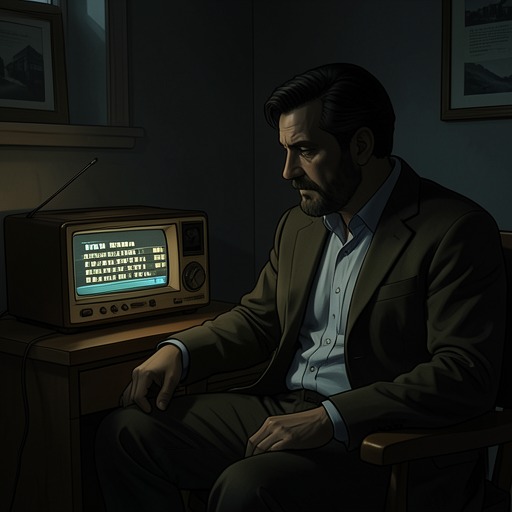
In the narrator’s account, photography depends on looking through an apparatus and fixing an image. The camera makes that practice portable. From within the box, he can turn his position and take pictures without first becoming an ordinary, openly visible observer. The arrangement gives him a measure of distance from the scene, but it does not make him neutral: what he chooses to photograph, and the meanings he assigns to the resulting image, remain his own.
The Attack Photograph and Its Claim to Proof
The camera’s most concrete evidentiary role begins at the end of the long black wall of a soy-sauce factory, near a slope and a change from pavement to gravel. The Box Man Narrator reports hearing a sharp noise and feeling pain in his left shoulder while standing there. He looks through a small opening in the box, sees a man beginning to rise near an old mulberry tree, and notices that the man has a long object resembling an air rifle. Without rearranging himself, he sets up the camera, turns the box toward the scene, and takes three photographs in succession as the man crosses the road and disappears from view.
The narrator gives the exposure as f/11 at one two-hundred-and-fiftieth of a second, adding that the picture was more or less in focus despite his not having time to adjust the distance. Those details make the account sound like a working photographer’s record, attentive to equipment and conditions rather than only to the dramatic event. The camera does not provide a view from nowhere, however: the pictures are made through the narrator’s restricted position, at a moment when he is startled and acting quickly.
The distinction between the photographs and the narrator’s later testimony is explicit. He says that film analysis can establish almost everything up to the point when the pictures were taken, but that what follows has no objective evidence behind it. The camera thus supplies a material basis for part of his story without certifying the full account. The image can show a figure and an object as they appeared in the frame; it cannot automatically verify every subsequent interpretation or conclusion.
Identification and the Camera’s Return
Later, the narrator invokes the developed photograph while confronting the Doctor and the false box man. He describes it as a rear view of a person moving up the slope with a rifle concealed along his body, and draws attention to details he takes to be identifying clues: the person’s haircut, a made-to-order suit, its conspicuous trouser creases, and distinctive low shoes. From those features and the setting beside the soy-sauce factory, he argues that the armed person was a doctor making house calls. The camera has changed the scene from an encounter remembered by one witness into an image that can be inspected and used in an accusation; the identification, however, is still an inference made by the narrator from what the image shows.
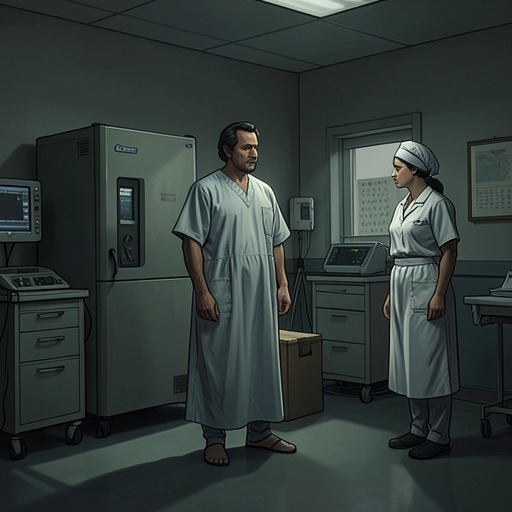
The camera also reappears in a different, more personal context. When a hospital girl permits him to take pictures, he reaches toward the camera in his tote bag but decides not to use it. He understands that setting it up would imply a shared life with the box man, an intimacy he compares in his thoughts to giving someone access to his private room. The choice shows that the camera is not merely an instrument he is eager to use: taking a picture can itself establish a relationship, and he hesitates when the act seems to make that relationship consequential.
Photography, Concealment, and Uncertainty
Marginal additions propose a further, less secure account of the link between the camera and the box. In this story, a photographer accidentally takes a picture of a box man, becomes absorbed in trying to find him, and turns instead to photographing parts of the town that resist being seen. He then puts on a box to take street photographs without attracting notice. The account says that he became a false box man, gained some standing among fellow photographers, and eventually vanished from his apartment; rumor has it that he became a real box man. Because this appears as an embedded explanation rather than a straightforwardly verified history, it enlarges the camera’s thematic role without resolving the identity behind it.
Elsewhere, the narrator describes the work of photography through the darkroom process: a developed image gradually emerges, with one outline appearing over another. That gradual appearance offers a useful counterpoint to the camera’s claim to immediacy. A shutter can record a brief instant, but the meaning of the image takes shape through development, selection, and interpretation. Across the narrator’s own photographs and the marginal story of the photographer, the camera serves both concealment and disclosure: it enables a hidden observer to make images, yet those images never remove the observer’s responsibility for what is seen, what is omitted, and what is claimed as proof.