Fake box-man status
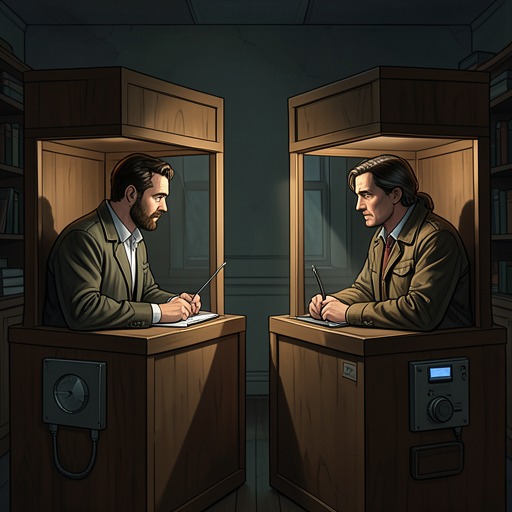
The Box ManFake box-man status is not settled by appearance or self-declaration: the novel tests it against experience, bodily change, and the unstable authority of testimony. The narrator’s claim to be the genuine article is eventually set beside his confession that he was a fake, making authenticity less a secure identity than a question the narrative repeatedly reopens.
Identity and the Test of Experience
The narrator proposes an unusual way to distinguish a real Box man from a fake: rather than trying to identify the genuine one directly, it may be easier to ask who is not genuine. The distinction, he argues, rests on experience. A Box man has experiences and adventures that only a Box man can describe; a fake cannot tell those particular stories. Authenticity is thus presented not as a costume, a label, or a claim alone, but as knowledge acquired by living in the condition.
That test is difficult to apply from outside. The narrator’s argument gives the genuine Box man a privileged kind of testimony, but it does not supply an independent authority capable of verifying each claim. The reader is asked to consider the experiences while also encountering them through a narrator whose own identity will become doubtful. The proposed distinction therefore establishes a standard and exposes its vulnerability at the same time: experience may separate the real from the fake, yet the account of experience remains subject to questions of trust.
The Body as Evidence
The narrator gives the distinction physical weight by describing the first summer days after becoming a Box man. Heat brings a feeling of suffocation, while sweat accumulates with dirt against the skin. The resulting irritation is described as more difficult to endure than visceral pain. An ordinary refuge—the outflow of air conditioning at the entrance to a building facing an underground passage—can ease the heat, but not the discomfort of the body’s changing surface.
After four or five days, the narrator says, the discomfort almost disappears. He considers two explanations: the skin may have grown used to the dirt, or the body may have adapted its breathing and oxygen consumption. He then makes sweating a criterion of identity: as long as a person sweats, that person is a fake Box man. The claim turns an involuntary bodily process into a test, but its force is unsettled by the narrator’s account of adaptation. The body that has learned to endure the box seems to provide evidence of a change in condition, while the rule about sweat makes authenticity depend on a physical sign that may itself change over time.
Boredom, the Town, and the Fake
The narrator also distinguishes genuine from false status through the experience of time. A Box man can obtain food from store counters, so foraging for leftovers is not a necessity. It can, however, help him become accustomed to the town, an adjustment the narrator connects with enjoying life among crowds. As the Box man grows familiar with the town, time begins to form concentric circles around him: the background moves quickly, the foreground slowly, and the center remains still.
In that arrangement, the Box man is not bored: the changing background and the unmoving center give time a distinctive shape. The narrator assigns boredom instead to the fake Box man in his box. This is a striking reversal because the box might seem, from outside, to make its occupant’s life monotonous. The narrator’s account makes the decisive difference less a visible setting than a way of inhabiting it. Yet the distinction also echoes the bodily test: both propose observable signs—sweating or boredom—while leaving open how reliably those signs can establish who is real.
The Hospital Encounter and Confession
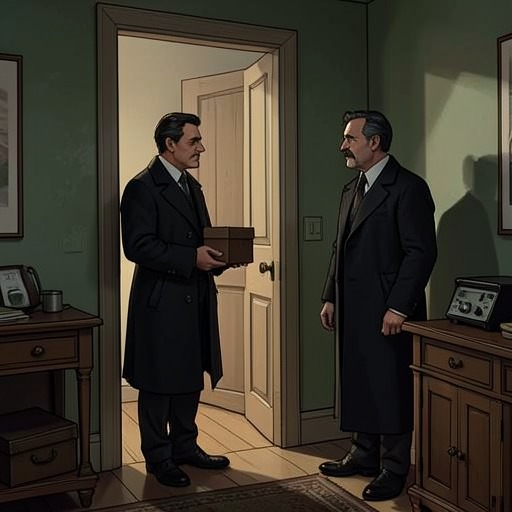
The distinction becomes personal when the narrator reaches the Hospital. Its door is locked, a notice says there will be no examinations that day, and the girl opens the door after he rings and presses the bell. She appears to mistake him for the fake Box man, or the fake doctor. He tries to correct her and identifies himself as “the real thing … the genuine article,” adding that he is the former photographer who had been waiting under the bridge the previous night. Her surprise does not settle the matter; she scrutinizes him, then says he has not kept his promise and tells him to take off his box.
Later, the speaker confesses, “I confess … I was a fake.” That admission sharply revises the earlier insistence on being genuine. It does not, by itself, explain precisely when the status applied or whether the confession resolves every question about the narrator’s later identity. Instead, the reversal makes his earlier claim newly uncertain and shows how readily the labels can change within an encounter: the girl first misrecognizes him, he asserts authenticity, and the conversation later contains an admission of fakery.
Notes and Unsettled Authority
The narrator then insists that the notes in his possession are genuine, describing them as the will the real Box man gave him to keep. The claim separates the narrator’s compromised status from the authority he assigns to the document: even if he was a fake, the notes may carry the testimony of someone he calls the real Box man. But that distinction depends on the narrator’s account of where the notes came from and what they represent.
The narrative immediately cautions against treating that account as conclusive. Writings left by the dead, it observes, do not necessarily tell the truth about them. The dead may have jealousies and envies that survivors cannot understand, and some may answer the empty promises of truth with deliberate lies. The notes therefore cannot be accepted merely because they are presented as a dead person’s testimony. This warning circles back to the proposed test of authenticity: a Box man’s experience may be uniquely his, but when that experience reaches others through an admission, a claim, or a document, its authority remains unsettled.