Hospital Sealed After the Failed Courtship
The Box ManHospital Sealed After the Failed Courtship is the turn from a failing romance to the Box Man Narrator’s deliberate isolation of the Hospital. A separation that might ordinarily end with a departure instead becomes a locked building, a search through altered space, and a final uncertainty about whether the woman has escaped or cannot find her way to him.
Causes and Background
The event is framed as the ending of an affair that the narrator insists began with lost love. In the passage titled Five Minutes to Curtain Time, he describes a fierce, sensual wind that has already begun to carry the expectation of its own change: it may turn cool, leaving no lasting recollection of its heat. The image makes the romance feel intense but temporary even before its break becomes visible. He offers an explanation, then turns the matter into a performance, asking whether his listener wants him to continue and likening his account to a one-man show.
That theatrical address is more than an ornamental frame. The narrator tells the listener that the story is taking place as it is heard, and that listening makes the listener a cast member obliged to play an assigned role. He thus presents the courtship as both a private relationship and a staged encounter whose audience has been drawn into it. The emphasis shifts away from a conventional explanation or conclusion and toward the immediate force of feeling: the fiery wind, he argues, matters more than the denouement. In this way, the impending separation is announced as a change in lived sensation before it is set out as a sequence of practical events.
The couple’s secluded routine gives that change its specific stakes. For close to two months, the woman and the narrator had lived naked together inside the building, with their ordinary contact with the outside world reduced. They had removed the nameplate and sign from the door and extinguished the red lamp at the gate; callers stopped coming. Once each day, the narrator put on his box and went into town for daily necessities, mainly food. He believed that the two of them could continue their modest life indefinitely. Their private arrangement had come to seem less like an interlude than a complete world, making the woman’s return in clothing a sharp sign that its terms had changed.
The Separation
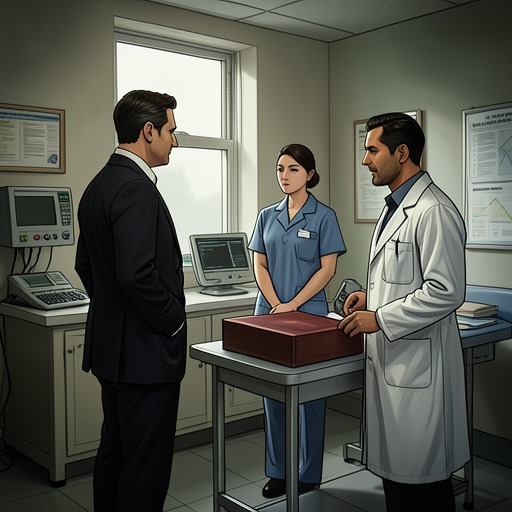
The decisive change arrives without a spoken confrontation. The narrator notices that the woman who comes toward him is dressed rather than appearing as she had during their shared routine. He feels disappointment and a renewed sense of distance, while recognizing his own nakedness as pitiable. She looks around, apparently trying to identify a bad smell, and returns to her room without acknowledging him. He withdraws to the former examination room and waits. His questions about whether they might begin again do not lead to a conversation; he hears no sign that she is moving, and cannot know whether she is waiting for him or has simply withdrawn.
The narrator later acknowledges that from his return from outside until her departure they exchanged no words. He regrets the silence, but doubts that speaking would have repaired anything: in his account, the useful stage for words had already passed, and their glances had conveyed an understanding that came with the disintegration of their love. The relationship’s ending is therefore represented not as a quarrel but as a failure of speech and renewed contact. The silence offers no clear agreement between them, yet he treats it as a form of complete communication.
When he hears a door close, he interprets the sound as her leaving and imagines it as hesitant rather than hostile. He says he is neither angry nor bitter, and attributes compassion to the sound. He waits ten minutes before nailing up the entrance, intending that she be far enough away not to hear the hammering. He grazes the base of his left thumbnail and sees a little blood, but the pain quickly passes. The small mishap accompanies a much larger decision: rather than accept the separation as final, he begins to close the building around it.
Sealing the Hospital
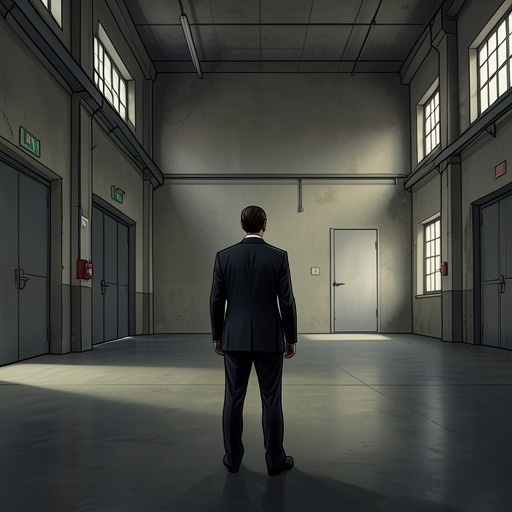
The narrator describes the Hospital as already cut off from the outside world. Windows and vents have been blocked with plywood or cardboard, leaving no daylight to enter; after securing the entrance, he says that only the lock on the second-floor emergency stairs remains. He presents his departure from the building as an escape possible only to a box man, while postponing an explanation of where he goes and how. The account makes the sealing both material and narrative: exits are being closed, but the means by which the narrator himself can leave are withheld for later notes.
The later confession complicates that sequence. The narrator says that the front door had been nailed up from the first and that the emergency stairs are locked, so the woman cannot leave that way. The relationship’s end has thus become a situation of confinement, not simply a departure followed by an empty building. He also states that he cannot bear to be seen by her in clothing and imagines that darkness would make her seem naked again. Rather than leave the box, he proposes enclosing the world within it. He has disposed of objects that could create light or shadows, including matches, candles, lighters, and his flashlight, then cuts the power. The stated purpose is to alter what can be seen; the consequence is that his attempt to regain the conditions of intimacy further narrows the woman’s freedom and makes the building’s darkness part of his plan.
The Search and Its Unresolved End
When the narrator looks into the woman’s room after cutting the power, he expects to see only faint signs of her. Instead, the space seems to have become a narrow alley behind shops, near a station. He describes a real-estate office combined with a privately run baggage room across the passage, which is cluttered with rubber hose, a metal-drum incinerator, cardboard boxes, drying bonsai, and old bicycles. At what appears to be the dead end, a small concrete stairway descends to an abandoned balcony. The night construction sounds in the distance and the roadbed far below make the search seem to have crossed from an ordinary room into an unfinished urban landscape.
The narrator goes down to the balcony but finds no route onward. He wonders where the woman has gone and looks into the darkness below, while recognizing that another step would not necessarily bring him closer to her. The scene does not confirm that she has escaped, nor does it establish that the changed passage is a literal location. It makes the distinction between the Hospital and the world outside unstable: even the apparent alley remains, by his own account, part of the same building.
He concludes that the woman is somewhere within the labyrinth of the box, though he allows that she may not be running away and may simply be unable to find him. The box, which looks like a plain rectangular object from outside, becomes from within a maze of interlocking rings whose routes grow more complex as one struggles. His confidence that clues will lead to truth sits beside his inability to locate her. The sequence ends not with reconciliation or a confirmed escape but with that unresolved search, accompanied by the sound of an approaching ambulance. The failed courtship has sealed the setting without settling what has happened to either person.