Impersonating a Doctor and Practicing Medicine Illegally
The Box ManC’s impersonation of the Army Medical Captain began as an improvised continuation of their wartime medical work and grew into years of independent, illegal practice. C describes real surgical experience and patients’ trust, but also a clinic sustained under another man’s credentials, a doctor’s drug dependence, and a mounting conflict between personal responsibility and legal accountability. His eventual confession does not erase that contradiction: it makes the act of explaining the deception part of the story of how it was maintained and finally brought to an end.
Origins and Wartime Training
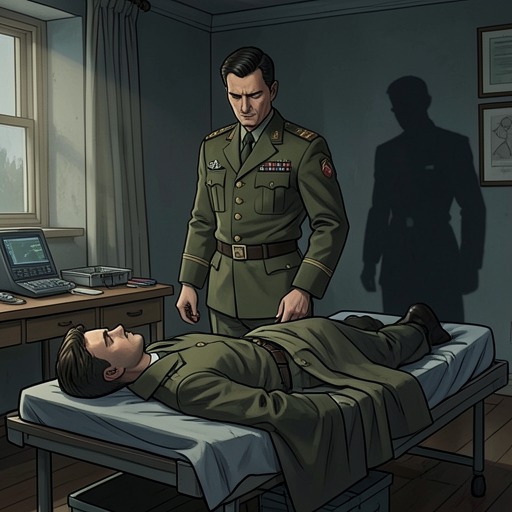
The arrangement grew out of C’s service as a medical corpsman. In the final year of the war, he was assigned as an orderly to the Army Medical Captain at a field hospital. The doctor’s attention was absorbed by research into producing sugar from wood, and C consequently took over a substantial share of patient examinations and treatment. Under the doctor’s guidance, C learned to perform complicated operations. His later practice, then, did not begin with formal medical qualification, but neither does his account present it as entirely without training.
C says that after demobilization he and the doctor opened a clinic together, with C assisting in both management and medical work. The doctor’s illness increasingly prevented him from examining or treating patients in person; he gave instructions through medical charts instead. C says he used his wartime experience to practice on his own, never seeking instruction or help from a regularly licensed doctor. He identifies surgery, including appendectomies, as his particular strength and says patients regarded him well. Those claims help explain how the clinic functioned, but they do not change the basic fact that C practiced without his own license.
A Practice Sustained by Care and Dependence
C presents the doctor’s drug dependence as one of the reasons he continued. During the war, after the doctor persistently pleaded for drugs, C began administering them daily; by the war’s end, the doctor showed signs of addiction. C remained with him through demobilization and later helped run the clinic. He says that replenishing the doctor’s drugs was an act of friendship rather than obedience, and accepts responsibility for it. At the same time, he acknowledges that continuing to supply drugs amounted to euthanasia over time, while insisting he lacked the courage to abandon the doctor.
The professional arrangement also supported C’s livelihood. He admits that the doctor’s qualifications provided cover for his work, although he denies exploiting the doctor’s vulnerability for that purpose. Nana, the doctor’s legal wife, handled the accounts. C says that he and Nana later became intimate, with the doctor’s knowledge and approval, and that the doctor himself feared C would leave. As C recounts it, the doctor applied pressure by warning that he might commit suicide if C gave up medicine. C’s account thus presents care, dependence, personal obligation, and practical advantage as entangled motives rather than cleanly separable explanations.
The Eighth Year and the False Identity
A decisive change came in what the narrative calls The eighth year of the doctor’s practice. The doctor had previously managed outside contacts, including attendance at medical meetings, but his speech and conduct became increasingly abnormal. Reports of abuse and accusations that he was mad reached the clinic. At the same time, the clinic faced investigation over its excessive drug use. After discussions between the two men, they closed the clinic and moved to another city.
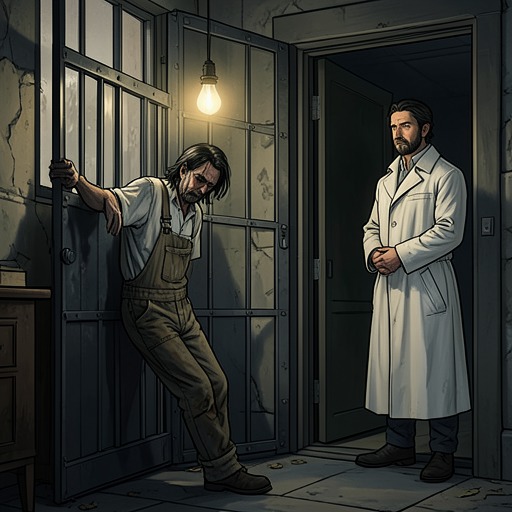
There, as the doctor’s mental state worsened and his inclination toward suicide became more apparent, Nana suggested that C register himself under the doctor’s identity. C says the doctor agreed. Although they made formal adjustments to their arrangement, C describes the actual medical work as continuing much as before, and says patients trusted him. He believed that this confidence meant there would be no lawsuits or prosecution if his guilt were discovered. Yet he also recognizes the weakness in treating an unaware patient as proof that no injury has occurred. He ultimately rejects that reasoning: public trust and his own lack of perceived harm, he concedes, did not give him the right to break the law.
The arrangement was also personal and domestic, not simply a matter of professional paperwork. C remained unmarried in law, but says he lived with Nana until the previous year, when he hired Toyama Yoko as an apprentice nurse. Nana objected to the new appointment and suggested that she and C live apart; he agreed. He says he continued to report revenues and expenditures to Nana and recognize her as a co-manager after they separated. He also reports that Nana had recently opened a piano school. These details place the clinic’s false identity within a wider relationship that continued to shape its finances and administration.
Exposure, the Doctor’s Death, and Confession
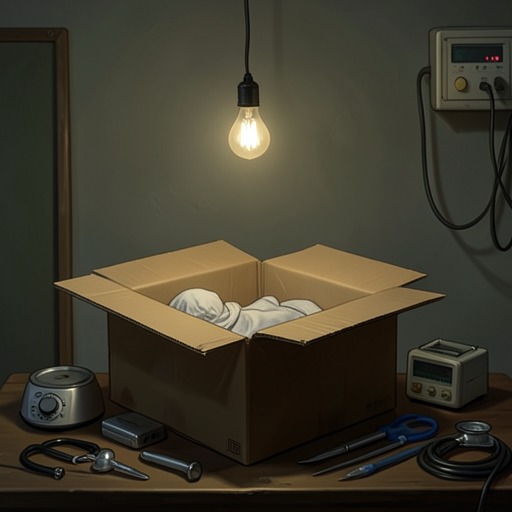
The doctor’s disappearance brought the arrangement under renewed scrutiny. C identifies the body at issue as that of the Army Medical Captain whose name and identity he had borrowed. He says the doctor had shown suicidal tendencies for some time and that he regretted failing to prevent his death. C offers uncertainty about how the doctor died: the doctor used the second floor and came and went at irregular hours, and C says he cannot account for all of his actions. He mentions a recent dispute over the doctor’s increased appetite for sweets, but does not believe it caused the death. Because the corpse wore a cardboard box over its head, C also considers that the doctor may not originally have intended to die. These possibilities remain part of C’s account, not a settled explanation of the death.
C says he had been summoned after witnesses reported seeing a box man enter and leave the hospital, and after the marks of repeated gunfire raised questions about the figure’s connection to the institution. He explains that he and the nurse had promised not to enter the doctor’s room unless called. They checked it only late on a Sunday night, after becoming suspicious; C says he was prepared to ask the police for help by dawn, even if that exposed his illegal practice. He also describes the doctor’s opposition to his giving up medicine, along with pressure and troubling demands involving Toyama Yoko. C says he felt concern, not bitterness, and argues that illness should be met with sympathy. His testimony therefore combines an account of the doctor’s dependence with an effort to explain why C remained involved.
By the time of his statement, C says the doctor no longer needed him and that he had no obligation to continue deceiving the public through illegal practice. He recognizes that such practice could harm patients both economically and physically, and rejects the doctor’s view that the absence of a claimant meant there was no crime. C says he regarded being a fake doctor as an offense and wanted to disclose what had happened and put down the responsibility he had carried. The confession is both an admission and a carefully reasoned defense of the motives that prolonged the deception; its own distinctions between friendship, skill, benefit, and legality keep the moral question open even as C declares the facts true.
Legal and Social Significance
The episode places C’s professional deception beside a broader world in which the law sorts and records people through names, credentials, and official categories. A police sweep in Ueno arrests 180 people under the Law of Minor Offenses and Traffic Laws, photographs and fingerprints them, then releases most after they promise not to return to vagrancy; within an hour, almost all appear to have gone back to their former haunts. Elsewhere, a dead vagrant in a busy station passage remains unidentified despite the crowds passing him. These reports do not make C’s actions equivalent to the treatment of homeless people, but they sharpen the story’s interest in the gap between a person’s lived circumstances and the identities institutions can recognize.
That tension becomes explicit in the book’s discussion of box men, whose existence is described as legally unrecognized. C’s false medical identity depends on credentials the public accepts, while the doctor’s fate and the unknown dead man expose how easily a person’s identity can become uncertain or disappear from official view. Against that background, C’s final acknowledgment that trust and good intentions cannot authorize unlawful practice is consequential but limited: he accepts the law’s claim over his conduct while revealing how care, professional ambition, intimate ties, and dependence had helped the deception endure.