Morgue
The Box ManThe Morgue is a small, windowless room at the end of a hospital corridor, both a practical passage for the dead and a place the narrator deliberately chooses to occupy. Its plain position and door conceal its function from patients, while its proximity to the emergency exit makes it convenient for carrying out corpses. For the narrator, however, the room becomes a chosen refuge and the imagined setting for a silent confrontation over whether he will be killed.
Setting and Hospital Function
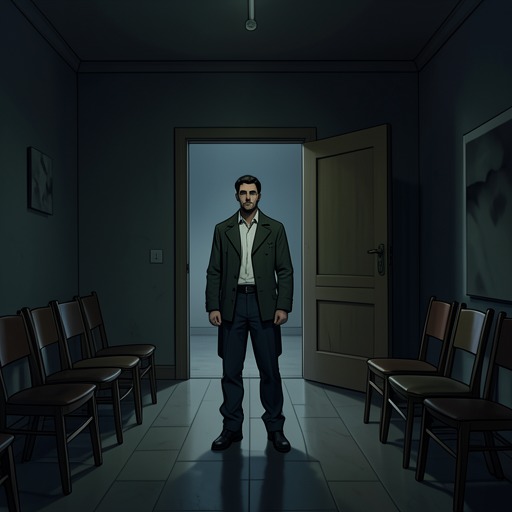
The room lies at the far end of the second-floor corridor, set back by the depth of the stairs. A varnished cryptomeria door stretches across the narrow passage and is almost indistinguishable from the walls. This unobtrusive design is considerate of patients who may be especially sensitive to death; the nearby emergency exit also provides a convenient route for removing bodies. The Morgue is therefore integrated into the hospital’s ordinary circulation even as its purpose is concealed.
That arrangement gives the room a double character. It is not marked out as a dramatic or separate space: patients need not be confronted with its function, and hospital staff can use it efficiently. Yet its closeness to an emergency exit and its coffin-like proportions make death present in the building’s practical layout. The room’s concealment does not remove it from the narrator’s awareness; instead, it becomes a boundary he must repeatedly acknowledge and then attempt to ignore.
A Room the Narrator Chooses
The narrator stresses that he is not a corpse and is not in the Morgue because the hospital has placed him there for ordinary treatment of the dead. He has requested the room and says that he likes it. Its lack of windows suits his current state: daylight irritates his eyes, while he describes having lost defensive feelings such as anger, discontent, and hatred. The room’s proportions also appeal to him, with its depth two and a half times its width. His account makes the Morgue a refuge selected for its physical conditions, not merely a place imposed on him by the hospital.
His presence there unsettles the distinction between patient and corpse without erasing it. He explicitly maintains that he is alive, yet identifies himself with a room arranged like a coffin and describes feeling at home in it. The building’s usual function remains intact, but his request turns that function into an environment for a living person. The contrast matters because he presents the choice as his own: he is not simply being stored or treated as dead; he has sought out a place whose enclosure matches his mood.
The Expected Visitor
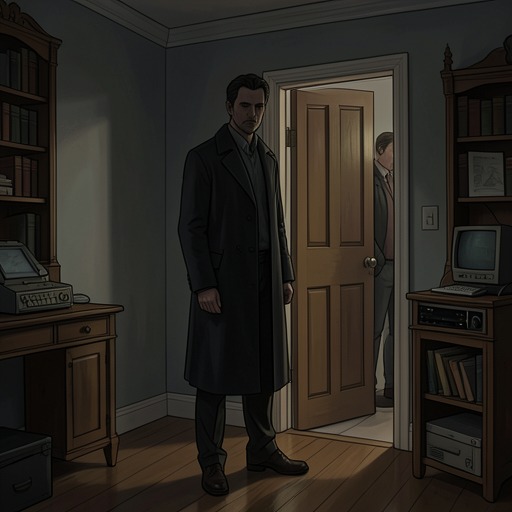
The narrator reconstructs someone’s approach to the room from sounds in the corridor. He follows the imagined route from the visitor’s room, along the tiled passage and up the stairs, counting the steps until the person reaches the landing and stops outside. Because the visitor’s head is covered by a box, the approach is understood through movement rather than a clearly seen face. The narration makes the threshold feel like a pause in which both people are looking for signs of the other.
He believes the visitor may have to act as an executioner, and imagines that killing someone who knows what is happening would make the task difficult. He considers whether talking about death could ease the encounter, but judges that a debate might be even more grotesque than silence. In his account, the door becomes the barrier between two people who are waiting for the other to move, and he anticipates that their nerves will eventually give way. This is an imagined confrontation, not a killing described as having occurred.
The narrator’s claim that he is awake complicates the scene further. A drug-addicted patient, he says, is rarely in a deep sleep, and he is sitting up writing while the visitor waits outside. He plans to pretend to be asleep if the person begins to move toward the door, believing that the appearance of sleep may make the visitor more comfortable. The room thus holds both an anticipated death and a small, deliberate performance intended to soften it. The visitor remains outside, and the account centers on the narrator’s expectation rather than a completed encounter.
The Morgue and Shared Domestic Life
Later, the Morgue is present in the narrator’s account of a secluded life with a companion inside the hospital. They close off the clinic: the nameplate and sign are removed, the red lamp at the gate is extinguished, and callers eventually stop arriving. The narrator goes out once a day in his box to gather necessities, chiefly food, and believes the two of them could continue living in this way for years. These arrangements make their life depend on withdrawing from public notice, while the hospital’s rooms and passages remain their immediate setting.
On his return by the back emergency stairs, the narrator removes his boots and box in the second-floor corridor, where his companion comes up to meet him. Their reunion is the high point of his day. They embrace and remain physically close as they turn toward the kitchen; even while she prepares food, he stays beside her. In his description, ordinary shared gestures take precedence over conversation, which he presents as limited and comically inadequate to their closeness.
The kitchen is almost unused, having been set up for hospital inpatients, and an empty room across the corridor serves as a place to collect kitchen waste. Mice scatter the stored scraps, and the couple largely disregard the conditions. The narrator suggests that their attention to one another helps them forget the Morgue nearby. He says they had decided to ignore it so completely that, for them, the room ceased to exist. That denial gives the location its strongest later significance: the Morgue has not moved, but intimacy and routine temporarily make it disappear from their shared world.