News Addiction
The Box ManNews Addiction is the Box Man Narrator’s former dependence on a continuous stream of current events, a habit he describes while speaking at the Hospital. Its sudden end comes not through a dramatic revelation but through an ordinary man’s death on a sidewalk. In that encounter, the narrator sees the difference between news as a reassuring account of change and an irreversible transformation that no headline can contain.
The Habit of Continuous Reporting
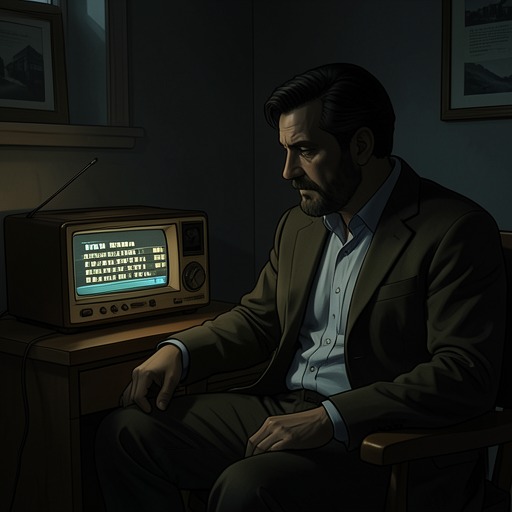
The Box Man Narrator recounts his addiction to the hospital girl while the Doctor remains in the room. He describes an appetite that had become difficult to resist: he needed fresh reports arriving one after another, and the possibility of a pause in the stream unsettled him. War developments changed by the minute; public figures married and divorced; rockets were launched; a fishing boat sent an emergency signal and went silent. Reports of crime, accidents, scientific projects, and international affairs arrived together, making the globe seem capable of changing shape whenever he looked away.
His monitoring was both systematic and excessive. He read seven newspapers, kept two television sets and three radios in his room, carried a portable radio whenever he went out, and left earphones connected while he slept. He listened to different stations simultaneously so that he would not miss a special broadcast. This equipment did not bring him closer to a secure understanding of events. Instead, the more channels he opened, the more urgent the possibility of missing something became.
The narrator compares the habit to the vigilance of timid animals that keep watch until their bodies seem altered by the effort. He recognizes that the comparison may sound ridiculous, but insists that the dependence is serious for the person caught in it. He spends much of the day reading or listening, resents his own inability to stop, and remains attached to the radio and television despite knowing that more reports will not necessarily bring him nearer to truth. What he needs, he concludes, is not truth or direct experience but the news form itself: events compressed into familiar summaries and phrases.
The Encounter That Ends the Addiction
The break arrives through what the narrator calls a trivial event. On a broad sidewalk between a subway station and a bank, he sees a middle-aged man walking normally before suddenly losing strength and falling motionless. A young passerby initially responds with amusement, then realizes the man is dead and goes to use a telephone. The narrator, who works occasionally as a commercial photographer, raises his camera and tries to focus from several angles.
He does not take the picture. His decision is not presented as an act of grief or as a deliberate tribute to the dead man. He refrains because he understands that the death will never become news. That judgment exposes the boundary his addiction had obscured: a camera can frame the event, and a report can classify it, but neither action makes an unreported death matter to the circulating news system. The narrator’s professional habit of looking through a lens gives the scene a sharp practical edge. He can attempt to convert the body into an image, yet stops when he recognizes that the image has no prospect of entering the public stream he once followed so obsessively.
The encounter also changes his sense of what counts as transformation. He considers the changes that follow death and the way a person’s appearance and clothes can seem altered by it. The dead man, however, has no stake in whether those changes attract coverage. Even the possibility that the death might resemble a larger public crime would not, in the narrator’s view, make the dead person’s way of dying fundamentally different. The change is complete for the man who has died, while no further report can reverse or equal it.
Reassurance, Catastrophe, and the End of the World
After this realization, the narrator revises his account of why people seek news. He had imagined that they listened in order to prepare for emergencies by learning what was changing. He now regards that explanation as false. In his view, listeners want reassurance: however catastrophic the reports, they remain alive while hearing them. News gives disasters a form that can be consumed without requiring the listener to leave the ordinary world behind.
The desire reaches its paradoxical limit in the imagined final broadcast announcing that the world has ended. Such news would end the isolation of having to face the catastrophe alone. The narrator suspects that his own addiction was sustained by eagerness not to miss that ultimate announcement. Yet the ordinary flow of news cannot deliver it. So long as reports continue to arrive, their very continuation indicates that the end has not occurred. The news comforts not by proving that events are safe, but by showing that the listener is still here to receive another report.
That reassurance depends on a gap between a life-changing event and its abbreviated public account. A bombing, a fire, or rising prices can be compressed into a familiar item; the person listening survives the report and moves on to the next. The narrator’s encounter with the dead man breaks this rhythm. Death is not merely another alarming update: it is a transformation that no accumulation of updates can match. The news form can summarize change, but its reassuring repetition also keeps the final, world-ending report perpetually just beyond reach.
News Reports and Unseen Lives
Other report-like passages in the text sharpen the distinction between public records and lived circumstances. An account of the Ueno police sweep gives an exact figure: 180 people were arrested in and around the station passages and Ueno Park. Most were released after promising not to return to vagrancy, yet an hour later almost all appeared to have returned to their former haunts. The official count records the operation with precision, while its immediate outcome suggests how little that count changes the conditions it describes.
A separate report concerns a forty-year-old vagrant found dead in the underground passage at Shinjuku Station’s West Exit. He had remained seated for hours amid the movement of commuters, but no one had reported him; he had no possessions establishing his name or address. The report can specify his age, clothing, money, and location, yet those details do not restore the identity he lacked in life or explain the experience of passing unseen. Read beside the narrator’s account, such documents expose both the reach and the limits of news: it can preserve numbers and circumstances, but a record is not the same thing as recognition or understanding.
The addiction’s sudden end therefore does not amount to a claim that events cease to matter once they are unreported. Rather, the narrator discovers how news had served as a defense against the finality of change. Its steady succession promised that the world remained available for another update. The sidewalk death interrupts that promise with something no broadcast can absorb: a transformation complete in itself, whether or not anyone notices.