Nurse's Letter
The Box ManThe Nurse's Letter is the message by which the nurse fulfills her promise to the box man, sending fifty thousand yen to cover the box and asking him to decide how it will be disposed of. Its importance lies not only in the sum or the instruction to destroy the box, but in the reversal it creates: the box man has prepared for the Doctor to come, yet the nurse arrives instead. Her action gives him the money and apparent authority over the box while leaving its motive open to interpretation.
Contents and Terms
The message states that the nurse trusts the box man and requires no receipt. She leaves the box’s disposal to him, with a specific request that he tear it up and throw it into the sea before the tide goes out. The accompanying fifty thousand yen is described as covering the cost of the box. The letter therefore combines payment with a transfer of practical responsibility: the box man is not merely handed money but asked to carry out a consequential act on the box itself.
That distinction becomes important to the recipient. He reasons that, because he has accepted the money, simply keeping or discarding the banknotes would not settle the matter; the request also concerns the box, whose ownership he believes has passed to the nurse. Yet the instructions do not compel him to act at once. He concludes that he can postpone disposal until he has checked her real motives, treating the letter’s trust as meaningful but not sufficient to remove his uncertainty.
Delivery at the Bridge
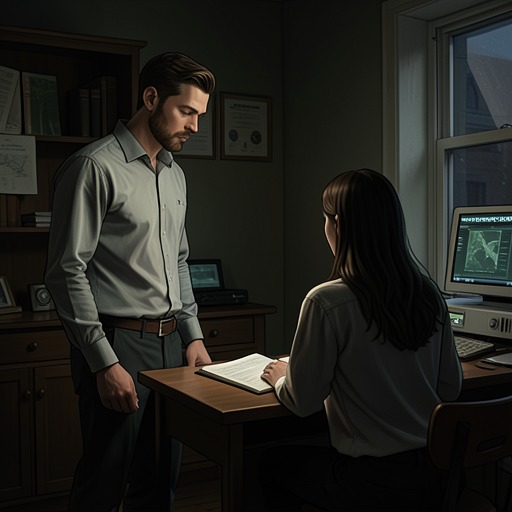
The box man expects the Doctor to appear. He has arranged his thinking and strategies around the possibility of an attack by him. Instead, the nurse comes in person, fulfilling the promise that the box man had expected might be broken. She does not approach him to speak. After passing a sign forbidding swimming, she rides along the provincial highway on a light-alloy bicycle with five gears, while the box man signals with his flashlight.
She later shines her own flashlight through the bridge balustrades. A vinyl bag weighted with a stone falls near the beam. Inside are the letter and five rolled ten-thousand-yen bills. Although she has come close to the box man, she leaves without saying anything; he cannot look up comfortably from inside the box. The exchange is thus direct in its practical result but not in conversation. He receives the promise in the form of a letter and money, rather than through an explanation from the person who made it.
The Recipient’s Competing Readings
The box man reads and rereads the letter, but finds no settled explanation for it. At first he treats the nurse’s arrival as an unsettling fulfillment: he had expected betrayal, and her keeping the promise leaves him at a loss. He then considers her position in the affair. One possibility he develops is that the nurse has acted to keep the Doctor from acquiring the box. He speculates that she may initially have gone along with the Doctor’s plan, or only pretended to, before becoming doubtful and opposing him as the time to carry it out approached.
In this account, the nurse’s confidence that the box man is attached to her could make his disappearance with the box a way to restrain the Doctor. The box man recognizes that he is conjecturing: the letter itself does not explain whether she is protecting the Doctor, acting from self-interest, or trying to prevent him from obtaining the box. He sees a conflict between them as plausible, but the precise cause and purpose of her intervention remain unresolved. His repeated reinterpretation makes the letter evidence of a divided situation without making it a transparent statement of motive.
Money, Ownership, and the Box
The sum sharpens rather than resolves the box man’s questions. He wonders why anyone would pay fifty thousand yen merely to have the box thrown into the sea, and whether the amount reflects some more practical reason connected to the Doctor’s desire to acquire it. He also considers returning the money, insisting to himself that he is capable of doing so. The payment consequently serves at once as compensation, a sign that the nurse has assumed ownership, and a clue whose significance he cannot determine.
His reluctance is not only suspicion of the nurse. He is dissatisfied with the impersonal quality of the encounter: she appeared, left the package, and departed without speaking. He had signaled to her, but she continued on her way. The box man had hoped for a private exchange, and the letter’s efficient delivery does not provide one. His hesitation over carrying out the request follows from both uncertainties: he does not yet trust her fully, and the money seems too small to represent what the box means to someone who has lived inside one for three years.
Narrative Role and Unresolved Request
The letter reaches the box man only moments before he writes about it. He calls the event barely five minutes old, then says there is nothing further to explain because neither killing nor being killed has occurred. That abrupt interruption frames the letter as an immediate record of a turn in the expected action, not a retrospective account with its consequences already known. The reader encounters the nurse’s decision through the recipient’s fresh, unsettled interpretation.
The box man’s response also limits what the letter can establish. It confirms that the nurse kept her promise, sent the money, and entrusted him with the box’s disposal. It does not confirm his theories about the Doctor or settle whether her intervention is protective or self-serving. Although the request specifies destruction before the tide goes out, the box man decides to delay until he can examine her motives. The letter thus transfers an obligation without securing its completion: the nurse has acted, but the box remains in the hands of a recipient who cannot yet decide what her act means.