Photograph of the Air-Rifle Attacker
The Box ManThe Photograph of the Air-Rifle Attacker is the Box Man’s claimed photographic record of the man who shot him, and the central piece of material evidence in his effort to identify the shooter as the Doctor. The image is described as a view from behind of a man carrying an air rifle as he leaves the scene. Its importance rests both on what it appears to show and on the gap between that visible record and the narrator’s interpretation of the person in it.
Image and Circumstances
The Box Man dates the shooting only approximately: it took place one evening about a week or ten days before he added his account, a qualification he attributes to the box man’s impaired sense of time. The location is more precisely described as the mountainside end of a long black wall belonging to a soy-sauce factory. The wall’s shadow cuts diagonally across the photograph’s foreground, offering a visual detail by which the stated setting can supposedly be checked.
At the moment of the shot, the Box Man was standing by the roadside inside his box. He first heard a sharp noise, which he initially associated with a small object striking the box, and then felt pain in his left shoulder. Looking through the box’s observation hole, he saw a man getting up near the bend where the factory wall ended and the pavement gave way to a gravel path. The man shifted a roughly three-foot stick from his shoulder and tucked it under his arm; the object caught the evening light and, in the Box Man’s account, appeared to be an air rifle.
Making and Description of the Photograph
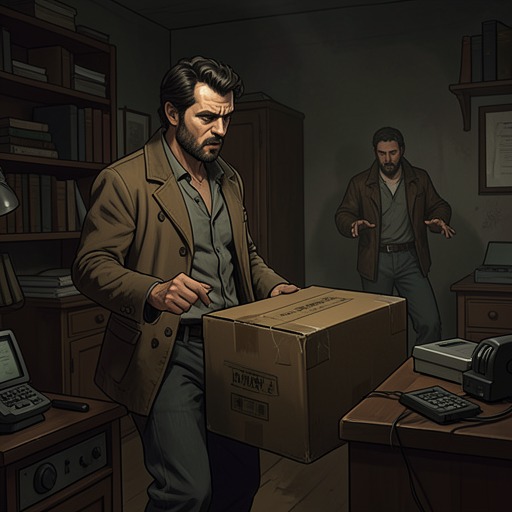
The Box Man says he responded by setting up his camera without first rearranging himself after urinating. He had been an independent photographer before becoming a box man and continued to carry a minimum of photographic equipment. He turned the box, took three pictures in succession, and did not have time to adjust the distance. He nevertheless says the camera settings left the images more or less in focus. The man crossed the road and disappeared from view.
The resulting photographic evidence is described in more than one form in the notes. The Box Man says that a black-and-white negative is taped to the upper-right corner of the inside cover. Elsewhere, he refers to the attached photographic evidence and describes a developed picture that he says he saw on the day of the shooting. The image is characterized as a back view: the man is hurrying up a sloping road, concealing the rifle under his arm in a way that makes it lie along his body. The account thus presents both a physical attachment and a narrative description of what it records, rather than asking the reader to rely on an image alone.
Identification of the Shooter
The photograph’s most consequential role is to support the Box Man’s identification of the shooter. He draws attention to the man’s haircut, a well-made suit that fits his rounded shoulders, conspicuous creases in the trousers, and distinctive low shoes with thin soles. He reasons that the clothing and footwear point to someone who often sits in the Japanese fashion and repeatedly removes and puts on shoes. From these details, he infers a profession in which such habits would be likely: a doctor making house calls.
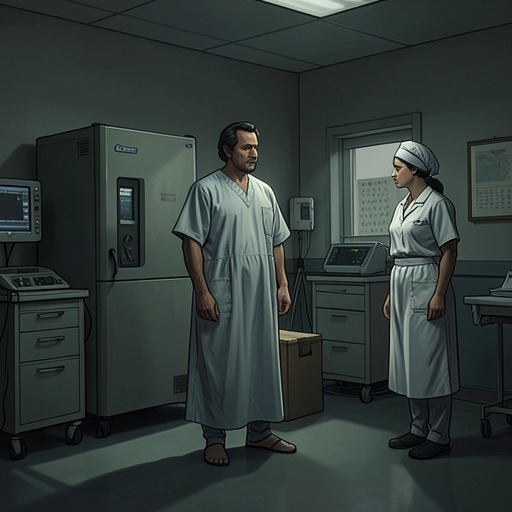
The notes then connect that inference to the Doctor at the Hospital on the Hill. The Box Man says the photograph clearly showed that the air-rifle man was the hospital doctor; the narrative later has him present the clothing and footwear as clues in a confrontation involving a false box man and the Nurse. The image therefore does more than preserve the outline of a departing figure. In the narrator’s account, it links the roadside shooting to the Doctor’s identity and to the conflict at the hospital. That identification is the Box Man’s claim, supported by the features he says are visible in the photograph; the image’s described contents do not independently disclose the man’s name or motive.
Evidence, Limits, and Narrative Function
The Box Man insists that the film can substantiate nearly everything up to the moment the photographs were taken, but that what follows has no objective backing. He treats the images as a safeguard against disbelief and says they provide material proof, while also admitting that a reader or finder of the notes must decide whether to accept his testimony beyond what the photographs can show. This distinction gives the picture a defined but limited evidentiary force: it may establish that a man carrying what appears to be an air rifle was present and leaving, but the explanation of who he is and why he acted depends on the narrator’s interpretation.
That limitation becomes concrete when the Box Man invokes the photograph during the hospital confrontation. He says he has convincing proof and describes the image’s identifying details, but when asked to show the film, he replies that he did not bring it. He regards it as his sole means of securing an equal right to speak. The photograph is therefore both an alleged physical object and an absent one in the scene where its evidentiary value is challenged. Its promise of verification intensifies the dispute, but it does not settle it there.
The photograph also belongs to a layered record made up of notes, additions, and attached material. Its placement inside the notebook’s cover makes the written account resemble a case file, while the narrator’s explanations guide the reader from visible features to a professional identity. Yet the image’s described clarity cannot erase the account’s own uncertainties: the shooting date is approximate, the later claims exceed what a rear-view photograph can directly establish, and the film is not produced at the confrontation. The Photograph of the Air-Rifle Attacker consequently stands at the boundary between documentation and interpretation, giving the Box Man a tangible basis for accusation without making his full account independently conclusive.