Sand-Filled Crocodile Toy
The Box ManThe Sand-Filled Crocodile Toy is a stuffed animal that Box Man Narrator turns into a concealed blackjack, transforming an apparently innocent plaything into an instrument of defense. Its importance lies in the gap between what it looks like and what it can do: the toy's cheerful appearance helps disguise its purpose, while its sand-filled body gives Box Man Narrator an advantage in his confrontation with Doctor, who is posing as a fake box man. The encounter makes the crocodile more than a weapon. It is also a carefully prepared object whose usefulness depends on concealment, timing, and the assumptions its appearance invites.
Appearance and Construction
The crocodile is described as a little under eighteen inches long, with a torso circumference of sixteen and a half inches. Its painted green body has inset plastic eyes and fangs, a warty back, light-brown claws, and a red mouth. These details give it the recognizable features of a child's toy, while its small scale and conspicuously playful design seem at odds with the serious function Box Man Narrator has assigned it. In the encounter, he relies on that contrast: a figure likely to be read as harmless is less likely to be treated as a weapon.
The toy's construction allows it to change purpose. Box Man Narrator ordinarily removes the shavings and spongy filling, carrying the crocodile's outer skin by itself. On this occasion, however, he has put beach sand inside it in advance. The familiar object is thus altered not by a visible redesign but by a change in its contents. Its soft exterior preserves the impression of a stuffed animal; the added weight makes it useful as a blackjack. The contrast between surface and contents is essential to how it works.
Preparation and Concealment
Before using the crocodile, Box Man Narrator retrieves it from a mountain-climbing bag in the corner by the door, where his clothes had been put after they were removed. He describes the bag as probably an American Army surplus item. The toy is therefore not introduced as something openly displayed or carried in hand: it is stored among personal belongings and produced when the confrontation is already under way. Its location and its ordinary-looking form both contribute to its concealment.
Box Man Narrator says that he had a premonition that morning and filled the toy with sand beforehand. The preparation gives the object a significance beyond opportunistic improvisation: he has made a particular alteration before its use, although the account does not explain the premonition further. He explains that, once the toy has served its purpose, its end can be opened and the sand scattered around a garden. That proposed method of disposal belongs to the object's design as he understands it: the contents can be removed, and the outer form need not announce what it has concealed. The crocodile's usefulness consequently depends not only on its weight but also on the possibility of returning it to an innocuous appearance.
Use in the Confrontation
Box Man Narrator first pretends to hand the crocodile to the fake box man reluctantly. That gesture makes the object appear to be an offered toy rather than a weapon being readied. Instead, Box Man Narrator strikes upward against the end of Doctor's rifle barrel. The movement displaces the barrel into the upper frame of the window, and the shot goes toward the ceiling. Doctor is caught off guard, and Box Man Narrator takes the rifle from his grasp. The crocodile's first decisive effect is therefore to interrupt Doctor's control of the gun, not merely to serve as a blunt instrument.
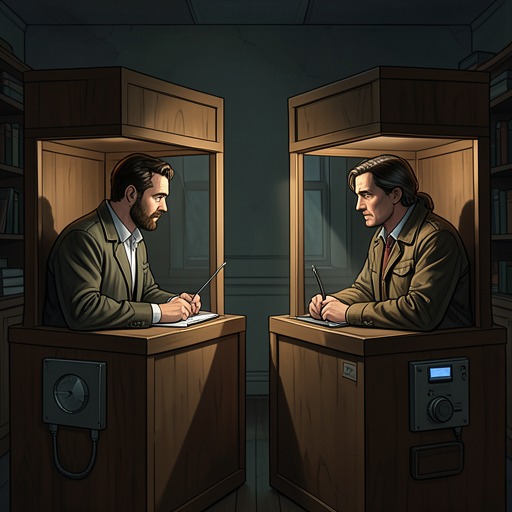
The exchange continues after Box Man Narrator has taken the rifle. Doctor reaches through the observation window and grabs Box Man Narrator's cheek; Box Man Narrator then uses the sand-filled toy against Doctor's farther shin. Doctor withdraws his arm into the box. Box Man Narrator begins to strike higher, near the top of the box, but stops because he does not want to damage it. He then continues targeting the shin more carefully. This change in where he directs the toy shows that the encounter has more than one practical constraint: he wants to stop Doctor, but he also wants to avoid damaging the box and creating a further problem for himself.
Function and Significance
The scene turns on the crocodile's double identity. As a toy, it seems to promise play and to invite a less hostile response; as a sand-filled blackjack, it gives Box Man Narrator a way to disrupt an armed opponent. The apparent gift and the hidden use belong to the same action: Box Man Narrator takes advantage of the gap between the object's visible identity and its prepared function. Its harmless look is not incidental decoration but part of how it can be brought close enough to Doctor to affect the rifle.
The object also remains materially specific rather than becoming a weapon in the abstract. Its measurements, plastic features, removable filling, and storage in the bag establish how an everyday-looking possession can be adapted without ceasing to look like itself. At the end of the exchange, Doctor curls into a passive posture inside the box, while Box Man Narrator looks at the box in the daylight entering the room. The crocodile has helped reverse who controls the immediate encounter, but it has not dissolved the surrounding uncertainty: the box remains present and vulnerable, a limit on how freely its occupant can be struck. Its significance rests in that precise balance of disguise, force, and restraint.