Subjective Time as Stasis and Repetition
The Box ManSubjective Time as Stasis and Repetition is the novel’s account of time as something intimate and unstable rather than a dependable measure. In the lovers’ enclosed life, physical closeness can dissolve duration, speech becomes unnecessary, and days lose their differences; the clock, by contrast, registers fixation through uneven wear. A poem-like meditation then turns these private distortions into a paradox: the world seems already to have passed the observer, even as the world he thinks he sees has not begun.
Time in Love and Pain
The narrator experiences time differently according to the pressure of desire. In the pain of trying to escape, time melts slowly, but the prospect of learning the techniques of wooing offers a hope of peace and happiness. He resolves to cherish a passionate force that begins with lost love, describing light contact with the woman’s skin as enough to stop time and bring eternity near. The moment is not presented as a permanent escape from chronology: it effects a physical transformation that, he says, will last until death. Intimacy makes time feel suspended while leaving its consequences irreversible.
That paradox takes shape in the couple’s daily routine at the hospital. For close to two months, both have lived naked; they remain together in near-continuous bodily contact, rarely leaving a circle eight feet in diameter. The narrator sits at the woman’s feet while she prepares vegetables, and they do not treat the neglected kitchen, scattered food waste, or its stench as reasons to break their closeness. They can talk optimistically about how long the waste might take to fill a room, yet cannot imagine their life as far as that half-year horizon. The future can be named, but it cannot be inhabited in thought.
Their confined existence also makes ordinary units of duration interchangeable. The narrator says that three days and three weeks amount to the same thing: passion burns toward its end, and once it is spent, the ending arrives at once. Time is therefore both suspended and compressed. The days stretch into an undifferentiated present, while the whole duration of the love seems capable of vanishing in a single instant. This is not simply a claim that the couple has lost track of the calendar; their bodily routine and inability to picture the near future give the distortion its lived conditions.
Communication Without Words
The changing relationship alters not only the pace of time but the need for language. After the woman returns from outside and later leaves, the pair exchange no words. The narrator feels some regret, but concludes that speech could not repair what has already passed beyond the stage at which words are useful. Their glances suffice. He calls this complete communication a phenomenon of their disintegrating love, joining mutual understanding to separation rather than treating them as opposites.
That silence belongs to a broader dissolution of personal identity. The narrator feels himself divided into parts before the woman; her comments concern the feel of his body rather than an assessment of his whole personality. He is not particularly troubled by this absence of a totalizing judgment. Words have begun to lose meaning, and time has stopped. The relationship persists as touch and fragments of sensation, while the language that might arrange those experiences into a coherent account falls away. The resulting stillness is not uncomplicated harmony: it accompanies a love already coming apart.
The change becomes visible when the woman, formerly encountered naked, appears dressed and silent. The narrator experiences her clothing as a return to a starting point and feels the pathos of his own nakedness. He wonders whether the relationship might begin again, but recognizes that beginning again could only reproduce the same time and place. The wish for renewal thus folds back into repetition. The scene’s temporal uncertainty is anchored in a specific reversal of appearance, but its larger effect is to make restart and continuation difficult to distinguish.
The Clock and the Uneven Present
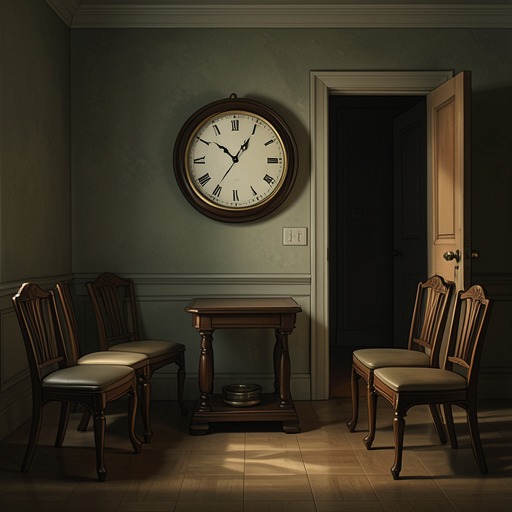
A short meditation on a clock converts obsessive attention into an image of wear. Its dial is worn unevenly, most severely around eight, because it is stared at with abrasive glances twice a day. Time here is not merely passing over an object: repeated acts of looking mark the instrument, making attention itself a force that alters what is supposed to measure duration. The worn patch records recurrence, while its unevenness gives recurrence a local, almost physical shape.
The poem contrasts that damaged clock with a flat watch worn evenly. Its wearer, it suggests, failed at the start and is running a lap behind. From there the temporal perspective reverses: the world is always a lap fast, while the world the observer believes he sees has not yet begun. These images do not settle into a single chronological explanation. They make lived time feel out of alignment with the world, so that the observer may be late relative to one measure and early relative to another.
The hands standing vertically on the dial mark illusory time, and the play ends without a bell announcing the raising of the curtain. The image makes ending precede its usual public signal: no ceremonial cue is needed for the performance to be over. It also echoes the lovers’ private sense that words and conventional stages have already lost their usefulness. The play’s unannounced ending gives formal shape to a time in which closure may have occurred before anyone has recognized or named it.
Repetition and the Threat of an Ending
The poem’s cycles return to the couple’s practical circumstances. After a ten-minute lapse, the narrator nails up the entrance and grazes the base of his left thumbnail; a little blood appears, but the pain quickly disappears. The measured interval and brief bodily injury offer sharp, concrete markers of duration. Yet the reflection that follows is not about the clock: it is about the silence between the lovers, whose glances have already replaced speech. Clock time continues to register minutes even when the relationship’s inner time has ceased to move forward.
The narrator’s imagined restart is ultimately bound to repetition rather than change. He considers whether the woman might be waiting for him to propose beginning again, then recognizes that every attempt would return them to the same time and place. The poem’s worn dial and its lap imagery enlarge that intimate loop into a model of perception: recurring attention makes a mark, but repetition does not guarantee progress or a fresh beginning.
At the same time, the suspended present contains a disturbing practical limit. The narrator hears the woman’s room door, knows that the front entrance has been nailed shut, and notes that the emergency stairs are locked. He considers cutting the electricity so that her clothes will cease to distinguish her from the naked figure he wants to see. The sealed building and his plan make the relationship’s stalled time inseparable from confinement and control. The novel’s temporal imagery therefore does not offer stillness as simple refuge: the eternity promised by touch, the repetitive present, and the play that ends without warning all exist alongside actions that restrict another person’s movement. Together they make subjective time both an intimate sensation and a sign of a relationship whose apparent suspension conceals an irreversible ending.