The Box
The Box ManThe Box is not merely a cover worn by a Box man: it is a constructed shelter whose dimensions, openings, and contents shape how its occupant sees, moves, and relates to ordinary life. The book presents it as both an object that can be made from common packaging and a boundary that becomes difficult to leave. Its plainness protects anonymity, while its carefully designed window gives the concealed occupant a limited way to look outward.
Form and Construction
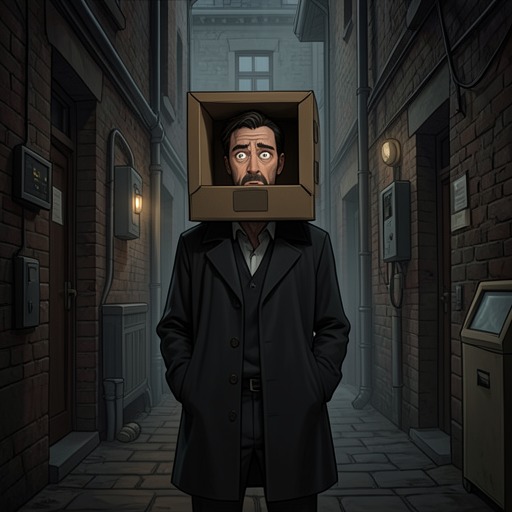
The account opens with the Box Man Narrator already inside a cardboard box that reaches his hips when he puts it over his head. The narrator identifies himself as a Box man recording the chronicle of a Box man, immediately joining the object to the act of telling the story. The practical instructions that follow make the Box seem reproducible: almost any empty container about a yard long and wide and four feet deep can serve, though the familiar standardized quarto form is preferred.
Standard dimensions matter for more than convenience. Commercial boxes are readily available, and their sameness makes any one harder to distinguish from another. The manual thus treats anonymity as a property that can be designed into an object. It also compares materials according to how they behave in use: ordinary corrugated cardboard is light, ventilated, and semi-waterproof, while the stronger, vinyl-finished Frog Box is presented as an option for extended use, particularly in wet weather. Its surface, however, collects dirt and becomes visibly wavy along the edges. A box can offer protection and still acquire identifying marks.
The instructions turn construction into an arrangement of small practical choices. The maker decides which side will be top and which bottom, cuts or folds the base, and uses wire and tape to secure the structure. A magazine placed on the occupant’s head stabilizes the Box and affects the height of the viewing window. Hooks made from bent wire can hold belongings against the inner walls; the manual recommends keeping these few, naming essentials such as a radio, mug, thermos, flashlight, towel, and small bag. The Box is therefore both an exterior disguise and a compact interior to be organized.
The Window and the Direction of Looking
The observation window is the Box’s most carefully specified feature. Its suggested measurements place the upper edge near the occupant’s eyebrows and the lower edge far enough down to show the ground; the opening should also allow a view several feet ahead for walking. Yet the instructions advise making it as small as possible while preserving visibility, ventilation, and the cardboard’s strength. The design holds a tension between seeing enough to move through the world and exposing as little as possible to it.
A frosted vinyl curtain makes that tension workable. Taped along its upper edge, it hangs across the opening with a narrow central slit and overlapping flaps. When the Box remains upright, the flaps screen its interior; a slight tilt allows the occupant to look out, with the opening regulated by how far the Box is angled. The curtain is thus not simply a cover over a hole. It allows the Box man to control when the boundary becomes permeable, and the instructions present that control as a form of expression as well as protection.
Additional small apertures in the side walls serve as supplementary viewing points and help the occupant locate sounds. The manual recommends arranging their flaps to face outward in rainy conditions. These practical details make the Box an instrument for sensing the street without fully entering its ordinary field of view. Its occupant is concealed, but not entirely cut off: sight and sound pass through selected openings, while the Box’s enclosing structure limits exposure.
A’s Passage into the Box
A’s story shows how an ordinary shipping container can take on a different significance. When a new refrigerator arrives in a corrugated cardboard box of a suitable size, A first decides to get rid of the empty packaging. Instead, after drawing the curtains in his home, he climbs inside. The dim interior and smell of waterproof paint seem homelike to him, though he soon regains his composure and comes out. He keeps the box rather than destroying it.
The next day, A cuts an observation window into it and tries the Box over his head, but immediately removes it. He kicks the Box into a corner, yet leaves it intact. These hesitant actions mark a difference between making the object and accepting the life it implies: the manual says that constructing a Box takes less than an hour, but becoming a Box man requires courage. In A’s case, the object first appears as something he can approach, reject, and put aside.
By the sixth day, A spends much of Sunday inside and recognizes that he needs things to make the enclosure workable. He buys a chamber pot, flashlight, thermos, picnic set, tape, wire, hand mirror, poster colors, and food that needs no preparation. He reinforces the Box and stores the supplies within it. With the mirror and flashlight, he paints his lips and circles his eyes in rainbow colors, regarding the result as fitting the container. The Box has become more than a temporary cover: it is an interior in which A arranges his belongings and changes his appearance.
A week after first trying the Box, he goes out into the streets wearing it and does not return. That departure gives the object its decisive consequence in his story. What began as packaging for a household appliance becomes the means by which A leaves his previous life behind. The narration links this change to the danger of treating Box men as an abstraction: the Box makes an otherwise ordinary person into an apparition, but it also offers a form of existence outside the expectations attached to ordinary public life.
Exchange, Identity, and Narrative Function
For the Box Man Narrator, leaving the Box cannot be treated as a simple return to an earlier condition. He says that he has lived in one for three years and compares the occupant’s dependence on it to a hermit crab’s dependence on its shell. Taking it off, in his account, would mean emerging into another world, not merely resuming ordinary life. He had privately hoped that a meeting with a woman would provide an occasion for that change, making the Box a boundary he longs to cross even as he describes himself as unable to leave it casually.
The importance of the object becomes visible in the exchange involving fifty thousand yen and a carefully copied Box. The other occupant’s version reproduces the narrator’s curtain in the same color and arrangement, though it lacks the small holes in the narrator’s own. The narrator finds the reproduction unusually elaborate and doubts that returning the money will be straightforward. He interprets accepting the payment as having shifted the right to be a real Box man to the other person, leaving him uncertain whether he himself has become the counterfeit.
That reversal makes authenticity inseparable from possession and use. The Boxes may look almost identical, but their occupants’ competing claims turn the object into evidence in a dispute over who has the right to inhabit its role. At the same time, the Box’s plain standardized exterior works against easy identification, while its individualized openings and contents distinguish one occupant’s arrangement from another’s. Across the manual, A’s departure, and the narrator’s crisis over the copied Box, the same object changes function without ceasing to be cardboard: it is shelter, disguise, controlled vantage point, domestic interior, and the unsettled material sign of a life that cannot be reduced to appearances.