The Box Man’s Social Invisibility
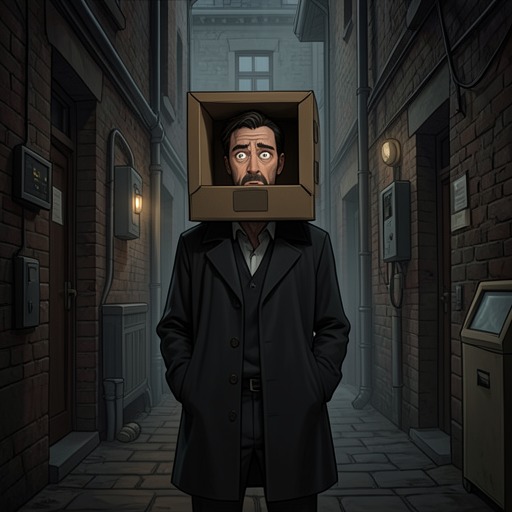
The Box ManThe Box Man’s Social Invisibility is not simply the result of hiding inside a cardboard enclosure. It describes a social failure of recognition: a person may be visible, close at hand, and even acting in public, yet pass without becoming an object of sustained attention. The novel makes that failure both a condition of life for Box men and a wider feature of the anonymous city, where people can remain unseen not because they are absent but because others avert their attention.
Visibility Without Recognition
The Box Man Narrator argues that Box men are not especially rare, even though there are no statistics to establish their number and public discussion of them is absent. The silence around them is part of the phenomenon. A Box man may resemble discarded rubbish tucked beside a guardrail, a public toilet, or a footbridge, but being easy to overlook is not the same as being literally invisible. The narrator suggests that people have opportunities to see Box men and nevertheless instinctively avoid acknowledging them. Concealment invites suspicion, yet the surrounding public also participates in concealment by refusing to look.
The cardboard enclosure makes this contradiction visible. It covers the wearer’s body, but its observation window allows the wearer to look out; the vinyl can be adjusted so that the opening itself communicates a look. In a later encounter, a box shifts and an eye appears at its window. The look is expressionless, but it reverses the usual arrangement: the observer finds himself made aware that he is being watched, while the Box man remains difficult to read. Social invisibility therefore does not mean an absence of perception. It can conceal the person who sees, and unsettle the person who had assumed that looking was a one-way act.
A and the Anonymous City
A’s experience begins when a Box man takes up residence directly below the window of A’s apartment. A tries not to look, but remains acutely aware of the presence. He initially experiences the Box man as an intrusion into his territory and expects someone else, such as the apartment janitor or a neighborhood busybody, to intervene. The janitor does not resolve the matter: the Box man is visible only from A’s window, and the person who can avoid being seen has little reason to move. A’s difficulty is thus not simply that the Box man is hidden. A alone is placed in the position of seeing him, while the ordinary channels of collective attention fail to turn that sight into action.
Over time, A’s relation to the box changes. He retreats into it, sleeps with it over his head, and, after a week, goes out into the streets wearing it and does not return. The transformation makes the box more than a disguise: it carries A from the uneasy position of a watcher into the precarious condition of the person whom others may disregard. The narrative does not present this passage as an inexplicable personal oddity. It connects A’s fate to an imagined anonymous city, one in which nameless inhabitants can move without defensiveness, rest by the roadside, or join a crowd without being required to establish who they are. That ideal of freedom and the danger of social neglect occupy the same urban space.
Everyday Practices and Urban Attention
The Box Man Narrator’s account gives social invisibility a material, everyday scale. A box man’s possessions are deliberately limited to practical objects such as a radio, mug, thermos, flashlight, towel, and small bag. Rubber boots must remain intact, while canvas wrapped around the waist helps hold the box in place and allows movement. These details describe a life organized around mobility and basic routines rather than stable domestic space. They also make clear that the Box man is not outside the city: he must eat, sleep, and manage daily needs within it.
The city can be learned through such repeated movement. The narrator describes going into busier districts to find food, where supplies and variety are more readily available. He says that getting accustomed to the town is necessary to enjoy life among its crowds. As that familiarity develops, time seems to move differently around the Box man: the background passes quickly, the foreground slowly, and the center remains still. The image suggests a paradox of urban anonymity. A Box man can be surrounded by movement and opportunity while occupying a social center that others scarcely register.
The same condition appears in the fake box man’s account of a photograph taken at a patient’s funeral. When the photograph is developed, a Box man is plainly present in the image, yet the photographer has no recollection of seeing him at the time. Later, the fake box man becomes more attentive to Box men in the streets and describes one reaching from a box to take inexpensive items from a greengrocer’s display. A nearby clerk appears not to notice. The episode does not establish that every Box man can act without consequence; rather, it shows how an observer’s deliberate or habitual inattention can make a visible action seem to pass outside ordinary social response.
Public Death and the Limits of Invisibility
A newspaper report extends the novel’s concern beyond Box men. It describes a forty-year-old vagrant found dead beside a pillar in the underground passage at the West Exit of Shinjuku Station in Tokyo. The man had apparently sat in the same position since noon. During the six or seven hours before the patrol found him, commuters and shoppers passed through the busy passage without reporting him. He was only about ten yards from a police box, but the officer on duty said that the pillar had blocked the view from the other side. The report identifies him through clothing and the few possessions he carried, including 125 yen in change and several sheets of newspaper, but gives no name or residence.
The dead vagrant is not identified as a Box man, and the distinction matters. The passage does not collapse the two situations into one; it shows that the social conditions associated with the Box man can reach beyond the box itself. Here, a person is not hidden by cardboard, yet remains unacknowledged amid an enormous flow of people. The pillar offers a literal obstruction to the officer’s sight, while the hours of unreported presence point to a broader failure of attention. In placing this report beside the Box Man Narrator’s descriptions, the novel makes anonymity less an eccentric privilege than a dangerous condition that public life can impose.
Significance
The Box Man’s Social Invisibility holds together opposing possibilities. The ability to pass without scrutiny can offer the Box man room to move through the city and reduce the demands of ordinary social recognition. But the same withdrawal leaves him exposed to indifference: others may avoid looking, fail to intervene, or register his presence only after a photograph or a death makes it impossible to ignore. A’s movement from the apartment window into the streets crystallizes this reversal, while the crowded passage makes its consequences legible without making the dead man a Box man.
The novel’s emphasis is therefore not that Box men cannot be seen, but that seeing does not guarantee recognition. The box gives this social condition a striking physical form, yet the narrator’s observations and the newspaper account reveal a larger urban pattern: crowds can contain people whom no one meaningfully notices. In that pattern, invisibility is at once a tactic for inhabiting the city and evidence of how readily the city can abandon those who inhabit it.