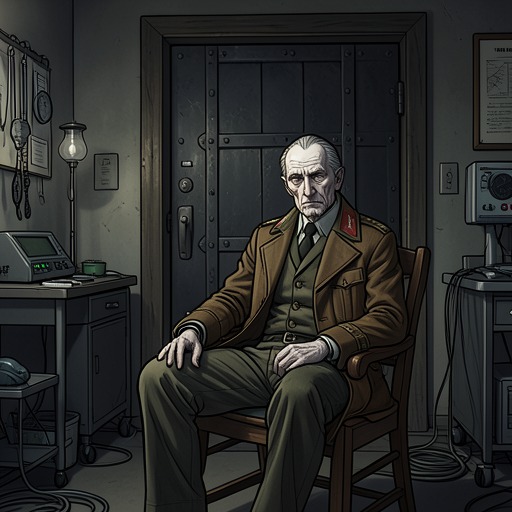
The Doctor's Death and the Staged Drowning Scene
The Box ManThe Doctor's Death and the Staged Drowning Scene turns a disputed corpse into a test of competing explanations. In an affidavit, the clinic's impersonating practitioner identifies the body as the Army Medical Captain, whose name and professional identity he had borrowed, and offers a possible accidental death. Later, a narrator addresses an imagined accomplice and sets out the steps for disguising a death as drowning. Yet the account is neither a verified reconstruction nor a straightforward confession: its precise instructions coexist with conjecture, a deliberate break in the text, and a later statement that the Doctor was seen alive. The episode makes the production of a plausible story about death part of the mystery.
The Affidavit and the Uncertain Cause
The affidavit first identifies the corpse as the Army Medical Captain, not the practitioner who had been treating patients under the borrowed identity. The speaker explains that he had used the title Doctor Captain for years, half jokingly, and that the usage had become habitual. He says the Army Medical Captain had shown suicidal tendencies in the past and expresses regret that he did not prevent what happened. This is an admission about the dead man's identity and vulnerability, but it does not establish the circumstances of death.
The account then offers a more tentative possibility: the Army Medical Captain may not have intended to die. The previous day's rain had left the embankment wet, and, the affidavit suggests, he might have slipped while walking there. The cardboard box found over his head is treated as a further uncertainty rather than proof of a plan. The speaker says he does not know why the dead man wore it, but allows that the Army Medical Captain may have used a box to conceal himself. The possibility is linked to his isolation and misanthropy, and to the idea that he felt he had become a nobody after surrendering his name, address, and license to the impersonator.
That explanation has a personal and legal context. The affidavit's author recounts that he served as an orderly to the Army Medical Captain during the war, learned medical work under his guidance, and later helped establish a clinic with him. He says the Army Medical Captain became dependent on drugs after the author began supplying them, and that his condition eventually left him unable to examine or treat patients. The author claims that friendship and a reluctance to abandon a sick man kept him involved, while also acknowledging that the borrowed credentials supported his livelihood and that practicing without authorization was unlawful. These admissions explain the entanglement between the two men, but they also come from a speaker with reasons to frame his conduct and the death carefully.
The Proposed Staging
A later passage shifts from retrospective explanation to a close, second-person account of an apparent plan. The narrator identifies a small metallic sound as a syringe being placed in a sterilizer, then describes hearing someone approach the room. The narration presents the approaching figure as a person wearing a box and imagines the visit as an act directed toward the narrator, who pretends to be asleep. The exactness of the imagined movements gives the passage the tone of observation, although the text does not establish that every described action has actually occurred.
The account then describes the use of morphine and the narrator's apparent death in restrained procedural terms. It moves immediately from that supposed death to a proposed drowning disguise: seawater is poured into the mouth, and the narrator explains that this would not deceive an official autopsy by itself. The distinction matters. The passage does not present the seawater as sufficient evidence of drowning; instead, it explicitly recognizes that an examination could expose the discrepancy. The old injection scars, the quantity of drugs used, and the authorities' existing interest in that use are identified as further grounds for suspicion. The staged appearance is therefore not a solved deception but a precarious attempt whose weaknesses the narrator is already enumerating.
The plan expands into a practical disposal sequence. The narrator names a location behind a soy-sauce factory, where a steep drop meets the water and the current might carry the body away. The proposed timing is narrowly constrained: the work is imagined as beginning after half past one and needing to be finished by three, before the outgoing tide passes its peak and the canal current stops. A bicycle-drawn trailer, the box, a rope, clothing, and a towel all enter the account as parts of the imagined preparation. The narrator even warns that a dog should be chained up so it will not follow. These concrete details make the scene sound workable, while the narrow time window and risk of overlooked evidence expose how fragile the plan would be.
Contradictions and Aftermath
The affidavit's author says he and the nurse did not visit the Army Medical Captain's room unless he rang for them. He recalls that they checked it only after becoming suspicious late on a Sunday night, and says he was prepared to request a police search by dawn even if this exposed his illegal practice. He also describes the dead man's worsening condition, including an intense desire for sweets associated with his old research into producing sugar from wood. When the author tried to restrict the sweets, the Army Medical Captain became angry, but the affidavit's author rejects that dispute as the cause of death. These details supply possible pressures without resolving the end of the man's life.
The staged-drowning passage, by contrast, speaks as though the dead body and its concealment are already present, then breaks off at a marked interruption. This interruption prevents the elaborate account from serving as a complete, continuous record of what happened. Its language moves between certainty about imagined logistics and recognition that the evidence could betray the plan. The text thus keeps several propositions in play: an accidental fall, suicide, an attempt to hide beneath a box, and a deliberate effort by someone else to disguise a death. None is independently confirmed by the evidence presented here.
The contradiction sharpens when the Nurse asks the box-wearing speaker to remove his disguise and mentions the Doctor. He replies that he knows whom she means and says he saw the Doctor in the street a little while earlier. The statement does not explain whether the person seen was the Doctor, the impersonator, or someone taken for one of them. It does, however, unsettle the affidavit's confident identification of a dead man and the later narration's apparent staging of a corpse. The Doctor's death remains caught between testimony, imagined procedure, and mistaken or concealed identity.
Narrative Function
The episode's documentary and speculative modes pull against each other. The affidavit offers names, professional history, and a proposed cause of death, but its author is implicated in the borrowed identity and the unlawful practice under investigation. The later account reverses the form: instead of calmly explaining the past, it anticipates actions in minute detail, yet its second-person address and interruption leave the boundary between observation and invention uncertain. A subsequent claim of seeing the Doctor alive prevents either mode from closing the question.
That structure makes identity as consequential as cause. The corpse may be the Army Medical Captain, while the public-facing doctor has long been the identity assumed by another man; the box offers still another means of hiding who is present. The episode does not merely ask how a death occurred. It shows how a death can be narrated, disguised, and challenged, while the people who might establish the facts remain entangled in the very identities at issue.