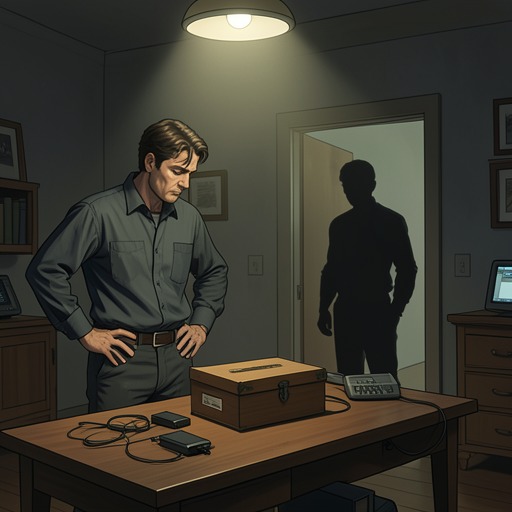
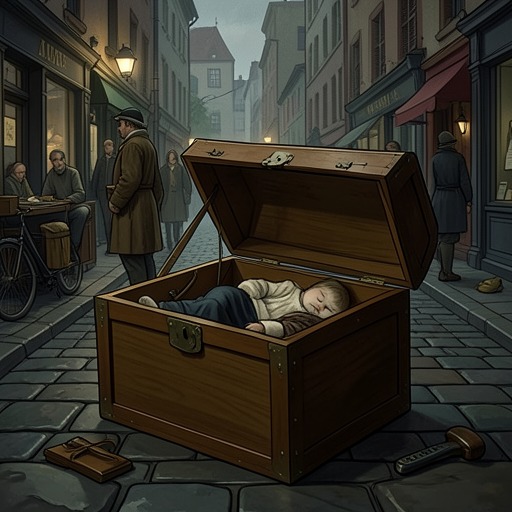
The box as an entrance to another world
The Box ManThe box as an entrance to another world is the Box Man Narrator’s metaphor for escape that is not a return to ordinary life. It names the possibility that the box, despite its confinement, can become a passage toward another form of existence. The image remains deliberately unstable: the opening may lead somewhere beyond the narrator’s present identity, but from inside it can look indistinguishable from a dead end. Its promise depends on an exit, and the narrator’s changing confidence in reaching one shapes the expression’s force.
The Box as Passage and Dead End
The narrator describes a chronic disturbance in the box man’s sense of direction: the earth’s axis seems to sway, bringing on severe nausea like seasickness. He separates this disorientation from any sense of guilt about dropping out of society. The box is not, in his account, an admission of wrongdoing or a punishment to be overcome. Instead, he understands it as an entrance to an unknown elsewhere. At the same time, when he looks out through the small observation window, the opening to that other world seems little different from a dead-end alley. The metaphor therefore holds possibility and enclosure together rather than resolving one into the other.
The distinction matters because the imagined passage does not promise a simple cure for the box man’s estrangement. The narrator does not specify what the other world contains, and he admits that he does not yet want to die. The unknown destination is meaningful precisely as an alternative to the narrow view from the box, not as a clearly described place or guaranteed escape. The narrator’s qualification keeps the image grounded in an immediate desire to continue living while leaving the direction of that life unsettled.
Emergence as Transformation
The prospect of leaving the box becomes more than a physical change of shelter. In considering the 50,000 yen paid for the box, the narrator insists that its significance cannot be measured by its price: after three years, a box man cannot simply remove the structure and resume ordinary existence. He compares the transformation to a hermit crab’s dependence on its shell, then shifts to the image of an insect emerging through metamorphosis. Taking off the box would mean entering another world, not merely returning to the one left behind.
This expectation attaches itself to the narrator’s anticipated meeting with the girl. He secretly hopes that meeting her will provide the opportunity to emerge from his human chrysalis. The encounter is thus invested with a threshold-like significance: it might convert the box from a lasting enclosure into a stage that can be left behind. The narrator’s hope is personal and contingent, however, rather than evidence that the meeting will in fact produce a lasting transformation.
The Portable Opening and the Gaze
A marginal reflection connects the box’s passage imagery to the narrator’s voyeurism. He wonders whether he became a box man in order to keep looking at places from concealment. The box becomes a portable hole, a substitute for punching openings through the world, while his stated impulses to flee and to pursue remain unresolved. The image of an entrance therefore has an uneasy double use: it suggests movement beyond the box, but also a means of maintaining the hidden observer’s position within it.
The narrator recognizes that his desire to spy on the girl has begun to exceed the capacities of the box. He also notes that the Doctor has paid 50,000 yen for the box and that the girl has suggested a separate bonus for him as a photographer. These circumstances complicate any clear separation between escape and continued looking: the contemplated opportunity to leave is bound up with the very activity the box enables. The opening is not simply a door outward; it is also the aperture through which the narrator watches.
A Threshold Reached, Then Questioned
At the municipal seaside bathhouse facing the Port of T, the narrator reconstructs why he has come there. A week earlier, he had chosen the place to prepare for treatment at the hospital, since he could leave the box unnoticed and use the dressing-room shower at a quiet time. Now he has washed his clothes and body, shaved, and waited inside the box while his clothes dried. He says he is there only temporarily and feels already halfway out; the tunnel’s exit is visible. In this moment the metaphor becomes a concrete scene of departure, although the narrator has not yet completed it.
The girl appears in his imagination as a light at the tunnel’s entrance, associated with the chance he has awaited for three years. But the scene also brings him face to face with the fake box man, his replica, who is watching her. The encounter unsettles the narrator’s relation to his own role. He recalls a recurring dream of hovering above his dead body, yet says he is already thoroughly bored with the box; a tunnel, he reasons, is functional only if it has an exit. The possibility of destroying his notes after finishing the final line further links writing to the anticipated departure, without confirming what follows it. The expression consequently closes not with a completed escape, but with a sharply felt threshold: the narrator can imagine the way out and is tired of remaining inside, while the promised other world remains undefined.