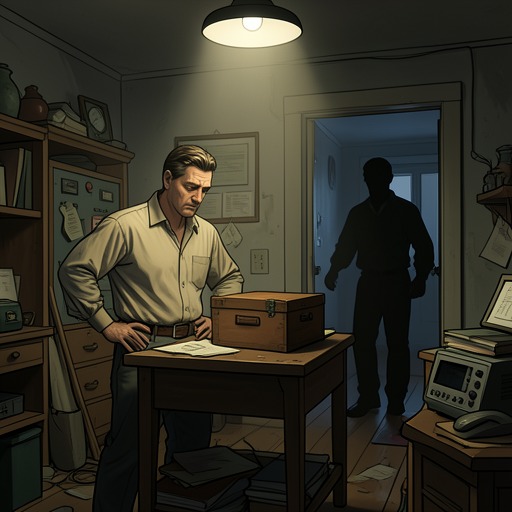
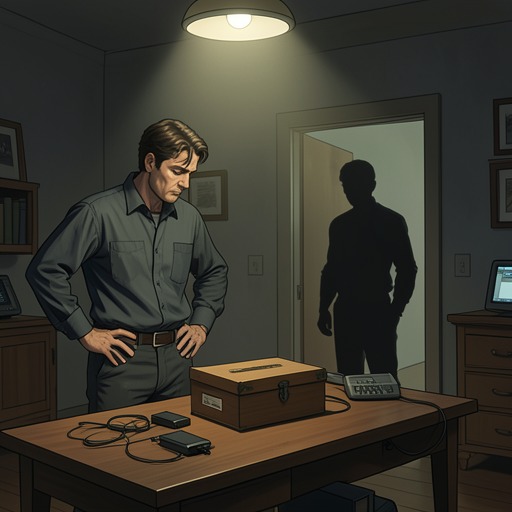
The box is a labyrinth of a hundred interconnecting puzzle rings
The Box ManThe box is a labyrinth of a hundred interconnecting puzzle rings expresses the narrator’s paradoxical account of the box: its exterior is a simple geometric solid, while its interior becomes a maze that grows more intricate through the effort to escape. The image joins physical enclosure to the narrator’s difficulty finding a vanished woman, and turns the box into a space where searching may itself produce further disorientation.
The Box from Outside and Within
In appearance, the box is a right-angled parallelepiped, a plainly bounded object. Seen from within, however, it becomes a labyrinth of a hundred interconnecting puzzle rings. The contrast is not merely between a container’s exterior and interior: the ordered geometry visible from outside gives way to an arrangement whose connections resist straightforward passage. The same object can therefore seem simple to an observer and impossibly intricate to the person enclosed within it.
Struggle and Increasing Complexity
The narrator describes the labyrinth as responsive to struggle. The more its occupant tries to get through, the more the box seems to grow an extra outer skin, adding twists and making its inner disposition increasingly complex. This reverses the expectation that effort necessarily brings someone closer to an exit. Here, exertion enlarges the puzzle rather than resolving it, so the box’s maze is not a fixed obstacle but a structure that appears to develop alongside the attempt to overcome it.
Blank Space, Search, and Uncertainty
The image appears beside the narrator’s insistence that processing the box requires leaving ample blank space for scribbling. However assiduously someone writes, the blank cannot be entirely covered; the narrator even observes that scribbling of a certain type is itself blank. The remaining space can still hold a name, though the narrator adds that disbelief in this possibility makes no difference. The written account thus echoes the box: both contain an interior that cannot be fully mapped or filled.
The narrator connects this unfinished space to the woman who has vanished. He is certain she is somewhere in the labyrinth, but does not conclude that she is fleeing; she may simply be unable to find him. He says he has no regret and treats the numerous clues as grounds for believing that truth exists in proportion to their number. The passage leaves both the woman’s whereabouts and the search unresolved, making the labyrinth an image of separation as well as confinement: two people may occupy the same enclosed structure and still fail to locate one another.