The relationship between C and the military doctor captain
The Box ManThe relationship between C and the Army Medical Captain began in wartime service and developed into a bond of care, professional dependence, and borrowed identity. C’s account presents him as both the captain’s devoted attendant and the practitioner who took over his work, while admitting that compassion, livelihood, ambition, and legal deception became difficult to separate. The arrangement preserved the captain’s medical practice after illness made him unable to treat patients, but it also left C responsible for continuing an illegal enterprise in another man’s name.
Wartime Service and Medical Apprenticeship
In the year before the war ended, C was assigned as an orderly to the Army Medical Captain at a field hospital. The captain was then absorbed in research into producing sugar from wood, prompted by wartime scarcity and the observation that goats ate paper. While the captain pursued the research, C took over about half of the examinations and treatment of patients. He says he had a good memory and a dexterous hand, and that the captain’s guidance enabled him to perform complicated operations. Their relationship thus began not simply as that of superior and subordinate: the captain’s instruction helped make C a capable medical worker, and C’s practical labor increasingly sustained the hospital’s treatment of patients.
The captain’s research was followed by a serious and unexplained illness. C could not determine whether the captain had been affected by the goats’ intestinal bacteria or poisoned by tasting processed wood. The illness brought a high fever for three days, followed by recurring three-day cycles of muscular cramps, spasms, and nervous disorders. Neither the captain nor his colleagues could diagnose it. C says he felt kindly toward the captain and did his best to care for him as the condition continued without satisfactory improvement.
Care, Drug Dependence, and Shared Practice
C recounts that, because he could not bear to see the captain suffer and the captain persistently pleaded for relief, he began administering drugs daily. By the end of the war, the captain had developed symptoms of addiction. C nevertheless stayed with him, and the two were demobilized together. C later characterized the continuing supply of drugs as a decision he made through friendship, not because the captain outranked or coerced him. At the same time, he recognized that administering drugs over time amounted to a form of euthanasia and said he had lacked the courage to abandon the captain. The account therefore sets C’s care beside its harmful consequence: the intervention he understood as relief helped sustain a dependence he could not resolve.
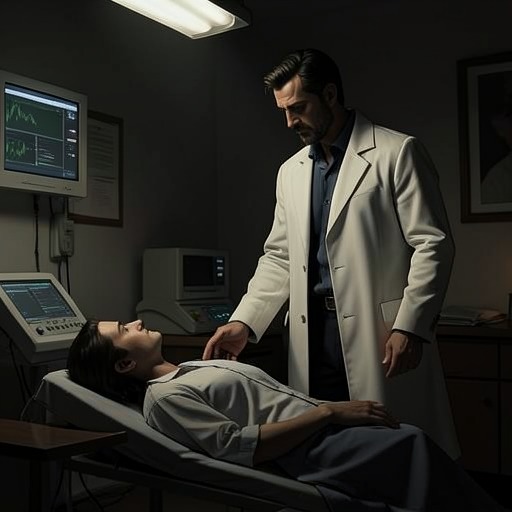
After demobilization, they opened a clinic together. C participated in both its management and practice, while the captain, increasingly incapacitated, could give instructions through medical charts but could not personally examine or treat patients. C says his wartime experience informed his independent work and that he became especially proficient in surgery, including appendectomies. He also describes patients as trusting him and says he studied medical books and specialist reviews. Yet the clinic’s practical operation depended on C’s skill while its formal authority depended on the captain’s qualifications. In C’s account, their partnership was both a means of keeping medical work going and the basis of his unauthorized practice.
Borrowed Credentials and Personal Entanglements
C’s real name was C, but the name under which he practiced and registered with the public-health authorities belonged to the Army Medical Captain, his wartime superior. C says he first used that identity with the captain’s permission. The captain’s credentials gave C a livelihood and professional standing that his own lack of a license could not provide; C explicitly acknowledged that this benefit was one reason he continued. He also maintained that he did not exploit the captain’s drug dependence to obtain the arrangement, and accepted responsibility for his own decision to practice.
Their private lives were also linked through Nana, the captain’s legal wife. C says that he lived with Nana as her common-law partner, with the captain’s understanding and approval; she helped as a nurse and managed the accounts. According to C, the captain feared that C might leave and pressured Nana to establish a relationship with him as a way of keeping him in place. C later describes himself and Nana as having become intimate, but says there had been no conspicuous discord between them until he hired Toyama Yoko as an apprentice nurse. Nana then proposed that she and C live apart, and C agreed. This personal arrangement gives the professional dependency a household dimension: the clinic’s continuity rested not only on C’s work and the captain’s identity, but also on a domestic alliance that eventually changed.
Deterioration and the Transfer of Public Identity
A turning point came in the eighth year of the clinic’s practice. C says that the captain’s speech and conduct became increasingly abnormal, and that reports questioning his sanity reached them. Their use of drugs also drew investigation, placing C in a position of legal risk. After discussing the situation, the two closed the clinic and moved to another city. As the captain’s mental state worsened and his inclination toward suicide became more pronounced, they stopped having him appear at public events. At Nana’s suggestion, C registered himself under the captain’s name. C says the captain agreed to this plan and that, despite formal changes, the actual working arrangement remained substantially the same.
That transfer made their interdependence more complete: C had long performed the medical work, but now also occupied the public identity attached to it. He claims that patients continued to trust him and that he believed no damages claims or prosecution would follow if his guilt were established. He also concedes that patient confidence and his own sense of competence did not make the practice lawful. His affidavit rejects the captain’s view that the absence of a claimant meant there was no crime; C concluded that practicing as a fake doctor was itself an offense and that he no longer had an obligation to continue deceiving the public.
The Corpse and the Limits of C’s Account
In the affidavit concerning a corpse whose cause of death is not established, C identifies the body with certainty as that of the Army Medical Captain. He explains that he uses the title because he had called the man the captain for so many years that it had become habitual. C also acknowledges that the captain had been at risk of suicide for some time and regrets that he failed to prevent whatever happened. This testimony establishes the captain’s identity and C’s sense of responsibility, but it does not establish that the captain died by suicide or specify the cause of death.
The relationship ends, in C’s account, with the collapse of the arrangement that had bound them: the captain’s medical identity had enabled C to practice, while C’s care and work had sustained the captain through illness and incapacity. C’s testimony neither reduces that bond to exploitation nor clears it of self-interest. He describes affection and responsibility alongside the advantages he gained, and recognizes that patient trust, medical skill, and the captain’s consent could not erase the distinction between effective treatment and legal authorization.