The relationship between the box-man narrator and Yamada Yoko (the bicycle girl)
The Box ManThe relationship between the box-man narrator and Yamada Yoko (the bicycle girl) is shaped by a sharp imbalance between what each gives and what each believes has happened. She first appears as a stranger who pays him; at the Hospital, she becomes the nurse who treats him and whose smile draws him toward an impulsive promise. He experiences that encounter as intimacy, then leaves it suspecting he has been deceived, yet unable to hate her. The relation remains unsettled: his wish to repay her and reverse his promise coexists with a voyeuristic desire that increasingly exceeds the limits of his box.
First Encounter and Recognition
The nurse enters the Box Man Narrator’s account while he is concentrating on the sham road. A voice from behind tells him there is a hospital at the top of the slope; white fingertips touch the observation window, and three thousand yen notes are tossed inside. He sees only a retreating bicycle rider, already some distance away. Her low, rasping voice strikes him as incongruous, but what fixes his attention is her movement: the slender, well-proportioned legs propelling the bicycle and the glossy backs of her knees. The sight is so vivid that he later cannot recall the color of her dress.
At first, he separates the girl from the air-rifle attacker rather than connecting them. He tells himself that the rifleman and the girl are distinct people and interprets her hurried departure as modesty about her charitable act. His injured shoulder worsens, however, and he goes to the Hospital at the top of the slope. There he recognizes the bicycle girl as the nurse and learns from the photograph that the doctor is the air-rifle man. The anonymous encounter under the box’s viewing slit thus leads directly into a setting where she is no longer only a figure glimpsed from a distance: she is among the people caring for him.
Treatment, Smile, and the Promise
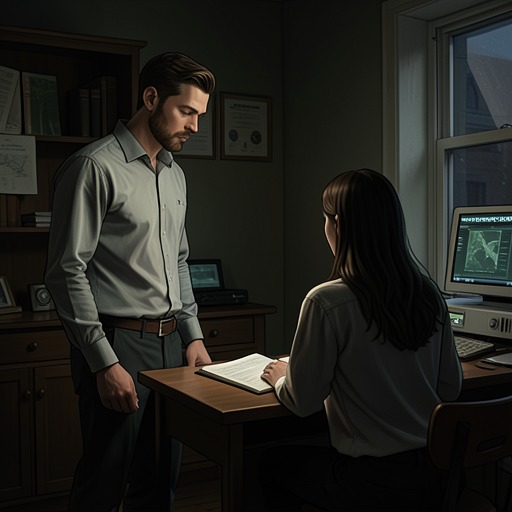
When the Box Man Narrator comes to in a hospital bed, the nurse is peering at him amid the smell of disinfectant and vitamins. He is no longer concealed by the box, and the exposure of his face brings a sense of release. As he tells her miscellaneous details about himself, she responds with an encouraging smile. He experiences that smile as unusually open and fleeting, and it gives him the illusion that she has made a confession of love to him. The account presents this as his perception, not as a confirmed declaration from her.
Under the spell of that response, he feels as if he has taken flight and imagines that he need not return to the box. He makes a promise he does not fully understand: he will buy the box for her from the box man for fifty thousand yen. He even stresses that he would sell it to her for nothing, yet the price and the offer remain tangled in the same impulsive commitment. He considers asking what she intends to do with a box, but her smile leaves him powerless to discuss its practical use. The scene’s movement is from treatment and relief to an imagined intimacy, then to a promise that exceeds what he has thought through.
Withdrawal and the Attempt to Undo the Promise
The apparent closeness does not survive his departure from the Hospital. As soon as he has left, he says, her smile vanishes. Back beneath the bridge, where he has hidden his box, he suffers stomach spasms and vomits for some time. He concludes that he seems to have been drugged without his knowledge and recognizes that he has apparently been taken in. Yet suspicion does not turn into hatred. His inability to hate her remains a distinct part of the aftermath: he can question what happened to him while still clinging to the emotional impression made by her smile.
Later, less than an hour after she has dropped money to him, he approaches her room at night. He intends to speak seriously with her, return the fifty thousand yen, and have her cancel his promise to throw the box away. He also considers whether he could help her in some other way, depending on her response. These plans suggest an effort to recover control of an exchange that he now regards as confused or compromised. But he does not reach her room in the evidence presented here; instead, a light in another part of the building draws his attention and he decides to look inside. His intended repayment therefore sits alongside, rather than resolving, his fixation on seeing her.
Her History and the Unequal Exchange of Looking
The nurse’s account of her past gives the relationship a material context beyond the narrator’s interpretation of her smile. Before taking her present position as an apprentice nurse, she had been a poor art student and earned money by posing for privately run art schools and amateur art clubs. She describes the work as leaving a bitter taste resembling regret, although she also says that modeling was the work she liked best. Two years earlier she had undergone an abortion at the Hospital; after an unsatisfactory recovery, she stayed there without charge for about three months. When a nurse left, she took that woman’s place for no particular reason. Her treatment was included in payment for her work, and she used evenings and time off to paint.
She says that exposing her body as a model gave her excitement and inspired her will to create, and that she would still be modeling if the doctor had not strongly objected. The Box Man Narrator’s account registers this history through his own attraction and judgments, including his disagreement with her explanation of what modeling meant to her. It also records her as someone with work, artistic ambitions, and a history of bodily exposure that cannot be reduced to the role he assigns her in his private fantasy.
That tension becomes explicit when he admits that his desire to spy on her is beginning to exceed what the box can accommodate. He says she has indirectly hinted at a special bonus from her to him as a photographer, in addition to the fifty thousand yen the doctor paid for the box. The hint is reported through the narrator and does not establish exactly what she intends. For him, however, it becomes part of the same unstable knot of money, looking, and imagined intimacy. The box enables his concealment, but the relationship exposes the limits of that concealment: he wants both to retreat from and to pursue her, while his sense of what she has offered remains filtered through his own desire.