Toyama Yoko
The Box ManToyama Yoko is an apprentice nurse whose arrival redirects the Box Man Narrator’s course from concealment under a bridge to the hospital on the hill. She helps him enter a world outside the box, but his interpretation of her kindness shifts between gratitude, romantic hope, suspicion, and an urge to protect her. Her own account of her past gives her a life beyond his gaze, while the narratives surrounding her leave some of her intentions unresolved.
Identity and Background
Yoko first appears on a bicycle, approaching while the Box Man Narrator is hidden inside his box. She tells him that there is a hospital at the top of the slope and puts money through the observation window. Her low, rasping voice surprises him, and the encounter is brief: he has no time to point his camera at her before she rides away. He remembers the movement of her legs more clearly than the color of her dress, a detail that shows how quickly his attention turns her into an object of observation.
At this point, the narrator does not know who she is. The injury in his shoulder leads him to the hospital, where he recognizes the bicycle girl as a nurse and identifies the air-rifle attacker as the hospital doctor. The connection changes the significance of her earlier visit: she is not simply a stranger offering directions and money, but someone associated with the place where the narrator’s injury will be treated.
Work and Earlier Life
In a later account, Yoko tells the narrator pieces of her history. Before taking her present position as an apprentice nurse, she had been a poor art student who earned money by posing for privately run art schools and amateur art clubs. She continued to paint in the evenings and during time off from nursing. Although she said she had found modeling tiring and requiring stamina, she also described it as work she preferred and as an important stimulus to her creative life.
Two years before the account, Yoko had an abortion at the same hospital. Her recovery was unsatisfactory, and she stayed there without charge for about three months. When a nurse left, Yoko took the vacant position for reasons the narrative does not make fully clear. Her treatment was provided in payment for her work, joining her past as a patient to her present employment at the hospital. The narrator judges her artistic work in his own terms, but his assessment does not establish the quality or meaning of her paintings; the account instead makes clear that she continues to paint and that modeling matters to her.
A separate first-person account describes a practitioner who says he hired Toyama Yoko as a new apprentice nurse. He reports that Nana, his common-law partner and assistant, was unhappy about the appointment and proposed that they live apart; he agreed. This account presents Yoko’s arrival as a change within that household as well as a staffing decision, without establishing that Yoko herself sought or caused the separation.
The Narrator’s Encounter with Her
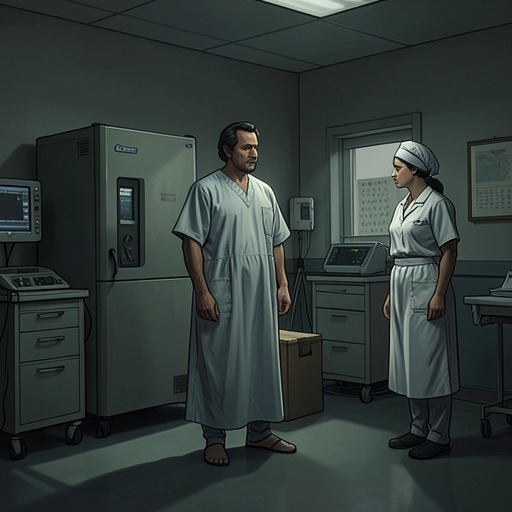
After the Box Man Narrator wakes in a hospital bed, Yoko is looking in on him. Her encouraging manner and smile make him feel released from the box and, briefly, less troubled by being seen without it. He mistakes this emotional response for a possible declaration of love and promises to buy the box from its owner for fifty thousand yen. He even says he would give it to her without charge, but admits that her manner leaves him unable to discuss what she would actually do with it. The promise expresses his own sudden hope more securely than it reveals Yoko’s intentions.
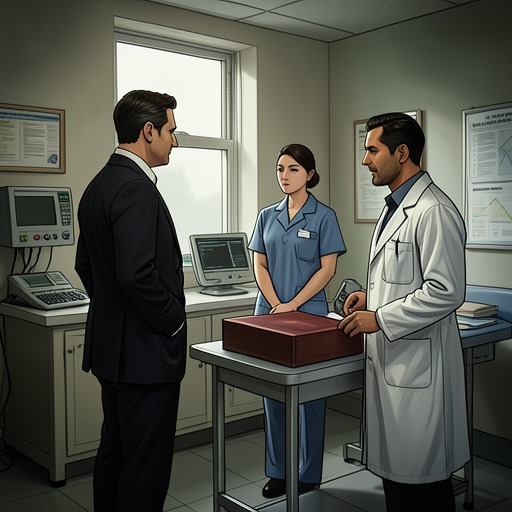
The narrator later recalls that the doctor had paid fifty thousand yen for the box and that Yoko suggested a special bonus from her for him as a photographer. He reads her interest in his photography as provocation. He also thinks she had already guessed that he was a box man without his disguise, based on the air-gun bullet in his shoulder and his raggedly cut hair. These are the narrator’s interpretations, not an explanation Yoko gives of her motives. The distinction matters: he repeatedly turns her actions into clues about a relationship, while the evidence preserves uncertainty about what she intended.
Reversal and Narrative Significance
When the narrator leaves the hospital, he finds that Yoko’s smile has vanished. Back at the place where he hid his box under the bridge, he vomits and concludes that he may have been drugged, but the account does not confirm that this happened or identify who might have done it. His immediate reaction combines a sense of having been deceived with his inability to hate her. The episode therefore reverses the release he felt in the hospital without resolving what passed between them.
Yoko’s role also exposes the imbalance between being seen and being known. The Box Man Narrator watches her closely, recalls selected details, and builds expectations around her kindness; her own history, by contrast, emerges only in fragments she tells him. The novel’s broader image of the box man as a figure people avoid acknowledging sharpens this contrast: Yoko does engage with the hidden narrator, but his attention does not grant him reliable access to her thoughts. She is a nurse, a former art student and model, and a continuing painter, not merely the object of his gaze. The account’s unresolved motives preserve that difference between his intense observation and the limits of what he can know.