Under the Canal Bridge
The Box ManUnder the Canal Bridge is a temporary refuge and writing place for the Box Man Narrator, but hardly a secure one. While he waits there for a prospective buyer to pay fifty thousand yen for his worn cardboard box, the canal, the rain, and the narrow approaches make the setting a study in exposure: he writes, watches, and plans for what might arrive along the embankment.
Setting and Conditions
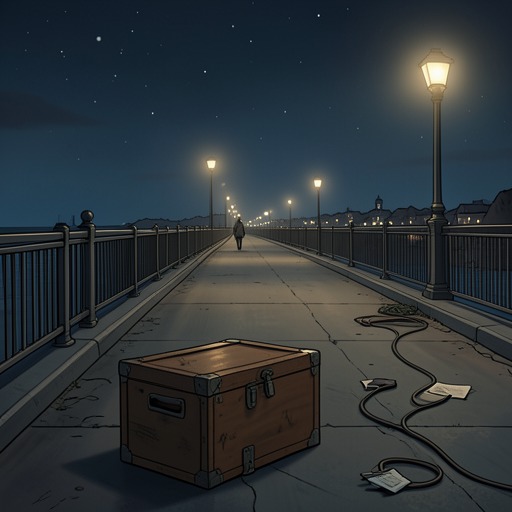
The bridge carries Prefectural Highway Three over a canal. The narrator settles beneath it on a dark, rainy night, among fishery warehouses and lumber sheds, with no homes nearby and no passersby. Truck headlights cross overhead without reaching his position. He uses a flashlight suspended from the box’s ceiling to write, an extravagance by his own standards: people living on the road generally rely on what they can find, and streetlamps usually provide enough light to read while sheltering from rain.
The shelter is imperfect. The bridge girders are high, and the drizzle blows in from every direction; after more than two hours, the narrator still judges the place unsuitable for a Box Man. The rain nevertheless helps him observe through the box’s window: moisture on its vinyl covering softens the surface and improves visibility. From behind that aperture he can see the concrete embankment, the faint lights of a small freighter, and anyone who crosses the exposed pavement.
The Waiting Place
The narrator is under the bridge because a woman has offered to buy his old box for fifty thousand yen. He is unsure whether the offer is credible, but says he had no particular reason to distrust her; her presence has already unsettled his customary reserve. The site was partly her choice, although he had suggested it too. His remark that her danger is his danger gives the meeting a shared, uncertain stake. The evidence establishes that he is waiting for the transaction, not whether it is completed beneath the bridge.
The canal-side details sharpen that uncertainty. At the foot of the bridge stands a stone Jizo wearing a red flannel bib, apparently placed in memory of a child who drowned. Nearby, a freshly painted sign prohibits playing in the water, and stone steps descend to a boat landing upstream. The signs of danger are not abstract: the narrator watches the tide, the embankment, and the water as practical conditions that could determine whether he can remain or escape.
Surveillance and Preparation
The box’s observation window converts the bridge shelter into a lookout. A stray cat crosses the pavement, and the narrator can distinguish its matted coat, swollen belly, and torn ears while continuing to write. This close observation reassures him that the buyer cannot easily surprise him. The position offers concealment, but only through continuous attention to what is visible beyond the box.
He also works out how to protect his notes if the meeting turns threatening. He would put them in a vinyl bag, seal it, wrap the opening with doubled wire, attach a fist-sized stone with twisted paper, and throw the package into the current. He estimates that this would take about half a minute, while an approaching person would need two or three minutes to descend the stone stairway, cross the slippery slope, and reach him. The bridge’s approaches therefore become part of his defensive calculation: the water might carry his record away before an intruder could seize it.
A Precarious Base
The location exposes the tension between the Box Man’s careful routines and the insecurity of life on the road. Elsewhere in his practical instructions, he describes hanging a radio, mug, thermos, flashlight, towel, and small bag inside the box, and using layered canvas to hold the box in place while leaving room to move. Under the bridge, even such adaptations cannot make the shelter fully weatherproof or safe; the narrator’s plan depends instead on the window, the distance to the landing, and the current below.
The bridge is also a temporary point in a mobile existence rather than a settled home. The narrator later considers tearing the box into three or four pieces so it can be discarded as ordinary rubbish before going back to the hospital at eight for negotiations. His account of city life elsewhere describes how the Box Man learns to forage and become accustomed to crowded districts, until time seems to circle around him. Under the bridge, that larger practice contracts into an intense watch over a single pavement and a meeting whose outcome remains uncertain. The place makes the box’s double character visible: a shelter from ordinary view, yet a fragile position from which the narrator must keep watch.