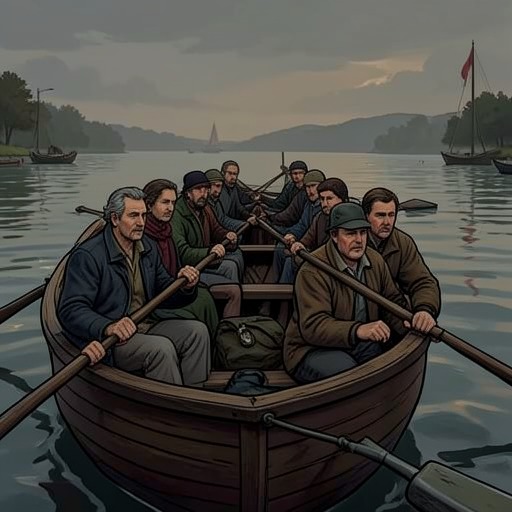
“Where is the spiritual value of rowing … The losing of self entirely to the cooperative effort of the crew as a whole.”
The Boys in the BoatGeorge Yeoman Pocock’s question, “Where is the spiritual value of rowing? . . . The losing of self entirely to the cooperative effort of the crew as a whole,” gives collective action a moral and spiritual meaning. It appears as the epigraph to the chapter following the Olympic final, where the Washington crew’s victory is followed not by a solitary celebration but by gestures that pass recognition around the boat. The expression connects the discipline of rowing to a larger claim: achievement belongs to the cooperation that makes a crew move as one.
A Definition of Rowing’s Value
The expression rejects the idea that rowing’s deepest value lies only in speed, strength, or victory. Pocock locates it in the loss of individual self-importance within a cooperative undertaking. The wording sets up a contrast between the individual and the crew, but does not erase the individual’s effort: each oarsman contributes, while the result depends on those contributions being coordinated. In that sense, the phrase describes both a sporting method and an ethical ideal.
Its placement gives the claim particular weight. The epigraph introduces a chapter that opens with the boys already certain they have won, then follows them as they row past the grandstands and receive the laurel wreath. The movement from the question of spiritual value to the concrete aftermath of a race makes the idea legible through action: the victory is theirs collectively, even as the scene preserves the particular gestures of individual crew members.
A Sport of Public Attention and Unequal Access
The ideal took shape in a sport that was both a major public spectacle and an elite tradition. In the 1920s and 1930s, collegiate crew drew press coverage and crowds on a scale comparable to baseball and college football. Leading sportswriters covered major regattas, millions followed crews through the season, and devoted fans collected crew trading cards. In the East, rowing was cultivated by private schools modeled on institutions such as Eton College and was associated with a path into prestigious universities.
That prominent place in public life did not mean rowing was equally accessible. The long-established regatta at Poughkeepsie drew as many as 125,000 spectators in 1929, while eastern colleges dominated its results for much of the early twentieth century. Western crews faced the cost of transporting both athletes and delicate racing shells, as well as condescension from audiences accustomed to seeing the sons of powerful and wealthy families in the boats. The collective ideal celebrated what a crew could accomplish together, but the institutions around the sport remained marked by class distinctions.
The exclusion was explicit at the Henley Royal Regatta. Its rules barred anyone who had worked for wages as a mechanic, artisan, or labourer, and the Australian policemen who arrived to compete were deemed labourers and turned away. Their refusal of that judgment sent them on to Berlin, intent on defeating the British crew. Against this background, rowing’s language of shared effort sits beside a history in which working people could be denied entry to prestigious competition because of their occupations.
Western Competition and Collective Recognition
The expression also resonates with the rise of western collegiate rowing. The University of California, Berkeley, and the University of Washington had competed since 1903, drawing tens of thousands to their annual April regattas. Yet western programs had little funding, their coaches were paid far less than eastern coaches, and neither school had money for recruitment or a substantial base of wealthy patrons. The western crews generally raced one another, while the center of national collegiate rowing remained in the East.
The Washington crew’s 1923 victory at Poughkeepsie began to challenge that imbalance. In the home stretch, Washington raced Navy bow to bow; coxswain Don Grant raised a red flag cut from a Cornell banner to signal the crew to give everything. Stroke oar Dow Walling, rowing despite a leg swollen by three boils, raised the rate, and Washington secured the West’s first Intercollegiate Rowing Association victory. The scene makes the achievement depend on a group’s coordinated response, while also showing the distinctive acts and physical costs within that group. It gives Pocock’s later formulation a history of hard-won recognition, not merely an abstract sporting ideal.
The Ideal in the Victory’s Aftermath
After the Olympic final, the Washington boys rowed slowly past the grandstands to polite applause. Al Ulbrickson and George Yeoman Pocock pushed through the crowd to reach them, while Royal Brougham hurried to write what he regarded as the sports story of his career. His account would not appear the next morning: a news writers’ guild picket line meant there would be no edition of the Seattle Post-Intelligencer.
At the float in front of Haus West, an Olympic official shook Bobby Moch’s hand and presented Don Hume with an enormous laurel wreath. Unsure what to do with it, Hume lowered it over his head, then passed it to Joe Rantz; Joe passed it to Shorty Hunt, and it continued down the boat to Roger Morris. The wreath moved from rower to rower rather than settling on one person. That small, slightly awkward ceremony gives visible form to Pocock’s claim: the crew’s honor is shared, and the victory cannot be reduced to a single oarsman. When Ulbrickson arrived, breathless and short of words, he pointed to the wreath and asked Roger where he had got the hay. The joke punctured the ceremony’s grandeur without undoing its meaning: the crew’s collective achievement was present in the boat, and in the way its members passed recognition among themselves.