Al Ulbrickson
The Boys in the BoatAl Ulbrickson was the exacting, famously reticent coach who took the University of Washington crew from regional rivalry to Olympic gold. His authority rested not on speeches but on disciplined observation, carefully timed decisions, and a belief that a boat’s success belonged to the crew as a whole. In 1936, he committed himself publicly to a goal he had rarely voiced, then assembled and guided a crew whose route to Berlin tested both his judgment and his command.
Identity and Background
At thirty, Ulbrickson was a tall, muscular former oarsman whose dark three-piece suit, crisp white shirt, tie, and fedora made him look unmistakably like the man in charge. He often turned a Phi Beta Kappa key on its lanyard, a small, repeated gesture that reinforced the boundary he maintained between himself and the boys he coached. His bearing was deliberate: many of the rowers were nearly his age and as strong-willed as he was, so he made authority visible before he spoke.
That authority grew out of a background far removed from the image of rowing as an eastern gentleman’s pastime. Born in the Montlake district and raised on Mercer Island, Ulbrickson came from a family of modest means. To attend Franklin High School, he rowed a small boat two miles to Seattle and two miles back each day for four years. He excelled at school but found little challenge in its classrooms; at the University of Washington, he found demanding work both academically and athletically. After graduating in 1926, he joined the university’s coaching staff, first as freshman coach and then as head coach. Before that appointment, he had stroked Washington crews to national championships in 1924 and 1926.
His public manner was so spare that sportswriters struggled to obtain a quote and called him the “Dour Dane.” Half Danish and half Welsh, he was known for an inscrutable expression and for commanding respect without raising his voice. His few words could land with unusual force because he used them sparingly. He forbade his rowers to smoke, curse, or drink, although he was known occasionally to do all three himself when safely out of view. The contrast suggests a coach who treated discipline as a rule of command, not a claim to personal perfection.
Coaching Method and Competitive World
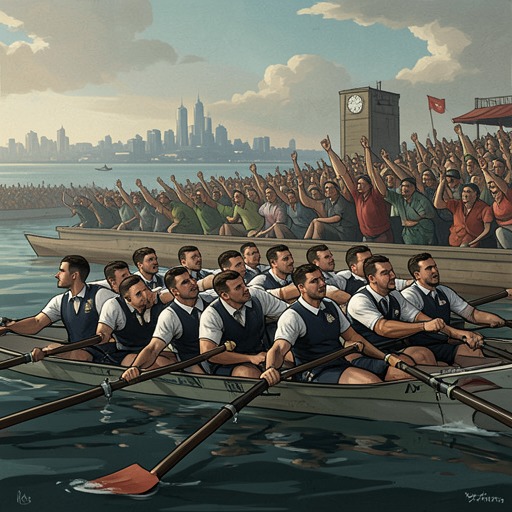
Ulbrickson’s work unfolded in a sport whose prestige and resources were unevenly distributed. Collegiate rowing drew enormous crowds and national press, but eastern private schools and universities held much of its cultural authority. Washington and the University of California, Berkeley, had built a fierce western rivalry, yet both programs struggled for funding and recognition. Their coaches earned far less than eastern counterparts, neither school could afford recruitment, and western crews largely raced one another. Royal Brougham hoped that a shift in rowing’s center of attention toward the West might bring distinction to Washington and its city; the possibility that it could instead settle in California sharpened the rivalry.
The class distinction was visible at the Intercollegiate Rowing Association regatta at Poughkeepsie. Western crews had faced curiosity and condescension as well as practical obstacles: transporting rowers and delicate shells across the country was expensive. Eastern spectators were accustomed to seeing the sons of prominent and wealthy families, not farmers, fishermen, and lumberjacks, in racing shells. At Henley Royal Regatta, the rules went further, excluding people who had earned wages as mechanics, artisans, or laborers; even policemen were classed as laborers. Ulbrickson and George Pocock regarded the British crew as the boat to beat in Berlin, but the broader rowing world made the stakes larger than a contest of speed: access, money, and social standing shaped who could compete.
Within that world, Ulbrickson watched crews closely and kept a private record of what he saw. During a wet winter, he complained in his logbook about bad weather and, more pointedly, a lack of spirit among the older rowers. He recorded too many social distractions and complaints, too little energy, and efforts that seemed unlikely to improve through mere wishing. The notebook offered a sharper view of his judgments than his controlled public manner did. In a training race, he gave the junior varsity a three-length head start and stopped the freshmen at two miles so coaches could assess their time under racing conditions; the varsity and junior varsity continued to three miles. Handicaps and distances were instruments for comparison, not decoration.
He also understood that competition could be decided psychologically. After Joe Rantz watched a varsity race, the lesson was that beating an equal or superior opponent might require more than giving everything from the first stroke: a crew could conserve something, reveal it at the decisive moment, and unsettle its rival. Ulbrickson’s approach to racing thus joined physical preparation to the management of expectation. His later patience with a crew’s apparent weakness, and his ability to change course when the evidence shifted, belonged to the same strategic outlook.
Testing the Sophomores
When the freshmen who had won at Poughkeepsie moved into the upper classes, Ulbrickson saw a possible varsity crew in their unusual size and character. They had won with striking ease, averaged 190 pounds, and possessed considerable raw power. Their rowing mechanics still needed work, but he considered their earnestness, hard-working habits, and relative malleability promising. He summoned the sophomores to assemble on the ramp, took a position slightly above them, straightened his tie, and twirled his key before speaking. The staging reflected his practical understanding that commanding tall, determined rowers required every available advantage.
He announced a change in training: rather than easing into winter work and concentrating first on technique, the crews would row all out from the outset, regardless of weather. They would race in set lineups rather than continually changing combinations, with the highest stakes attached. Ulbrickson made the aim explicit: Washington had won major American honors but had never taken part in the Olympic Games. The change turned the season into a sustained contest among the crews and tied daily training to the possibility of Berlin.
The sophomores did not immediately justify his confidence. When they began struggling even against junior-varsity crews, Ulbrickson questioned whether they were the same rowers who had dominated at Poughkeepsie. He called George Lund, Chuck Hartman, Roger Morris, Shorty Hunt, and Joe Rantz into his office for a talk. Yet after dinner at the Hotel Oakland, despite repeated defeats and the junior varsity’s anger, he chose to race the sophomores as the varsity. He apologized for the decision but said he could not help making it. To the Associated Press, he described them as potentially the best crew he had coached; in his logbook, he admitted how uncomfortable it was to make the call on the eve of racing.
His commitment remained conditional. On the first day of Poughkeepsie training, he told reporters the sophomores might not retain varsity status: experienced older rowers deserved a chance at a national championship before graduating, and Ulbrickson regretted having disappointed them in Oakland. He also had competitive grounds for keeping the question open. The older crew had dominated its Oakland opposition, while the sophomores’ victory had been extremely narrow. On June 12, six days before the regatta, the sophomores fell apart when the boats raced head-to-head and finished eight lengths behind. Ulbrickson made their demotion official and sent the older rowers as varsity. It was a serious blow to Joe and his crewmates, but to Ulbrickson the margin promised strength in the varsity event—the race he most wanted to win, and one Washington had not won since 1926, when he himself stroked the crew.
The Olympic Commitment and Selection
In September, Ulbrickson did something strikingly unlike his usual reticence. Early one morning, his wife, Hazel, found him at an old typewriter drafting a statement for The Seattle Times: Washington’s eight-oared crew would win gold at the 1936 Berlin Olympics. She was astonished; he seldom declared his hopes even at home. He folded the statement and sent it. The announcement made his private ambition a public commitment, one that would require him to overlook personal preferences, outwit Ky Ebright, find money in a lean year, and make fuller use of George Pocock’s expertise.
The promise did not settle the lineup. In March, one crew repeatedly proved itself in races against the others: on March 22 it led from start to finish; the next day it won one race by seven lengths and another by three or four. On March 27, in a late snowstorm, it finished three lengths ahead. In a two-thousand-meter sprint that afternoon, Don Hume raised the stroke rate to forty and the rest of the crew followed cleanly. Ulbrickson elevated the boat to varsity status on March 28. He waited a few days to tell the press, but the decision fixed the crew with which he would pursue the Olympic goal.
Preparation extended beyond lineup selection. On the train east, the rowers had deliberately gained three or four pounds; Ulbrickson and Tom Bolles then worked them at a low rate over long distances to bring them back toward racing weight and condition for June 22. The coaches’ plan had to contend with the cooking of Mrs. Calimar. Meanwhile, reaching the games was itself uncertain. The American Olympic Committee lacked funds, and athletes in several sports were being asked to finance some or all of their travel. The rowers learned that the winning crew might not be sent. Ulbrickson was stunned and angry: the university had already scraped together money to get the boys east, and the crew members could not pay their own way. They were working-class Americans, not heirs able to absorb the cost.
The response came through a broad public collection rather than a single wealthy patron. The Seattle Times started the drive with $500; donations ranged from $1 from an anonymous giver to $50 from Standard Oil. Hometowns contributed too: Montesano and Bellingham each sent $50, Olympia sent $299.25, and Sequim sent $75 for Joe Rantz. Volunteers sold $1,523 in fifty-cent tags on the first day. On the second, the chairman of the Seattle Chamber of Commerce sent Ulbrickson a certified check for $5,000. The episode exposed the financial barriers surrounding amateur sport while making the crew’s Olympic passage a collective undertaking.
Berlin: Command Under Pressure
At Poughkeepsie, Ulbrickson’s attention remained on what the crew had not yet shown. Washington drew lane seven, exposed in the middle of the river, while California drew lane one, sheltered by the railroad embankment. In the observation train, Ulbrickson sat apart, chewing gum and watching Joe. As the race unfolded, the Washington boat appeared far behind. The press car’s observers urged Bobby Moch to increase the pace, but Ulbrickson stayed silent: he expected Moch to make the planned move. In the failing light, the crew’s white blade tips were the clearest sign of its steady rhythm, still at twenty-eight strokes a minute.
When the result was certain, Ulbrickson told reporters that the boys had made it close but had won, then conceded that the coxswain might have known what he was doing. The praise carried a second purpose. The crew still had to race California in two two-thousand-meter sprints for the right to represent the United States, and Ulbrickson did not want victory to make the rowers complacent. He was also displeased by Moch’s insubordination and needed to reinforce that he remained in command. His public account of the season’s success, however, put individual distinction aside: he credited the crew’s absolute confidence in one another and its cooperation, rather than any single rower, including Hume.
At Grünau, Hume’s fever returned on the morning of the Olympic race. Ulbrickson decided he could not row and told the crew that Don Coy would take the stroke position. As the boys went upstairs to gather their gear, he called after them to bring Hume along. The instruction preserved the ill rower’s place with his teammates even though he could not occupy his seat. It also gave a brief, human counterpoint to the exacting substitutions and selection decisions by which Ulbrickson had built the boat.
From a balcony beside Haus West, Ulbrickson initially had a restricted view of the course: trees and buildings hid the nearer lanes. When he could see Germany and Italy leading, he kept his eyes on the American boat on the far side, trying to read Moch’s decisions. As the crowd chanted for Germany, he remained motionless and expressionless, a cigarette in his mouth, expecting Hume to pitch forward over his oar at any moment. Once the Washington crew’s victory was certain, he and George Pocock hurried down from the balcony and pushed through the crowd to reach the rowers. The reserve and composure that had marked his coaching now gave way to urgency: he wanted to get to the crew whose long campaign he had directed.
Later Career and Significance
Ulbrickson coached at Washington for another twenty-three years. His varsity crews won six Intercollegiate Rowing Association titles, and his junior-varsity crews won ten. In 1956, he was inducted into the National Rowing Hall of Fame in the same year as Tom Bolles, Ky Ebright, and Hiram Conibear. Washington remained among the leading collegiate rowing programs during most of his tenure, a measure of the institution he helped sustain beyond the Olympic season.
When he discussed retirement with reporters in 1959, he recalled many achievements, but among the first was the day in 1936 when he put Joe Rantz in his Olympic boat and watched it take off. That recollection gathers the central tensions of his career into one decision: a coach shaped by working-class effort, a demanding program in a sport marked by unequal resources, and a crew whose composition could not be settled by reputation alone. His legacy rests not just on the gold medal, but on the sustained judgment, discipline, and mutual confidence that made the boat possible.