Bob Green
The Boys in the BoatBob Green is a returning sophomore in Joe Rantz’s championship freshman crew, now caught between the promise of that unit and the harder judgments of varsity competition. In the new season he rows at six in the nine-man boat, but his most consequential contribution is vocal: his habit of shouting encouragement, once tolerated within the crew, gives a rival coxswain a way to provoke the sophomores into losing their composure.
Identity and Place in the Crew
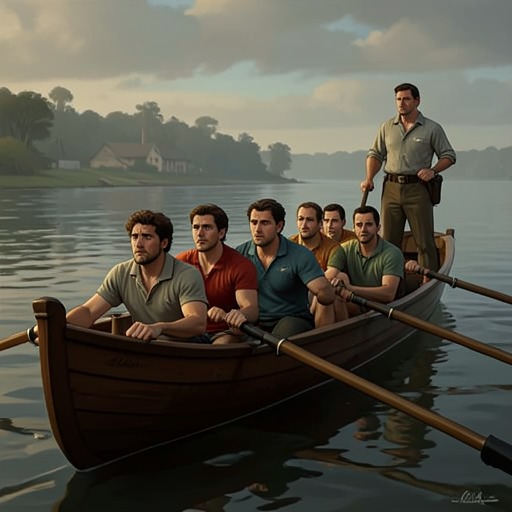
When Al Ulbrickson posts tentative rosters for the new year, four of the five possible varsity boats mix rowers from different classes and crews. The exception is Joe’s intact freshman-first boat from the previous season. Green is listed at six, behind Delos Schoch at five and ahead of Roger Morris at seven; George Morry remains coxswain, and Joe rows at three. The continuity matters: the former freshmen have returned together, not been scattered among the other lineups.
Their placement, however, complicates any simple reading of that reunion as a promotion. Ulbrickson puts the intact sophomores in the fifth boat, the lowest rung in the program, even as the shared lineup suggests that he has unusual confidence in them as a group. The boys welcome rowing together again because they seem to do it well, but their championship has not protected them from demotion. The mixed signal leaves them intimidated, and their earlier swagger fades. Green’s later race-day shouting belongs to this unsettled position: the sophomores have reason to value their collective identity, but must now prove it under a more demanding coach.
Encouragement Becomes a Vulnerability
Green gets excited during races and calls encouragement to his crewmates. The habit breaks with ordinary shell-house protocol, under which the coxswain is generally the only person speaking in the boat. More practically, another voice can confuse the stroke. Yet Green’s outbursts had seemed to help the sophomores the year before, and Morry, their usual coxswain, had accepted them in good humor. The narrative therefore presents the habit not simply as a breach of discipline but as something that had worked in one crew and setting.
The same behavior irritates older rowers in other boats, especially Bobby Moch, a junior coxswain whose JV crew appears to be a leading varsity contender. As head-to-head trials begin in February, Moch recognizes that Green’s enthusiasm can be turned against its source. When the boats draw alongside one another, Moch quietly cues his own stroke oar to prepare a burst of effort. Meanwhile, Green is loudly urging the sophomores on. Moch then directs his megaphone toward their boat and announces that Green has opened his mouth again, making the provocation audible just as his own crew begins to surge.
Moch’s Counterattack and the Crew’s Response
The tactic works because it converts Green’s calls from encouragement into a distraction. Angered by Moch’s taunt, Green shouts still more loudly. Morry answers with his own instruction to take ten big strokes, but the boat does not recover its coordination. The sophomores dig their oars too deep or too shallow and fall out of time, trying desperately to close the distance. The result is not a failure of effort: they are working hard, but their effort has ceased to be synchronized.
The pattern recurs whenever Moch tries it. The sophomores lose their cool together, and their breakdown becomes visible in their poor form and falling out of contention. Green’s reaction is one part of that collective response, not the sole cause assigned to him: the account emphasizes the whole boat’s anger and disorganization. Joe, in particular, takes the episode as another joke at his expense, as though the maneuver were designed to show him up. Moch, by contrast, sits in the stern looking back at the struggling sophomores, chuckles, and waves them off. His repeated success establishes him as a perceptive rival rather than a merely louder one.
Individual Impulse and Collective Rowing
Green’s episode anticipates Al Ulbrickson’s diagnosis of the squad’s deeper difficulty. While his logbook records technical faults among individual rowers—including problems in the timing of Joe Rantz’s and Chuck Hartman’s arms and in when several men catch the water—Ulbrickson concludes that technical corrections alone do not explain the impasse. He has more good individual men than on any squad he has coached, but the boats too often contain individuals rather than functioning crews. His efforts to correct personal faults while preaching teamwork can leave the boys retreating into separate, sometimes defiant worlds.
Within that larger tension, Green’s shouting has a double significance. It began as a form of support that seemed compatible with the sophomore boat’s success; against Moch’s calculated provocation, it becomes an opening through which irritation spreads and shared rhythm breaks down. The narrative does not present Green as a villain or establish that he abandons the habit. Instead, it places his conspicuous voice beside the larger challenge facing the crew: individual drive can add energy, but it cannot substitute for the coordinated response that makes a boat move as one.