Bobby Moch
The Boys in the BoatBobby Moch was the coxswain whose tactical intelligence helped turn Washington crews into disciplined, dangerous competitors. Small enough to sit in the stern with a megaphone, he controlled more than the cadence: he read his rowers, watched opponents, and altered a race plan when the water demanded it. His defining skill was knowing when to make a crew work harder and when to hold it back. That judgment carried him from junior-varsity contests in Seattle to the pressure of the Olympic course, and later into a career that joined coaching with law.
Identity and the coxswain’s work
In the rowing world described in the book, Moch competed during a period when collegiate crews drew crowds and extensive press attention. The western programs of Washington and the University of California, Berkeley had developed a following through their annual rivalry, even as western crews struggled for funding and recognition against established eastern colleges. The Intercollegiate Rowing Association regatta at Poughkeepsie had long been dominated by eastern schools. When Hiram Conibear first took a Washington varsity crew east in 1913, its third-place finish startled spectators accustomed to eastern supremacy. Moch’s career unfolded in a sport where a coxswain’s judgment could shape both a boat’s performance and its public reputation.
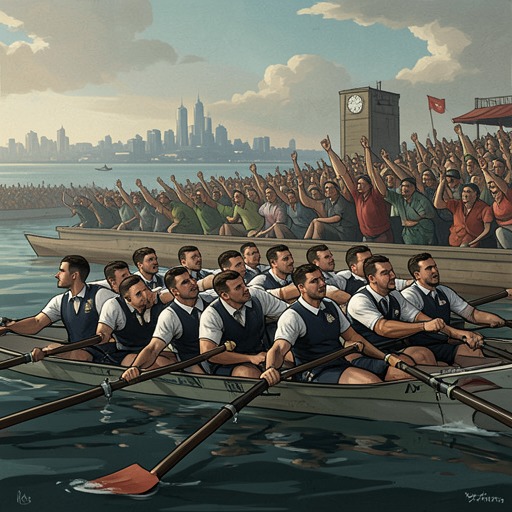
The coxswain’s authority began as soon as a shell was launched. The coxswain was responsible for the boat’s physical and psychological control, knew the rowers’ strengths and vulnerabilities, and tracked opponents’ habits and likely surges. A coach supplied the race plan, but the coxswain had to carry it out amid changing conditions—and respond when those conditions made the plan unsuitable. Moch’s work repeatedly demonstrated that this role depended on observation and timing as much as volume. He could project commands through a megaphone, but his greater advantage was understanding how a crew would react to them.
Junior-varsity contests and tactical provocation
Moch’s competitive resourcefulness was visible when Washington boats began racing head-to-head for varsity status. In one junior-varsity boat, he faced the all-sophomore crew that included Joe Rantz. Bob Green’s loud exhortations irritated the older boys, but Moch turned the contrast between Green’s shouting and his own quiet preparations into a tactical opening. He instructed his stroke oar to wait, then to deliver a set of powerful strokes. At the right moment, he used his megaphone to tell the sophomores that Green had started up again and urged them to pass.
The provocation worked because the sophomores responded collectively but lost their coordination. As Green shouted more loudly, George Morry, coxing the other boat, called for ten hard strokes. The crew’s anger and haste disrupted its form: the rowers pulled out of time and let their blades go too deep or too shallow. Rantz, for whom the episode seemed another attempt to make him look foolish, was caught in the same breakdown. Moch’s crew accelerated while its opponents struggled to recover. Moch looked back, laughed at their sudden loss of form, and waved casually as they dropped out of contention. The pattern established him as more than a loud motivator: he could provoke an opponent into defeating its own purpose.
His own boat contained rowers whose abilities were still emerging. Jim McMillin, nicknamed Stub, had not stood out in the second freshman boat the previous year, but now found a place in Moch’s lineup. At six feet five inches, he supplied leverage and power in the middle of the boat, and he continued to row hard whether the crew was winning or losing. He believed he belonged in the first boat. Chuck Day, another promising sophomore, was also among the crew’s surprises. Moch’s boat could therefore be understood not only as a tactical unit but as a setting in which a rower’s potential became more apparent.
As February turned to March, Al Ulbrickson abandoned fixed lineups and moved rowers among the boats, seeking a varsity combination that would decisively outpace the alternatives. He tried removing Rantz from the all-sophomore boat; it slowed, and Rantz returned the next day. Ulbrickson also tested McMillin in the number-seven seat, moved Shorty Hunt into Moch’s junior-varsity boat, and continued rearranging the crews. These experiments made the junior-varsity results consequential: the racing was also a contest for future places in the lineup.
At the 1935 Pacific Coast Regatta, the junior-varsity race gave Washington’s older boys an occasion to answer their demotion and establish themselves for what might come next. At 4:10 p.m., they lined up south of Jack London Square, three miles from the finish. California took an early lead and settled into a stroke rate of thirty-two. With Moch calling the cadence and McMillin powering the middle of the boat, Washington methodically drew level and then moved ahead. By halfway, the Washington crew had open water between itself and California; as it crossed beneath the bridge, its lead had grown to eight lengths and was still widening. The result gave Moch a striking demonstration of how steady execution could convert a slow start into overwhelming separation.
Codes, discipline, and race management
Moch developed a private vocabulary for his crew, much of it intended to keep opponents and coaches from learning what a command meant. Some signals shortened practical instructions: SOS meant to slow the slides, while OK meant to keep the boat on keel. Others carried more pointed competitive messages. WTA meant to beat the opposing crew; BS meant to beat the sophomores; BAB meant to beat Al’s babies. These codes made communication part of his tactical system. A call could guide the boat’s movement, reinforce a shared purpose, or conceal the crew’s intention from those listening nearby.
Moch also understood that a coxswain’s words could shape how rowers interpreted the race. In a later Poughkeepsie contest, Washington held a comfortable lead over Navy through the final mile and a half. The sophomores rowed in a long, coordinated line and finished two lengths ahead. Bombs on the bridge signaled their victory, and Royal Brougham praised the crew on the radio, describing the rowers as though they could continue downriver to New York City without tiring. The image matched the qualities Moch’s methods sought to produce: a crew that appeared composed, coordinated, and capable of sustaining its effort.
His judgment was not simply to urge maximum speed. When Washington’s opponent was ahead and rowing in the mid-thirties while maintaining its lead, Moch told Don Hume to reduce the stroke rate to twenty-nine. In another race, after seven boats had remained abreast for five strokes, Washington eased up and let the field move ahead. Moch settled his crew at twenty-eight and chanted the instruction to conserve power. The tactic required the rowers to accept an apparent setback while trusting that their effort was being reserved for a later demand.
At one stage he described a four-length gap to California as only one length. He then gave the crew successive targets: ten strokes for Ulbrickson, ten for George Pocock, and another ten under a fabricated claim that California was coming up. The calls brought Washington past Columbia and toward Navy in second place. When Moch then ordered the decisive increase, Hume raised the rate from thirty-five to thirty-six and then thirty-seven. Rantz matched the stroke smoothly, and the boat began to swing forward. Washington passed Navy. Moch’s deception was not an incidental flourish; it was a means of translating a distant objective into immediate, manageable efforts.
National and Olympic pressure
Washington’s victory at Poughkeepsie made the varsity crew national champions and completed a sweep of the Hudson. The comeback drew unusually emphatic notice from sportswriters. Robert Kelley of The New York Times called it a high mark in the regatta’s history; other reports characterized the race as spectacular, brilliant, and a demonstration of psychology, nerve, and rowing intelligence. James Burchard singled out Moch’s intelligence as the best oar in the Washington boat, while Royal Brougham characterized the coxswain’s performance as cold-blooded. Moch’s role became legible beyond the crew itself: the race was remembered not only as a physical contest but as an exercise in reading, nerve, and control.
At the Olympics, Washington’s opening position was precarious. The American crew got away badly, and an oar washed out near the start. Japan surged into the lead at nearly fifty strokes per minute; the British crew, coxed by Noel Duckworth and led by Ran Laurie, settled into second. The United States was last, rowing at thirty-eight. With 250 meters remaining, Moch called for ten strokes, and the American shell began to move past the British boat. Duckworth and Laurie raised their rate to forty, briefly holding their position, but Moch called on Hume to raise the rate again. The American boat resumed advancing. The passage echoes Moch’s earlier racing methods: he responded to the actual positions of the boats, then asked for a greater effort at the point when the finish made it necessary.
The Olympic final tested his control under more punishing circumstances. At the start, Moch and Duckworth were both focused on lining their boats up straight, calling instructions forward and checking the start. Once underway, Moch repeatedly urged Hume to raise the rate, but Hume continued at thirty-five and appeared unable to respond to the calls. Moch could not catch his eye, and the American crew was losing ground to nearly every boat. As the race approached its conclusion, Moch looked toward the finish sign and calculated what effort was needed to get ahead of the boats to his left. With Germany and Italy surging, he knew the exhausted rowers were already giving everything they had. He struck the wooden knockers on the tiller lines against the ironbark boards fixed to the hull, trying to communicate through vibrations even if the crew could not hear him. The episode shows the limits as well as the force of his command: exhortation could not make fatigue disappear, so he searched for another way to reach the rowers.
Later life and significance
Moch’s post-collegiate life continued to join athletics and professional ambition. He entered law school, married, and remained an assistant coach at Washington until he was offered the head-coaching position at MIT in 1940. He accepted and arranged a transfer to Harvard Law, holding the coaching job while completing a demanding legal education. By 1945 he had passed the bar examinations in both Massachusetts and Washington and returned to Seattle to practice law. He later built a successful legal career and won a case before the U.S. Supreme Court.
Across these settings, Moch’s distinguishing quality was the ability to manage a group through changing conditions. In junior-varsity races, he made an opponent’s temper work against it; in championship contests, he concealed meanings and broke a long race into immediate calls; under Olympic pressure, he adjusted effort and sought communication when ordinary commands failed. His story makes the coxswain’s work visible as a form of leadership grounded in attention: to the crew’s rhythm, to the opposition’s behavior, and to the difference between effort that should be spent now and effort that must be saved.