California crew
The Boys in the BoatCalifornia crew, the University of California, Berkeley’s rowing program, was both a formidable racing outfit and one half of the West Coast rivalry that challenged the eastern hold on American collegiate rowing. Under Ky Ebright, its crews won Olympic gold and repeated national titles; against Washington, their contests could turn on selection decisions, racing pace, and the crews’ ability to find a common rhythm. The program’s rise made western rowing impossible to dismiss, even as travel costs and the sport’s inherited social hierarchies continued to shape who could compete and where.
Identity and the western rivalry
In the 1920s and 1930s, collegiate rowing drew crowds and sustained press attention on a scale that could rival baseball and college football. Eastern institutions such as Harvard, Yale, and Princeton drew on an elite tradition modeled on British schools including Eton. In the West, California and Washington developed a heated rivalry dating to 1903. Their annual April regattas attracted tens of thousands of students, alumni, and local spectators, and victories over eastern crews gradually raised the standing of both programs.
That progress did not erase the imbalance between regions. Western coaches received a fraction of eastern coaches’ salaries, and California and Washington lacked the recruitment funds and wealthy patrons enjoyed by many eastern institutions. The sport’s national center remained among eastern universities and rowing venues. Royal Brougham hoped that a Washington rise might shift that center to Seattle, while recognizing that California could claim the same prize. California was therefore not merely a recurring opponent: its success made the struggle for western recognition a contest between neighboring programs as well as against the East.
Poughkeepsie and national recognition
Poughkeepsie, the site of the Intercollegiate Rowing Association regatta, embodied the national hierarchy California and other western crews sought to challenge. The regatta had grown from a long history of prominent American rowing contests into a major sporting spectacle, attracting as many as 125,000 spectators in 1929 and millions of radio listeners. Yet eastern colleges dominated for much of the early twentieth century. Stanford’s 1912 appearance ended in sixth place; Washington’s first eastern campaign, in 1913, produced a startling third. California, Stanford, and Washington returned only occasionally in the following decade: transporting crews and delicate shells across the country was expensive, and western rowers encountered curiosity, condescension, and sometimes open derision.
California’s later national prominence was built within this uneven landscape. The book identifies the Bears as warm and well accommodated during a Poughkeepsie campaign: their new boathouse on the town side of the river had city water, hot showers, dining and cooking facilities, electric lights, and roomy sleeping quarters. Washington’s party, by contrast, faced a leaky boathouse, cold river-water showers, meager meals, and crowded rooms. Such differences did not decide a race by themselves, but they made visible the unequal conditions under which crews prepared and traveled.
Ebright’s crew and the 1935 title
By the Poughkeepsie regatta of 1935, Ebright’s California crew had a national championship to defend. Shortly before leaving Berkeley, Ebright moved four boys from the previous year’s championship crew back into the varsity shell; six members of the resulting boat were veterans of that winning crew. The reshuffle prompted Washington coach Al Ulbrickson to wonder whether California’s defeat in Oakland had been a deliberate concealment of its strength. The comparison sportswriters made between the reassembled Bears and California’s Olympic gold-medal crew of 1932 intensified the pressure.
California’s stroke, Eugene Berkenkamp, was reported to match Peter Donlon, the celebrated stroke who had led California to Olympic gold in 1928 and to the fastest time then recorded on the Poughkeepsie course. Washington ultimately demoted its sophomores after they lost an internal head-to-head trial by eight lengths, but the varsity race remained close. California secured its third consecutive national varsity title by one-third of a second. It finished in 18 minutes 52 seconds despite a stiff crosswind and heavy chop; only Ebright’s own 1928 Olympic gold crew had gone faster on the course. The narrow margin and near-record time established California as the standard Washington still had to surpass.
The 1936 contest with Washington
Ebright entered the 1936 season with reason for confidence. His varsity had recorded a three-mile time of 15:34 on the Oakland Estuary while running with the tide, then 16:15 in slack water on April 8—five seconds faster than Washington’s reported time trial. Ebright nevertheless refused to let past results guarantee anyone a seat: he placed the names of his oarsmen, including the previous year’s champions and other contenders, in a hat and drew them to determine the initial boatings. Every rower, regardless of prior success, had to earn his place again.
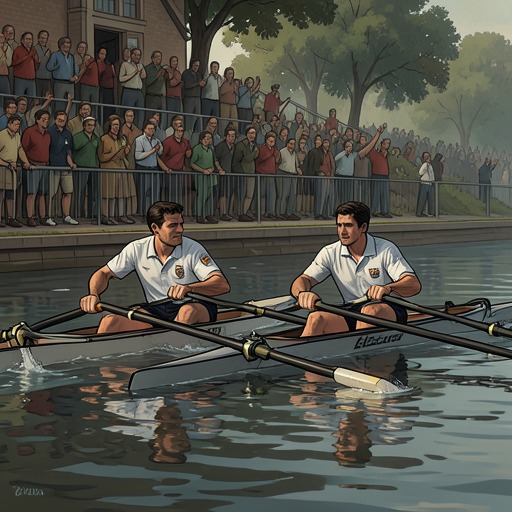
In the Pacific Coast Regatta on Lake Washington, California’s powerful stroke Berkenkamp quickly put the Bears in front. For three-quarters of a mile, the crews matched one another in choppy water, but Washington’s Don Hume could not close the gap while matching California’s high rate. Washington coxswain Bobby Moch responded by telling Hume to lower the stroke count to twenty-nine. The change helped Washington find its swing: Hume took long, smooth pulls, and the rest of the crew followed. By the one-mile mark the boats were level, and Washington began to edge ahead.
Washington eventually won by three lengths and set a course record of 15:56.4, beating the previous mark by 37 seconds. California continued to row hard, and both crews surpassed that earlier record, but the result reversed the Bears’ advantage from the previous year. Washington’s victory established the crew as exceptional in Ulbrickson’s eyes, though it did not settle the larger rivalry: for two years running, Washington had beaten Ebright’s crew in the Pacific Coast Regatta only to lose to California at Poughkeepsie. The shifting results made the season’s central question not simply which crew had won the latest race, but which could sustain its form when the stakes and course changed.
Sport, access, and significance
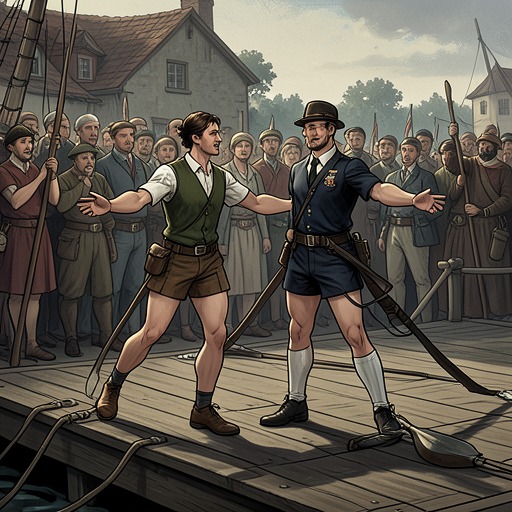
California’s success belonged to a sport shaped by institutions beyond the water. At the prestigious Henley Royal Regatta, a rule dating from 1879 barred anyone who worked for wages as a mechanic, artisan, or laborer; the Australian policemen were deemed laborers and excluded. The rule exposed the class assumptions embedded in rowing’s claim to be a gentleman’s sport. California’s own victories, alongside Washington’s, meanwhile, challenged an eastern order in which the sons of prominent families were more familiar to national audiences than western farmers, fishermen, or lumberjacks.
Across the book’s account, California crew is consequently both rival and measure: its championship pedigree gives Washington’s wins their force, while its own selection practices and repeated performances show a program continually testing and renewing its strength. The rivalry brought western crews before a national public, but the expenses of travel, the distribution of patronage, and rules governing amateur eligibility remained part of the competition’s larger structure.