Chuck Day
The Boys in the BoatChuck Day is the broad-shouldered, quick-tempered, irrepressibly playful number-two oarsman whose refusal to surrender makes him both a source of comic disruption and a formidable competitor. His life in the book moves from rivalry with Joe Rantz to a hard-won comradeship, from the pressures of the Olympic campaign to a successful medical career; the cigarettes that accompany his jokes and nerves eventually become a fatal presence in his story.
Identity and Athletic Character
Day is introduced as a sophomore whose earlier rowing had not yet matched his temperament. In a junior-varsity boat steered by Bobby Moch, he was one of the promising surprises alongside Stub McMillin. The bespectacled Day was conspicuous as a chatterbox and prankster, and his oarsmanship was still uneven. But he brought a combative spark: his instinct was to fight first, and that energy was beginning to serve him as a rower. Al Ulbrickson had noticed him as a freshman, and now saw the possibility that Day’s forcefulness could help a crew find its rhythm and intensity.
His physical presence suited the demands of the number-two seat. Day was broad-shouldered and strongly built, but somewhat lighter than the men who rowed in the middle of the boat. He had brown hair, a square face and a broad jaw; behind his spectacles, his expression could turn from merry to furious. He often had a Camel or a Lucky Strike at his lip, except when Al Ulbrickson was nearby. The combination of toughness and mischief resists a single description: Day could be ornery, but he was just as likely to be laughing, fooling around, or ready with a joke.
The book places this forceful personality in a social world sharply divided by class. Collegiate rowing drew huge crowds and national press coverage, but its eastern institutions cultivated the image of a gentleman’s sport, and elite clubs could exclude working people from competition. At the Henley Royal Regatta, Australian policemen were barred under a rule excluding people who worked for wages as mechanics, artisans, or labourers. Day himself came from a comfortable family, yet his history as a rower belongs to a Washington crew competing against old assumptions about who could claim the sport. The contrast makes the crew’s athletic achievement more than a matter of individual strength: the sport’s traditions and restrictions helped shape the contest in which Day took part.
Rivalry, Work, and Comradeship
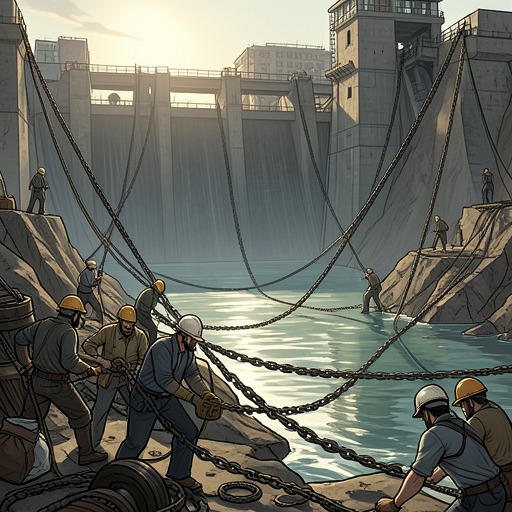
Day’s relationship with Joe Rantz begins in competition, not easy friendship. In the previous season, he rowed as one of Joe’s rivals in a junior-varsity boat that became a varsity contender; the two had hardly exchanged two civil words. Their shared summer at Grand Coulee Dam changed the terms between them. Day arrived in 1935 with the same powerful build that made him an effective number-two man, and a temperament that met a challenge head-on. Though his father was a successful dentist and his family had been spared the worst of the Depression, Day was drawn to the punishing work of the dam. Joe would come to understand that Day’s attraction to the job lay in his ferocious competitiveness: if a river needed damming, Day wanted to be let at it.
At Grand Coulee, Joe, Day, and Johnny White set aside the shell-house rivalries, the insults of the previous year, and the coming competition for places in the boat. They formed an easy confederacy without needing to announce it. This change matters because the men were not simply escaping their earlier conflict; they were learning to live and work alongside one another before they had to race together. The dam’s crushing labor and the boys’ shared circumstances gave their association a new basis, while the rivalries they had set aside still waited for them back at the university.
By March 19, 1936, Day had secured the number-two seat in the boat Al Ulbrickson was quietly assembling for the Olympic campaign. Roger Morris sat at bow; Gordy Adam, Johnny White, Stub McMillin, Shorty Hunt, Merton Hatch, and Don Hume filled the other positions, with Hume at stroke. Day’s selection placed him in a crew built from different seasons and levels of experience. At the Princeton trials, the Washington rowers faced a further disadvantage: other contenders could include recent graduates, while their own boat consisted entirely of undergraduates. As the stakes settled over the crew on the night before the preliminary heats, Day’s nervousness appeared in a familiar form. He smoked forbidden cigarettes in the dark while Joe Rantz and Roger Morris stayed awake telling stories and joking to steady themselves.
The Olympic Campaign and Day’s Temperament
Day’s journals offer brief, immediate traces of the pressure surrounding the final Olympic trial. In the morning he wrote, “Final Olympic trials, very nervous but confident.” The phrase holds two states together rather than resolving one into the other. The boys were rowing for a place in the 1936 Summer Olympics, while Al Ulbrickson faced a public test of his judgment: Royal Brougham was preparing to broadcast the race live to fifty stations, and the outcome would reach listeners far beyond the course.
In New York, the crew’s travels exposed them to a country watching them become more than a university boat. Day joined the other rowers on their visit to Coney Island, where they rode the Wonder Wheel and the Cyclone and moved through the crowded amusement district. His journal was much less impressed than the outing might suggest. He called the place “Dirty, crowded, gyp joints,” and described New Yorkers as tired-looking, pale, and soft beside people from the West. The judgment is revealing less as an objective portrait of the city than as an expression of Day’s blunt, combative outlook. In Times Square, a stranger recognized Shorty Hunt from a newspaper photograph and told the crew he had decided to send his son west so that he too might row. For the Washington boys, such encounters began to make the change in their status tangible: the W on their jerseys was about to give way to USA.
At Huckleberry Island, away from the heat and crowds of Manhattan, Day appears more completely at ease. He smoked Lucky Strikes and cracked jokes while Roger Morris made gruff observations about his smoking. Joe Rantz wandered off to examine glacial markings in the granite, and Bobby Moch tried to organize the crew’s activities, only to be tackled and thrown into the water. Day’s easy mischief belonged to a group that could tease, swim, and relax together. Al Ulbrickson ended the swimming after three days, believing that exercise other than rowing developed the wrong muscles. The episode offers a small contrast between the crew’s social ease and the strict physical discipline imposed on it.
The same mixture of playfulness and aggression surfaces in Germany. Day sought Al Ulbrickson out for confidence-building conversations as the Olympic preliminary heats approached, chain-smoking Lucky Strikes and Camels while laughing off his teammates’ efforts to get him to cut back. Yet the Washington crew also became entangled in a dispute with the Yugoslavian team. After the Americans rigged a device to dump water on people making noise below their rooms, a lunchtime performance of “Yankee Doodle” convinced Day that the Yugoslavians were insulting the United States. He bolted from his seat and attacked them; Bobby Moch followed, and the rest of the Washington boys joined in, with the Australian crew also entering the fight. German rowers sided with the Yugoslavians, chairs flew, and the Dutch crew eventually separated the combatants. Day’s response was rash, but consistent with the competitive instinct that the book has traced from his earlier rowing to the dam: he interpreted a perceived challenge as something to meet directly.
The Race and Its Pressures
On August 11, the United States performed poorly in the rowing preliminaries: it placed second to last in three events and last in the other three. Day called the showing “A very rotten performance.” The results left the eight-oared crew carrying the expectation that it must come through for the country after the other American boats had failed to do so.
The following day Don Hume was ill, feverish, and fourteen pounds below his usual Poughkeepsie weight, but he insisted he was ready to row. In the final, the American boat made a disastrous start. The crew was already a stroke and a half behind as the Husky Clipper got moving, and Bobby Moch’s handicap was made worse by the lane assignment. Day felt his confidence falter at the sight of the other boats pulling away. He and the crew had to absorb the setback, keep rowing, and remain in contention under a demanding pace set by Hume. Day’s reaction makes the opening minutes of the race a character moment as well as a tactical crisis: confidence was not something he possessed once and for all, but something the crew had to keep rebuilding while the race unfolded.
Later Life and Legacy
After the Olympics, Day returned to Seattle with Roger Morris and Bobby Moch only after a six-week tour of Europe. He continued his education, earned a medical degree, and joined the navy at the outbreak of the war. He served as a naval doctor in the South Pacific before returning to Seattle and establishing a successful gynecological practice. Yet his smoking remained part of his life. The Lucky Strikes and Camels that had accompanied his jokes and his anxious moments eventually took a terrible toll.
The crew’s bond persisted after its members went their separate ways. They met at least annually, often with their spouses and children, and marked their history with anniversary rows. In 1946, the nine rowed the Husky Clipper on Lake Washington for the first ten-year reunion; they rowed together again in 1956. By the 1966 anniversary, Day had died of lung cancer in the hospital where he had practiced medicine. The nurses and doctors who had worked with him wept in the hallways. His absence changed the reunion from a return to the boat into a reminder that its members could not all come back.
In 1971 the full crew entered the Helms Rowing Hall of Fame. Five years later, the eight surviving rowers gathered for the fortieth-anniversary row, posed with their oars, and climbed into the Husky Clipper. Their shoulders sagged and their hair had grayed, but they still rowed with a crisp, clean efficiency. Day was no longer among them; his place in the crew’s history remained visible in the yearly reunions, the boat they continued to row, and the loss those gatherings had learned to carry.