Collective cooperation and mutual trust in rowing
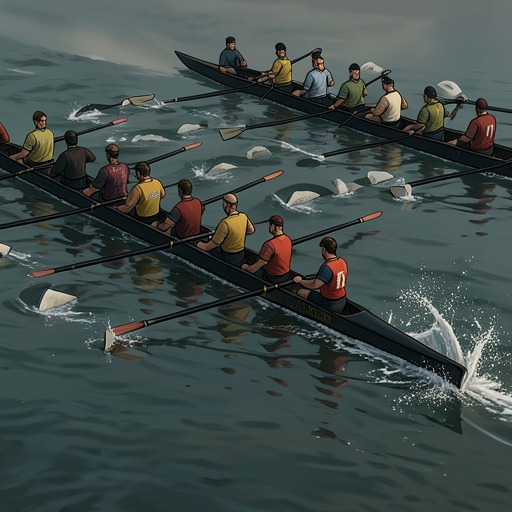
The Boys in the BoatCollective cooperation and mutual trust in rowing become the decisive achievement of Joe Rantz’s Olympic race: the crew can move as one only when each rower commits without reservation, relying on the others to do the same. The book presents that unity not as the disappearance of individual effort, but as the moment when individual effort becomes inseparable from the crew’s shared work.
The Principle of the Crew
George Yeoman Pocock frames rowing’s spiritual value as the loss of self within the cooperative effort of the crew as a whole. The idea gives collective action an inward dimension: success depends not merely on bodies performing coordinated strokes, but on each rower relinquishing the isolation of acting alone. The crew’s unity is an achieved relationship between individual commitment and shared purpose.
That relationship is demanding because each rower must act at the instant the crew needs him, without holding back for certainty. Mutual trust is therefore practical as well as emotional: it makes coordinated effort possible under the pressure of a race, when hesitation could interrupt the boat’s movement.
Trust in the Final Sprint
The principle becomes concrete for Joe in the last few hundred meters of the Olympic final on the Langer See. Gasping in the Husky Clipper as it drifted beyond the finish line, he recalled the pain and bewildering noise of the desperate sprint. He understood that he could do nothing more to win by adding effort of his own; what remained was to abandon doubt and trust the rower ahead of him and the boys behind him to do exactly what the moment required.
That trust meant accepting vulnerability. Joe had to throw himself into each stroke without hesitation, relying on his teammates to be there so that he would not catch the whole weight of the shell on his blade. The risk was repeated stroke after stroke, at forty-four strokes per minute. His effort did not diminish when he trusted the crew; it became possible to give it without reservation because he knew the others were committing alongside him.
From Individual Effort to Shared Achievement
The race transforms cooperation from an ideal into a lived certainty. Joe’s understanding is not that one rower can carry the others, but that no rower can complete the decisive work alone: each depends on the precisely timed actions of those around him. The crew’s collective rhythm is built out of individual acts of faith, renewed moment by moment under extreme strain.
In the white-hot final meters at Grünau, Joe and the other boys forged the prize they had pursued throughout the season—and the prize Joe had sought for nearly all his life. The achievement is presented as both athletic and relational: the crew’s victory comes through the trust that lets its members lose themselves in common effort without losing their capacity to act.
Meaning and Resolution
After the race, the medal remains important, but Joe’s nighttime contemplation of it makes clear that it is not the most important thing he will bring home from Germany. The deeper gain is the experience of having trusted his teammates absolutely and discovered that they were there for him, stroke after stroke. The book links that recognition to his feeling whole and ready to go home.
The episode thus gives collective cooperation a personal consequence. Trust does not erase the strain or the need for individual exertion; it changes what exertion means. Joe’s final commitment is at once a contribution to the crew and an acceptance of dependence on it, turning victory into a shared achievement that answers a need extending beyond the race.