Dick Pocock
The Boys in the BoatDick Pocock emerges as both a champion in his own right and a practical counterpart to his brother George: a young waterman whose rowing success helped finance an abrupt departure from England, and whose later work carried the family’s boatbuilding craft across North America. His story moves from the competitive world of the Thames to the uncertain labor market of Vancouver, then east again to Yale University.
Family Craft and Competitive Skill
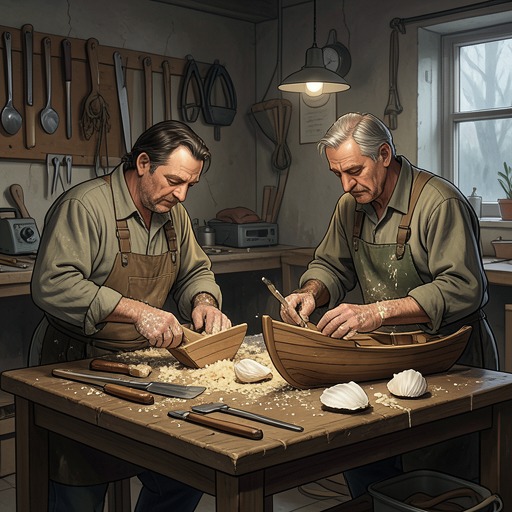
Dick’s early world was shaped by a family trade. His father built racing shells for Eton College, where young men had competed in rowing for generations, and his uncle had built the first keel-less shell in his shop beneath London Bridge. The family’s knowledge was practical as well as inherited: boats were made and maintained by hand, while the Thames offered a place to learn what they could do in motion.
Dick and George Pocock learned to row as well as build. Their style drew on that of the Thames watermen, whose short, powerful strokes used a quick catch and release. Messing about on the river after formal practice, the brothers repeatedly left the aristocratic Eton boys behind. Their skill unsettled the usual social order of the boathouse: the sons of the boatbuilder, despite being the boys’ social inferiors, could outperform them on the water. The Pocock brothers also gave informal lessons to young men including Anthony Eden, Prince Prajadipok of Siam, and Lord Grosvenor, son of the Duke of Westminster.
Victory in the Doggett’s Coat and Badge
Dick’s clearest individual achievement was winning Doggett’s Coat and Badge, described as one of rowing’s greatest prizes. The annual race had been held since 1715, running from London Bridge to Chelsea. Its reward was not merely a title: the winner earned the right to wear a striking crimson coat and matching knee britches, with a large silver badge on the sleeve and white knee-high hosiery. In a sport where the brothers’ skill had already made them conspicuous among Eton’s young aristocrats, Dick’s victory gave him a place in the long tradition of Thames watermen.
George was preparing to make his own attempt at the same prize when the family’s circumstances changed. Late in 1910, their father abruptly lost his job at Eton after acquiring a reputation for being too lenient with the men who worked under him. With their father suddenly without means, Dick and George chose to leave rather than become a burden. They had heard that work in the woods of western Canada could pay as much as ten pounds a week. Their race winnings became passage money, turning athletic success into a means of departure.
Departure and Work in Vancouver
The brothers packed clothes and a few boatbuilding tools, then sailed steerage from Liverpool aboard the Tunisian, bound for Halifax. After crossing Canada by rail, they reached Vancouver on March 11, 1911, with forty Canadian dollars between them. Dick was a year older than George, who turned twenty that day. They arrived filthy, dazed, and hungry, and found the town unlike the familiar surroundings of Eton. Their uncertainty was immediate and material: they rented a downtown room for eighteen dollars a week, with only two weeks’ rent money available, and went out looking for work.
Dick found employment as a carpenter at a mental hospital in nearby Coquitlam. The job was one of several practical attempts to establish themselves in a place where neither brother yet had secure prospects. George, by contrast, went first to a logging camp and later found work in Vancouver’s shipyards, where he lost two fingers. The brothers’ paths thus diverged even as they shared the same precarious beginning: Dick’s first documented work in Canada used his carpentry skills, while George’s early jobs exposed him to the physical dangers of logging and shipbuilding.
Later Boatbuilding Work
After the First World War, Dick moved east to build racing shells for Yale University, while George remained in Seattle and began receiving orders for his carefully crafted shells from around the country. Their separation extended the family trade in different directions. Dick’s move placed his boatbuilding within an eastern university rowing program; George’s continued presence in Seattle connected his work to generations of Washington crews and coaches.
The surviving account gives little detail about Dick’s life beyond these milestones, but the contrast with George’s later prominence is itself significant. Dick was not simply the brother who emigrated alongside him: he had won the Doggett’s Coat and Badge before leaving England, helped make the journey possible through the brothers’ race winnings, and pursued boatbuilding at Yale. His story links competitive rowing to skilled labor and migration, showing how the brothers’ expertise could carry them from the Thames into distinct working lives in North America.