Eton College
The Boys in the BoatEton College stands in this history at the meeting point of rowing, craftsmanship, and social privilege. Its long-established culture of competitive rowing trained gentlemen for the sport and gave George Pocock his first sustained education in building and handling racing shells. The craft he learned there would later inform innovations that changed American boatbuilding, while the class distinctions embodied by the school’s rowing world remained visible in the rules governing who could compete.
An Elite Rowing Tradition
By the 1920s, collegiate rowing drew national attention in the United States, but its social model had deep British roots. Eastern private schools modeled themselves on elite institutions such as Eton College, teaching rowing as a gentleman’s sport and sending their oarsmen to universities including Harvard, Yale, and Princeton. The distinction mattered: rowing was not simply an athletic discipline but also a marker of education and social standing.
American rowing’s landmark contests helped establish that tradition across the Atlantic. The first collegiate crew race in the United States took place between Harvard and Yale in 1852, and Harvard’s 1869 race against Oxford on the Thames brought rowing still wider publicity in the United States. By the early twentieth century, rowing clubs flourished among the well-to-do, and the annual regatta at Poughkeepsie had become a major national sporting event. Eton College’s place in the account is therefore both institutional and emblematic: it represents the British school culture from which much of elite rowing’s prestige derived.
George Pocock’s Apprenticeship
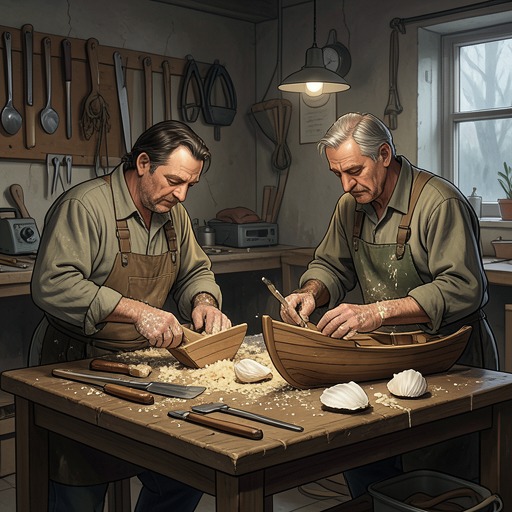
Eton College was also a working environment and formative home for George Pocock. His father, Aaron, built racing shells for the school, whose ancient boathouse stood across the river from Windsor Castle. George grew up there and, at fifteen, formally apprenticed himself to his father. For the next six years, the two worked side by side, maintaining and expanding Eton’s fleet with hand tools.
George learned to row as well as to build. He studied the Thames watermen’s short, powerful strokes and quick catch and release, then adapted that style for racing shells. On the river after formal practice, he and his brother Dick repeatedly outrowed Eton’s aristocratic boys. The Pocock brothers’ ability crossed a social boundary without erasing it: though their status was lower than that of the pupils, they were soon giving informal lessons to figures including Anthony Eden, Prince Prajadipok of Siam, and Lord Grosvenor.
The school’s influence on George extended beyond manual training. Conscious of the difference between how he and his father spoke and how they were addressed, he worked to acquire the polished accent of the boys they served. The effort reflected his broader pursuit of precision and excellence, which he applied to speech, rowing, and boatbuilding alike. At seventeen, he entered the Sportsman Handicap at Putney in a shell he had made himself from Norwegian pine and mahogany; after three heats against fifty-eight oarsmen, he won the race. His brother Dick later won the celebrated Doggett’s Coat and Badge.
From Eton Craft to a New Kind of Shell
The methods George learned at Eton provided a foundation, not a limit. Until 1927, he built shells in the manner his father had taught him: a spruce and ash frame, Spanish cedar planking, and thousands of brass fasteners painstakingly finished by hand. The process demanded exacting labor, and a slip of a chisel or careless hammer blow could ruin days of work. George retained a commitment to hand tools even as power tools became available, valuing their fine control and the close attention they allowed him to give the wood.
In 1927, he began experimenting with western red cedar, a local material proposed by Washington coach Ed Leader but initially discouraged by head coach Rusty Callow. Cedar was light, buoyant, flexible, and naturally resistant to rot. George found exceptionally straight, tight-grained timber near Lake Cowichan and had it milled into wide planks, then shaved into matched sheets only five-thirty-seconds of an inch thick. He steamed these sheets over a shell frame, allowing them to bend into shape before gluing them in place. The method replaced laborious nailing and produced sleek shells that were both more beautiful and faster; Harvard reported that one of its experimental boats had cut several seconds from the crew’s best times.
The resulting boats carried forward the care learned in the Eton workshop while departing from its inherited construction practice. George selected different Northwest woods for the keel, frame, gunnels, seats, and washboards, and finished each hull through repeated varnishing and hand rubbing. He also recognized an unexpected effect of cedar in water: as the wood expanded lengthwise against a dry, rigid ash frame, the shell’s ends lifted slightly, creating camber and continual compression. He understood this spring-like tension as a source of liveliness in the boat. Eton had formed the craftsman; George’s later work showed how that training could be carried beyond the school’s established methods.
Class Boundaries and Competitive Ideals
Eton College’s gentlemanly rowing tradition also helps explain the class restrictions that persisted in prestigious competition. In 1936, the Australian crew arrived in England hoping to race at the Henley Royal Regatta. Its rules barred anyone who earned wages as a mechanic, artisan, or labourer. The Australians, who were policemen, were judged to fall within the excluded category and were refused entry. They left Britain for Berlin determined to race there instead.
That exclusion exposed a tension at the center of rowing’s prestige: the sport celebrated strength, discipline, and technical skill, yet some of its most respected institutions restricted access according to occupation. The British Olympic eight, drawn from the Leander Club and selected from strong rowing ranks at Oxford and Cambridge, embodied the established tradition. For Al Ulbrickson and George Pocock, it was the crew to beat in Berlin. Set against the Australian exclusion, that expectation shows how Eton’s world of gentlemanly sport remained part of a broader system in which rowing excellence and social eligibility did not always coincide.