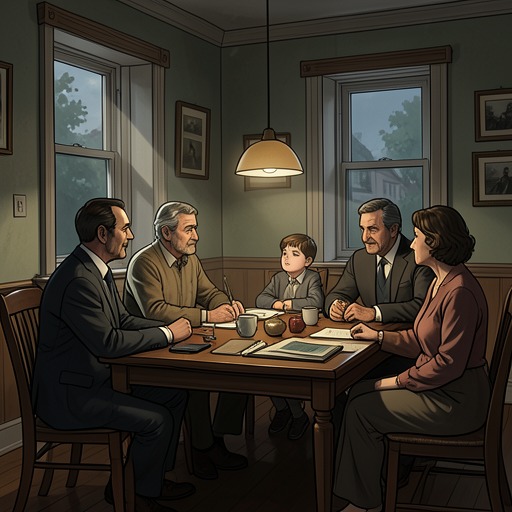
Fred Rantz
The Boys in the BoatFred Rantz, the older brother of Joe Rantz, repeatedly helped shape the younger boy’s path after their family was broken apart by loss. He first took Joe in as a child, hoping to give him a secure home; years later, he invited him to Seattle to complete high school and pursue a university education. Fred’s care was practical and consequential, though Joe did not always experience it as uncomplicated support: he also felt that his brother could be overbearing and inclined to direct his life.
Identity and Family Background
Fred was the first son of Harry Rantz and Nellie Maxwell, born in 1899. The family had moved west from Williamsport, Pennsylvania, settling in Spokane, where Joe was born in 1914. Fred’s childhood was altered by his mother’s illness and death in 1918. In Joe’s recollections of that period, Fred appears beside him in the family’s upstairs room, speaking softly about death, angels, and college. He also explained why he could not go east to Pennsylvania with Joe, who was being sent away while the family’s circumstances changed.
The brothers’ separation came amid several losses at once. Nellie died, Harry left for Canada, and Fred went away to finish college. Joe’s childhood account presents these developments not as a settled explanation but as fragments: a conversation with Fred, a journey east, and the disappearance of the familiar household. Fred’s departure was part of the upheaval, but the later course of his life would bring him back into a caretaking role.
Taking Joe In
In the summer of 1919, Fred, then twenty-one, had graduated from college and secured a position as superintendent of schools in Nezperce, Idaho. He had also married Thelma LaFollette. He summoned five-year-old Joe from Pennsylvania, hoping to provide his little brother with something like the safe and secure home they had known before their mother died and their father left.
The reunion revealed how much separation had changed the brothers’ bond. When Joe stepped off the train in Nezperce, he could barely remember Fred and did not know what to make of Thelma. Mistaking her for his mother, he ran to her and embraced her legs. The moment shows both the small child’s need for a familiar home and the difficulty of returning to a family life that could not simply be restored. Fred’s intention was to offer care and stability; Joe arrived without a clear memory of the brother who was offering it.
A Supportive but Uneasy Relationship
Fred’s help did not erase the imbalance Joe felt between them. Joe remembered Fred as somewhat overbearing, as if he were as concerned with directing his younger brother as with helping him. Fred seemed to regard Joe as inept in certain respects and in need of correction. That history shaped Joe’s response when Fred later proposed another change in his life: the offer carried real opportunity, but also revived Joe’s concern that someone else would decide what was best for him.
This tension makes Fred’s role more complicated than that of a rescuer. His interventions opened routes Joe might not otherwise have taken, yet Joe wanted to become capable of making his own choices. The brothers’ relationship therefore held both dependence and resistance: Fred could provide a home and a plan, while Joe had to decide whether accepting them meant surrendering too much control over his future.
The Invitation to Seattle
In the summer of 1931, Fred wrote to Joe from Seattle, where he was working as a chemistry teacher at Roosevelt High School. He urged Joe to come live with him and Thelma and complete his senior year at Roosevelt. Fred argued that graduating from a highly regarded school might help Joe gain admission to the University of Washington, opening possibilities beyond his present circumstances.
Joe was wary. He had begun to establish himself and did not know whether he wanted Fred—or anyone else—to tell him how to live. He was uncertain, too, about living with Thelma’s twin sister, Thula, and had not previously imagined attending university. Nevertheless, the proposal engaged his curiosity and his confidence in his academic ability. He was doing well in class and wanted to test his intellectual capacities. The opportunity Fred described thus met both a practical need and an aspiration Joe was beginning to form.
What Fred’s Help Made Possible
Joe’s decision to leave was also tied to the future he imagined with Joyce Simdars. He knew that remaining in Sequim was unlikely to offer the life he wanted, even though leaving meant being apart from Joyce for a time. He boarded up his house, told her he would return at the end of the school year, and took the ferry to Seattle to live with Fred and Thelma.
The move gave Joe a striking change in daily circumstances: for the first time in a long while, he had three meals a day and time for school and other interests. He excelled academically, joined the glee club, and became a standout on the men’s gymnastics team, particularly on the rings and bars. Fred’s household gave him room to pursue these activities and helped confirm that he wanted more than the limited prospects he associated with Sequim. Fred did not determine what Joe would ultimately make of that opportunity, but his invitation created the conditions for Joe to explore it. In the available account, Fred’s decisive contribution is this repeated act of opening a door—first to a home in Nezperce, then to education and a wider future in Seattle—while leaving Joe to cross it by his own choice.