George Hunt
The Boys in the BoatGeorge Hunt, known to his classmates by a nickname that belied his stature, emerges as one of Washington’s most imposing young oarsmen: a tireless worker, an indispensable teammate, and a sensitive, sometimes unsettled presence in the boat. His importance lies not only in what he can do with an oar, but in the contrast between his public confidence and the private boundary he keeps around himself, and in the loyalty he offers Joe Rantz when the crew is under strain.
Identity and Background
At seventeen, George Hunt was the youngest member of the boat and already six feet three inches tall. Al Ulbrickson regarded him as an ox for work and absolutely indispensable, but also high-strung and nervous enough to require careful handling. The coach’s comparison was to a racehorse: powerful, but not necessarily easy to settle. That mixture of force and vulnerability would shape how Hunt was understood within the crew.
Hunt had grown up in Puyallup, a small town between Tacoma and the foothills of Mount Rainier. Unlike Joe Rantz, he came from a stable family life and had become comfortable with himself and conspicuously accomplished. At Puyallup High School he excelled across school and extracurricular life: he played football, basketball, and tennis; served as class treasurer and assistant librarian; belonged to the radio club, honor society, and Hi-Y chapter; and made the honor roll every year. He graduated two years early. His athletic competence was therefore part of a broader record of achievement, not a talent that appeared only once he entered the shell.
His appearance added to his visibility. He had wavy dark hair, was often compared to Cesar Romero, and was considered good-looking. He dressed with care, attracting the attention of young women, though the account does not give him a steady girlfriend. His classmates gave him a nickname that he kept for the rest of his life, turning his extraordinary height into a familiar joke.
Place in the Crew
Hunt rowed at number two, directly behind Joe, in the freshman boat that Al Ulbrickson initially kept intact when he posted the tentative rosters for the new season. That decision carried two messages at once. The sophomores were assigned together, the same unit that had won at Poughkeepsie the previous June, suggesting that Ulbrickson saw unusual promise in them as a group. Yet he placed their boat fifth, at the bottom of the program’s ranking. The intact lineup signaled confidence; the low placement checked any assumption that their freshman championship guaranteed a place among the varsity contenders.
The team’s prior triumph belonged to a sport with a long-established hierarchy. Collegiate crew drew national attention, and the great eastern programs had long occupied the center of American rowing. Washington and California, public universities on the West Coast, were building their own following through a fierce rivalry, but western crews had faced condescension as well as practical disadvantages when they traveled east. Washington’s earlier breakthrough at Poughkeepsie showed that western crews could overturn expectations; the sophomores’ own victory made their continued progress matter to the program. Hunt was thus part of a promising unit whose achievement had raised expectations without settling its place in the varsity order.
Those expectations soon met difficulty. Ulbrickson had anticipated that the sophomores would establish themselves as the new varsity lineup, but instead they began struggling even against junior-varsity crews. He summoned Hunt, Joe, George Lund, Chuck Hartman, and Roger Morris to his office and warned that each risked falling out of contention. He criticized their insufficient effort, poor spacing, careless entry of the oars, and failure to keep their emotions out of the boat. The lecture made clear that the old championship was no protection: the crew would have to reproduce its discipline and effectiveness under a more demanding coach.
Temperament and Relationships
Hunt’s sociability did not mean that he was easy to know. He was talkative, liked being at the center of attention, and could be forceful in his opinions, yet he kept other people at a distance and was guarded about his private life. He could be sensitive to slights, and taunts from another boat were among the things that could unsettle his focus. Like Joe, he seemed to have an invisible boundary others were not invited to cross. His outward ease and inner guardedness make his confidence more complicated than simple swagger.
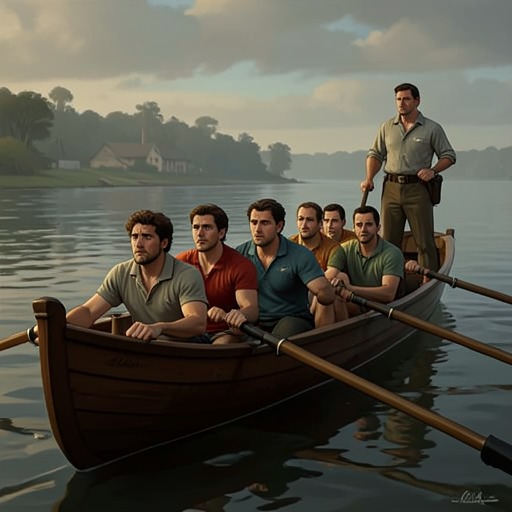
His closest friendship in the crew was with Roger Morris. The two had been companions from the beginning, despite their contrasting manners: Hunt was naturally garrulous, while Morris was reticent and gruff. Their friendship also gave Joe a dependable place in the group. Neither boy had given Joe a hard time; increasingly, both stood up for him when older rowers teased him. Hunt’s care was physical and direct. When Joe seemed down, he would put an arm over his shoulder and reassure him that he had his back. In a boat where individuals had to coordinate their effort, this was also a form of support beyond rowing technique: Hunt helped make the crew a place where Joe was not left to face every pressure alone.
Effort, Setbacks, and Significance
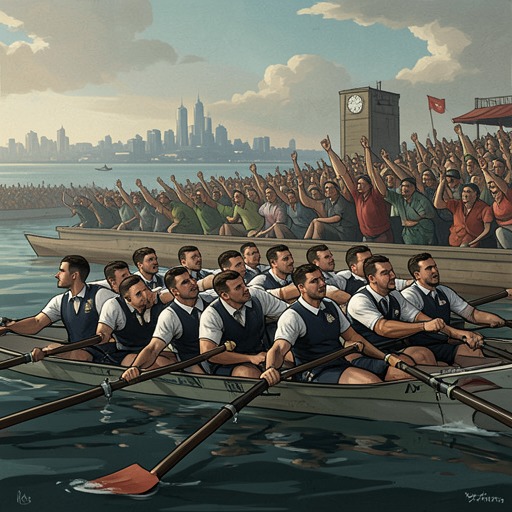
Hunt’s work rate was most consequential when the race narrowed to its final strokes. In a Washington–California contest, California sprinted to the lead at forty strokes per minute while Washington held a lower rate, preserving power for the finish. With the boats even again and the bridge closing in, George Morry called for successive bursts of effort. Hunt, Joe, Morris, and the other rowers threw themselves into the final pulls. Washington crossed amid disputed calls from the bridge and loud competing claims from the crowds; the official announcement ultimately declared Washington the winner by six feet. The scene makes Hunt’s strength meaningful not as isolated muscle but as effort committed to a shared finish.
His character is defined by that tension between individual force and collective dependence. He could be proud, sensitive, and difficult to settle, yet his labor was essential, and his loyalty to Joe extended beyond the race. Years later, Royal Brougham would name Hunt alongside Ulbrickson as one of the two greatest oarsmen ever to sit in a Washington shell. That retrospective judgment gathers together the qualities the earlier episodes establish: exceptional capacity, demanding temperament, and a presence whose full measure becomes clearer over time.