Grünau
The Boys in the BoatGrünau was a lakeside rowing district southeast of Berlin where generations of water sport met the grand, carefully staged infrastructure of the 1936 Summer Olympics. The regatta course offered a setting of striking natural calm, but its history also exposed the widening gulf between rowing’s ideal of fellowship and the Nazi persecution that dismantled Jewish participation in the sport.
A longstanding center of water sports
Grünau lay on the west bank of the Langer See, a long, narrow lake among the waters fed by the Dahme River. There, Berlin’s suburbs gave way to open meadows and dark woodland. The lake had been a center of local water sports since the 1870s, when rowing and sailing regattas began to be held on its deep blue water. Kaiser Wilhelm II built a summer pavilion in Grünau so the imperial family could watch competitions and take to the water themselves.
By 1925, dozens of rowing clubs had their headquarters in and around the district. Their membership included clubs for Jewish rowers, clubs for Nordic members, and mixed clubs. Women had rowed alongside men since 1912, although the required clothing—high-laced boots, long skirts, and tightly fastened long-sleeved tops—was ill-suited to the physical demands of the sport. The lake’s established club life made Grünau more than a convenient Olympic venue: it was a community organized around rowing.
Olympic construction and spectacle
For the 1935 European Rowing Championships, engineers completed a covered grandstand with room for 7,500 spectators. A grassy area beside it could accommodate another 10,000 standing spectators. As the 1936 Summer Olympics approached, officials planned enormous wooden stands extending over the water. A new boathouse, Haus West, rose beside the permanent grandstands, supplementing the existing Haus Mitte and Haus Ost.
These substantial buildings differed sharply from the makeshift boathouses familiar to the Washington crew at home and at Poughkeepsie. The limestone structures, topped with red tile, provided twenty dressing rooms, four shower rooms, twenty hot-water showers, space to store ninety-seven racing shells, and rooms equipped with massage tables. Haus West also served the international press: its rooms were assigned to writers, radio equipment, Teletypes, telephones, rapid film processing, and customs services. Its second-story terrace looked out across the course. It functioned both as a viewing platform for Germany’s most powerful men and as a stage from which spectators could watch those leaders watching the races.
A rowing community under threat
The Olympic site’s appearance of continuity concealed a radical change in the life of its clubs. After the Nazi Party came to power, German Jews were excluded from public and professional life, and Jewish clubs in Grünau faced the same persecution. The large Jewish Helvetia Rowing Club had been banned in 1933. Mixed clubs were threatened with dissolution unless they removed Jewish members; smaller Jewish clubs could be raided, closed, or stripped of their equipment at local Nazi officials’ discretion.
The change reached into everyday club life. Rowers who had spent years together began turning away from former teammates and neighbors. Names disappeared from club lists, signs appeared over boathouse doors, and locks were changed. In the countryside around Grünau, Jewish-owned homes were boarded up or rented to German families for a fraction of their value after their owners managed to leave the country. Against this background, the lake’s continued use for rowing did not signify that the old community had survived. The boats still moved over familiar water, but the right to belong had been violently narrowed.
The district also drew competitors excluded by the class rules of other rowing institutions. Australian policemen had been barred from the Grand Challenge Cup at the Henley Royal Regatta because the rules excluded people who worked for wages as mechanics, artisans, or laborers. The Australians went to Berlin determined to race there instead. Grünau’s international role thus brought together competition and contrasting boundaries of access: some rowers arrived after being rejected as workers, while Jewish rowers at the venue itself were being forced out of clubs and public life.
The Washington crew on the course
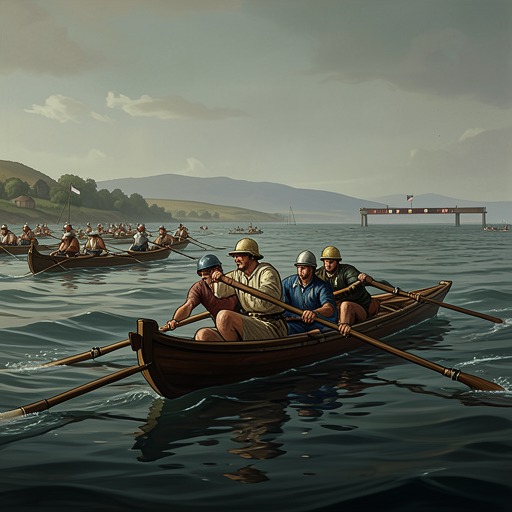
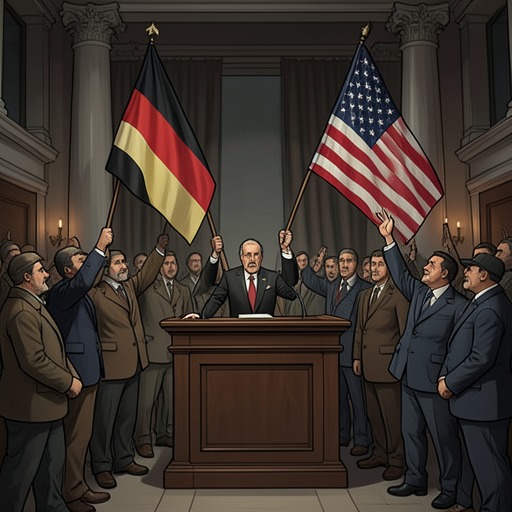
When the Washington crew arrived for Olympic rowing, they were taken by army bus from Köpenick to Grünau and assigned to share a new brick-and-stucco boathouse with the German national team. American and Nazi flags hung opposite one another above its entrance. The German crew, associated with the Viking Rowing Club and known as the Glider crew, appeared older, exceptionally fit, disciplined, and well equipped. Unlike other German crews at Grünau, it had emerged as a unit through its rowing ability; Al Ulbrickson and George Pocock nevertheless suspected that the Nazi government had heavily subsidized its training.
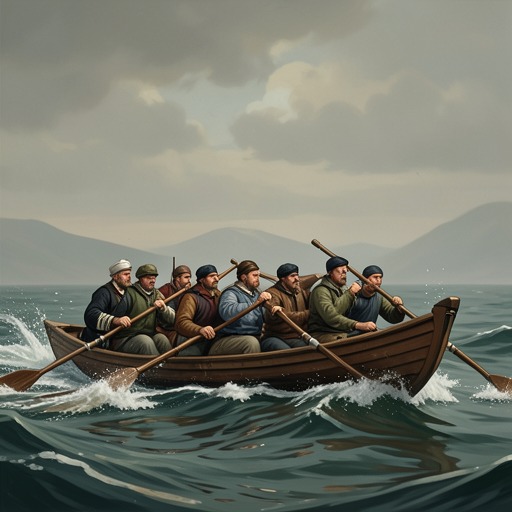
The Americans’ first outing was delayed when a photographer stood up beneath their shell, struck it, and opened a long, thin crack in the hull. George Pocock repaired the Husky Clipper, but the crew’s return to the water was discouraging: its timing was poor, its strokes weak, and practicing Canadian and Australian crews passed it. The rowers had colds, Don Hume’s illness was becoming more serious, and steady rain and cold wind made the police barracks where they stayed feel drafty and uncomfortable. Grünau was an Olympic venue, but the Washington crew’s arrival there began with damaged equipment, illness, and a performance that fell well short of its form.
The regatta rules gave each of the fourteen eight-oared crews two opportunities to reach the medal race. Preliminary winners advanced directly to the August 14 final; crews that lost had to win a repechage the following day. Washington’s preliminary brought it against France, Japan, Czechoslovakia, and Great Britain. On August 12, Hume, still ill and fourteen pounds below his Poughkeepsie weight, insisted on rowing. The day’s conditions were mild, with a slight following wind, and the crew raced in the sheltered first lane.
For the final, the course presented a different challenge. At the starting line, beyond the protection of the grandstands, the curvature of the northern shore exposed the boats to wind and choppy water. Roger Morris and Gordy Adam had to keep the Washington shell aligned against the gusts while Bobby Moch called instructions from the stern. The eight-oared race was presented as the day’s most prestigious contest, a test of collective power and coordination. Washington’s boys eventually won Olympic gold at Grünau, turning a venue where their prospects had looked uncertain into the setting of their triumph.
The course after the Games
The book returns to Grünau in 2011, seventy-five years after the victory. The regatta grounds had changed little: an electronic readerboard stood near the finish, while the covered grandstands remained and the Langer See continued to carry racing shells along lanes laid out in 1936. At the Wassersportmuseum, the author was led to the balcony of Haus West, near the spot where Adolf Hitler had watched the races. Below, young rowers prepared a shell for an evening outing as a single sculler moved toward the finish sign.
That return makes the site’s double history visible without erasing either part. Grünau remained a working rowing course, its water and facilities still serving the sport. But the terrace, flags, and Olympic buildings also preserve the setting in which athletic competition was turned into political spectacle, while the vanished access of Jewish rowers recalls what the continuing landscape cannot by itself show.