Grand Coulee Dam
The Boys in the BoatGrand Coulee Dam gives physical scale to a promise of shared recovery: control the Columbia River, bring water and electricity across the West, and create work in a time of hardship. The project appears first as a public vision voiced by Franklin D. Roosevelt before a vast crowd, then as an immense, dangerous construction site where Joe Rantz takes a jackhammer job. Its meaning rests in that tension between national ambition and the labor required to make it real.
A project for an arid region
On August 4, people traveled from different directions toward Ephrata, a town of 516 residents in the dry scablands near the Columbia River and the fifty-mile-long Grand Coulee. By midafternoon, twenty thousand people stood behind a rope line. George Pocock and his family were among them when Roosevelt appeared on the platform. The setting made the proposed dam’s scale and purpose legible: this was a federal undertaking meant to alter the conditions of a region defined by aridity.
Roosevelt described the benefits against the cost of 175 million public dollars. The project, he said, would reclaim 1.2 million acres of desert for farming, provide irrigation water for millions more acres of existing farmland, generate abundant cheap electricity for export across the West, and require thousands of workers to build its hydroelectric and irrigation infrastructure. The appeal was both practical and expansive: the dam was not merely a barrier across a river, but the center of a system expected to redistribute water, power, and employment.
His argument also widened the project beyond local boundaries. The Columbia’s water, he emphasized, ran unchecked toward the sea, and its energy remained unharnessed; the challenge belonged not only to Washington State or Idaho but to the whole country. He imagined electricity becoming a standard household resource wherever transmission lines could reach. His conclusion joined the promise of material improvement to a pledge of persistence: the work was useful, he said, and would be carried through for the country’s benefit.
Public promise and collective hope
The crowd repeatedly interrupted Roosevelt with applause and cheers. The response was more than a reaction to a list of projected benefits: the speech offered people enduring hard times a way to imagine agency beyond individual effort. For many who witnessed the gathering, the day became a first real hint of hope. If individuals could do little alone to reverse their circumstances, the project suggested that they might accomplish something together.
That idea also carries a contrast with the era’s familiar emphasis on rugged individualism. The account does not suggest that perseverance or hard work had lost their value; instead, it places a further possibility beside them: people could pitch in and pull together. The dam’s public significance therefore includes both the promised transformation of land and infrastructure and the collective undertaking represented by building them. The cheering audience, the federal expenditure, the projected jobs, and the scale of the work belong to the same proposition: shared effort might produce benefits no person could secure alone.
The construction site
When Joe drove to Grand Coulee, the government had recently committed to building the dam. Once completed, it would be the largest masonry structure built since the Great Pyramid at Giza, more than four thousand years earlier. The account brings that monumental comparison down to the working terrain. Joe crossed the Columbia on a steel bridge and parked at the National Reemployment Service building, where he found a job within half an hour.
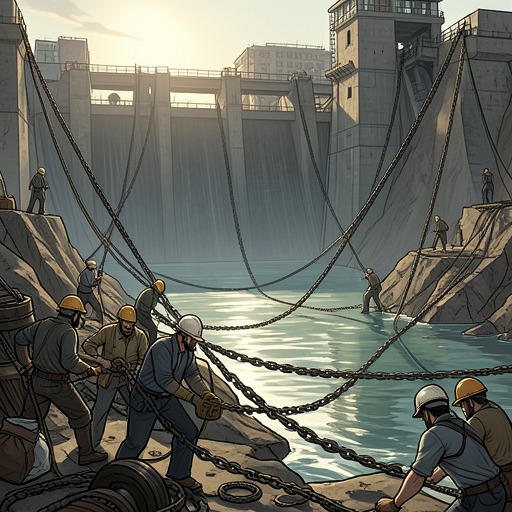
The construction landscape was already organized around moving water, material, and machinery. Across the river stood Engineer City, with modest houses and patches of green lawn against the brown surroundings. A narrow suspension catwalk stretched fifteen hundred feet over the water; a sturdier, low bridge carried a conveyor belt moving rock and gravel between banks. On the west side, a steel-sheet cofferdam was being built to divert water from the cliff base, while men and machines worked amid clouds of dust.
The site’s equipment made the project’s scale tangible. Steam and electric shovels excavated loose rock; bulldozers and Caterpillar tractors shifted and terraced the earth. Mack AP Super-Duty dump trucks carried automobile-sized boulders out of the canyon, and front loaders fed side-dump trucks and conveyors. Cranes swung steel sheets over the river as pile drivers on barges hammered them into the riverbed. At the cliffs, men with sledgehammers and crowbars loosened fallen rock for the loaders, while workers suspended on ropes drilled into the rock face with jackhammers.
The labor proceeded through a dangerous rhythm of work and warning. A shrill whistle sent the jackhammer crews scrambling to the tops of their lines and drove workers below away from the cliff base. Then an explosion reverberated through the canyon, white dust burst from the western cliffs, and rock and boulders tumbled down. Watching the operation, Joe was fascinated but apprehensive; he had not yet decided what he had entered, but was determined to find out.
Joe Rantz and the dam’s human cost
The employment office offered common labor at fifty cents an hour, but Joe noticed that cliffside jackhammer work paid seventy-five cents. The job demanded strength to resist the machine’s kickback, stamina to hold the body away from the cliff, agility on the rock face, and enough self-assurance to climb over the edge. Joe told the examining doctor that he rowed crew at the university, and the physical examination secured him the position. His athletic training thus became a qualification for industrial labor, though the demands of the job were distinctly different from rowing.
For eight hours a day, he dangled from a rope in the canyon’s furnace-like heat, working with a seventy-five-pound jackhammer that seemed to push back against his grip. Its rapid chock-chock-chock joined the deafening noise of the other machines. Rock dust entered his eyes, mouth, and nose; sharp fragments stung his face; sweat fell from his back into the void below. The work was not a distant consequence of the dam’s plans. It was the immediate, bodily process by which the plans advanced.
The engineering task required clearing hundreds of feet of loose overburden to reach the older granite that would support the foundation. Workers then had to shape the granite to match the contours of the future structure. The rock was so hard that roughly two thousand feet of steel disappeared each day from the bit ends of jackhammers and pneumatic drills across the canyon. That figure measures the unyielding material not as an abstraction but through the tools consumed in confronting it.
Work, camaraderie, and the dam’s significance
The job’s brutality did not exhaust its meaning for Joe. He learned to work in close coordination with the men hanging on either side of him: watching for falling rocks, warning workers below, and searching for seams in the stone. He came to appreciate the camaraderie of that shared vigilance. The labor left him exhausted, thirsty, and hungry, yet it could also leave him feeling cleansed and physically alive, much as a hard row on Lake Washington had sometimes done.
The dam consequently joins two forms of collective effort without making them identical. Roosevelt’s speech describes a public undertaking intended to distribute water, electricity, and jobs across a wide region; Joe’s experience shows cooperation in its immediate, practical form, among workers exposed to the same cliffside dangers. The project’s promise remains visible in the machinery, bridges, cofferdam, and rock cut from the canyon, but so does its cost in exertion and risk. Grand Coulee Dam stands in the narrative as both an instrument of hoped-for regional change and a structure made possible by people laboring together against immense material resistance.