Harry Rantz leaves Joe behind in Sequim
The Boys in the BoatHarry Rantz leaves Joe behind in Sequim at the moment his family’s livelihood has begun to collapse. In the rain-darkened autumn of 1929, Harry sets out with Thula and the younger children, while telling Joe that he cannot come. The departure lasts less than five minutes, but its consequences extend well beyond the driveway: Joe is left to face the unfinished house and the loneliness of being, in his father’s view, old enough to manage alone.
Economic collapse and family fracture
The decision follows a mounting sequence of losses. In the fall, Joyce Simdars’s family home burns while her family is away, and she is sent to live with an aunt in Great Falls, Montana, until the house can be rebuilt. Her absence changes the bus ride that had been part of Joe’s daily life. That private separation precedes a wider economic shock: when the Rantz family reads the news from New York City on October 30, the farm’s precarious position makes the Wall Street collapse feel immediate, despite its distance from Sequim.
Farm prices had already fallen sharply. Wheat brought only a fraction of its earlier price, and even in the Far West, where conditions were not yet as severe as on the Great Plains, the Rantz farm had only barely remained profitable. The household’s income then came under further pressure. Wild dogs left behind by families who had abandoned their farms chased the cattle across the property; the distressed animals eventually stopped producing the milk that was the farm’s principal cash product. Minks later killed chickens in the henhouse, diminishing the money the family received from eggs. The departure thus takes place after a prolonged deterioration, not as an isolated quarrel: the farm’s income and the family’s ability to stay have both become uncertain.
The departure from the house
One rainy afternoon in November, Joe gets off the school bus as darkness gathers. His father’s Franklin is running in the driveway, with a tarpaulin-covered load tied to its roof. The younger children sit among suitcases in the back, watching through the steamed windows; Thula is in the front seat, facing the house. Harry waits on the porch. The arrangement of the car makes the family’s departure visible before Joe knows what it means: the belongings are packed, the children are aboard, and the decision has already been made.
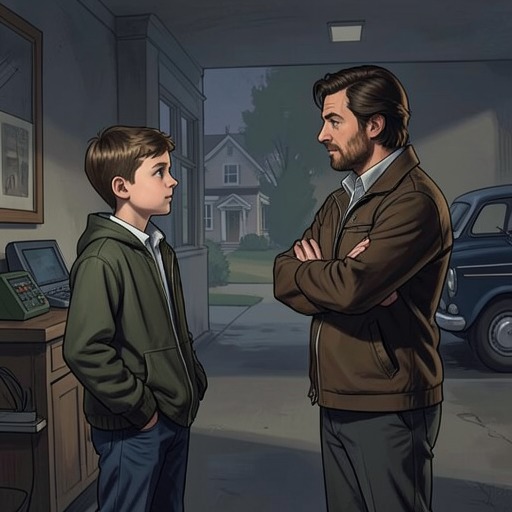
Harry tells Joe that they cannot make it there and that Thula will not stay. Asked where they are going, he says he is uncertain: first the city, then perhaps California. He explains that Thula wants Joe to remain and that he would stay with him if he could, but the younger children need a father more. He also treats Joe as nearly grown. The explanation presents the separation as a choice forced by competing responsibilities, but it does not soften its immediate effect: Joe is the one member of the family told to stay behind.
Joe freezes and cannot answer at first. He steadies himself on the rough cedar porch railing, then asks whether he can go along. Harry says no. He offers the lesson that Joe will need to learn to be happy on his own, then returns to the car. Mike and Harry Junior look back at Joe through the rear window as the Franklin drives down the driveway. Its red taillights disappear into the rain. Joe goes inside and closes the door; the whole exchange has taken less than five minutes.
Alone in Sequim
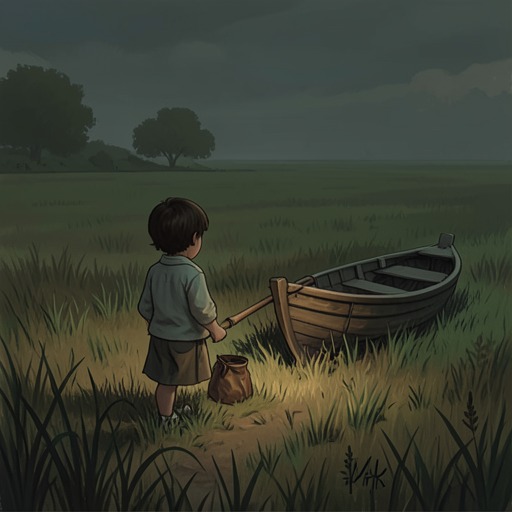
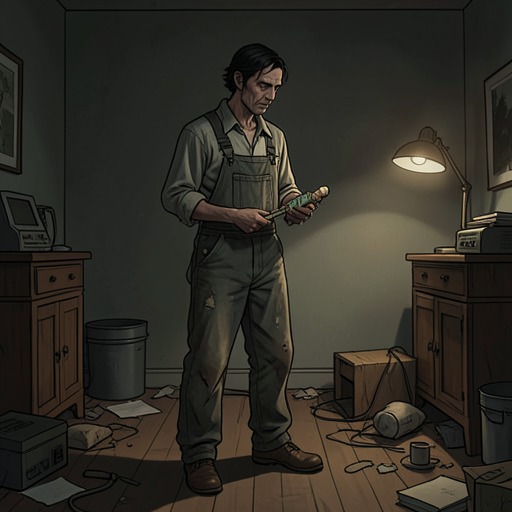
The scene ends not with a reconciliation or a plan for Joe’s future, but with the house itself: cold and damp, its lights flickering briefly before going out as rain beats on the roof. The next morning, Joe wakes in the half-finished house and lies in bed listening to the wind in the fir trees. The sound recalls his earlier childhood in Pennsylvania, when he lay alone in his aunt’s attic listening to distant trains. That remembered fear returns, connecting the departure to an older experience of being left without the security of home.
This aftermath clarifies what Harry’s instruction means for Joe in practice. He is not simply being encouraged to independence; he has been left behind in the place where the family’s prospects have failed, while the rest of the household departs together. The story gives the separation its force through ordinary details—the school bus, packed suitcases, a familiar car idling in the rain, and a door closed after the taillights vanish—rather than through an extended confrontation. Joe’s request to come along is refused, and no immediate comfort follows.
A turning point in Joe’s trajectory
The departure marks a turning point because it converts economic insecurity into a personal test of survival. The family’s losses explain why leaving has become necessary for Harry and Thula, but they do not erase the unevenness of the decision: the younger children travel with their parents, while Joe is expected to fend for himself. The contrast between Harry’s belief that Joe is nearly grown and Joe’s stunned silence makes the gap between adult judgment and the young man’s experience visible without resolving it.
Later, Joe leaves the region for work, driving east with his clothes and banjo in the Franklin and taking a physically demanding job at the Grand Coulee construction site. There he learns to coordinate closely with the men working beside him. Those later episodes show him undertaking life beyond the family home, but the departure in Sequim remains distinct: it is the moment when self-reliance is imposed upon him by his father’s decision, rather than chosen as a journey. The separation’s lasting significance lies in that abrupt reversal—from a household already losing its means of support to a young man left alone with the task of making a life.