Jim McMillin
The Boys in the BoatJim McMillin, called Stub by his crewmates, emerges as a powerful and fiercely persistent sophomore oarsman in the Washington crew. His progress is uneven: after an unremarkable start, he finds his place in Bobby Moch’s junior-varsity boat, where his leverage and refusal to accept defeat help turn a humiliating demotion into a commanding victory over California.
Identity and Early Development
McMillin is introduced as a six-foot-five, curly-haired beanpole whose slightly goofy appearance is offset by a disarming smile. He had not rowed particularly well in the second freshman boat the previous year, but in Moch’s boat he begins to find his niche. His size gives the crew leverage and power in the middle seats, making a physical quality that might otherwise be merely conspicuous useful to the boat’s work.
His promise is not presented as polish or effortless mastery. Instead, McMillin rows hard whether the cause is winning or losing, and he never seems to believe he is beaten even when the race is going against him. That stubbornness distinguishes him from a rower whose value can be measured only by immediate results. He also makes clear that he believes he belongs in the first boat, though the account does not establish that he ultimately earns a place in it.
Reassignment and Team Role
As Al Ulbrickson experiments with combinations in February and March, McMillin becomes part of the uncertainty surrounding Washington’s varsity selection. Ulbrickson tries him in the number-seven seat of the sophomore boat, then removes him the following day. The trial is one move among repeated substitutions: Ulbrickson shifts rowers between boats in search of a lineup that can decisively outperform the others. McMillin’s place is therefore provisional, even as his contribution in Moch’s junior-varsity crew is becoming more apparent.
The two leading contenders for varsity status are Moch’s boat, which includes McMillin and Chuck Day, and the original sophomore boat. Both post impressive trial times, but neither establishes a clear advantage. McMillin’s story at this point is not a simple ascent through the ranks; it unfolds amid competition between lineups and a coach’s continuing search for the right combination.
The California Race
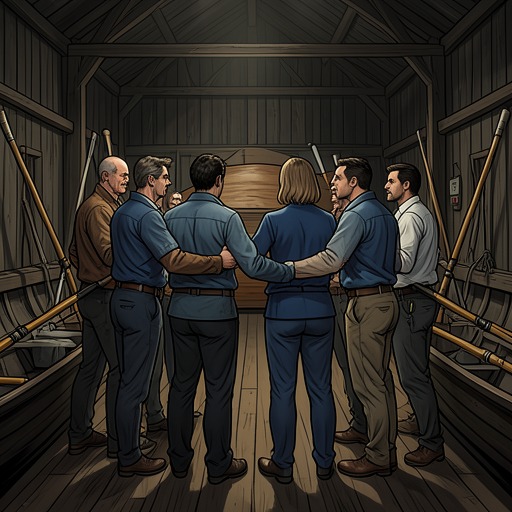
When Washington’s older boys arrive at the junior-varsity starting line after being demoted, the race carries the force of a response to Ulbrickson’s decision. California takes the early lead, but Moch calls the cadence as McMillin and his crewmates steadily pull even and then move ahead. By halfway, Washington has open water between its boat and California’s.
Moch calls for the crew to raise the stroke, and the rowers answer with a surge of effort. McMillin’s place in the engine room gives his strength a direct role in that collective drive: the boat builds its lead, reaches the bridge five lengths ahead, and crosses the line eight lengths in front, still pulling away. The victory is not just a result for the junior-varsity crew. It is a public answer to the demotion and a demonstration that Moch’s lineup, with McMillin in it, can row with force and purpose.
Narrative Significance
McMillin’s characterization turns on the contrast between early promise and imperfect technique, and between a crew’s uncertain status and its sudden, decisive performance. His insistence that he belongs in the first boat is an ambition, not a confirmed outcome; what the narrative does establish is how he contributes when given a place in Moch’s lineup. The California race makes that contribution visible through the crew’s sustained advance and widening margin.
His role also sits within a broader West Coast contest for recognition. Washington and California’s rivalry drew large audiences, while collegiate rowing’s prestige had long been associated with eastern institutions and elite traditions. McMillin’s victory does not by itself resolve that larger imbalance, but it gives the Washington crew a forceful local answer: a rower who had struggled in an earlier boat now helps power an eight-length win.