Joe Rantz
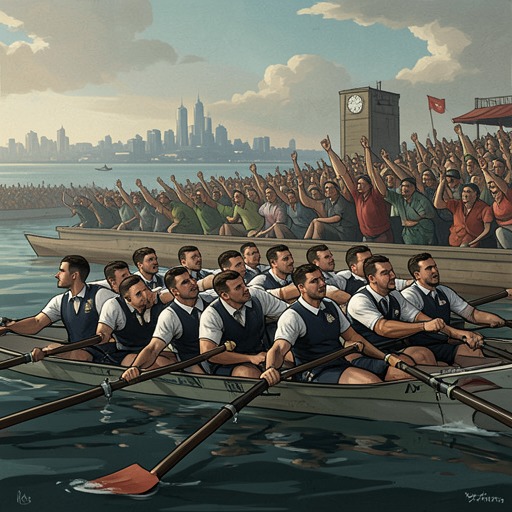
The Boys in the BoatJoe Rantz is remembered both as a gold-medal rower and as a young man for whom a place in the boat could determine whether he remained at the University of Washington at all. One of nine men from Washington State who won the eight-oared race at the 1936 Summer Olympics, he came from a working life far removed from the polished traditions of elite collegiate rowing. His achievement rested not simply on endurance, but on a personal change: he moved from solitary self-reliance toward complete trust in a crew.
Identity and Background
Rantz entered the rowing world as a poor student who knew how sharply he differed from many of his classmates. At Montlake, his trousers were not neatly creased, his shoes were neither new nor freshly polished, and his sweater was a rumpled hand-me-down. He understood that he might not be able to remain at the university if rowing did not go well. Without his place in the shell house, he feared losing the chance to become a chemical engineer and to marry Joyce Simdars.
That insecurity belonged to a larger pattern of hardship. His family had left him behind in Sequim, and his father explained that he could not stay because the younger children needed a father more than Joe did. The next morning, rain beat on the roof of the unfinished house. Lying in bed, Joe remembered an earlier period of loneliness in his aunt’s attic in Pennsylvania, where the distant sound of trains had accompanied his fear. The old feeling returned with such force that he did not care whether he got up. His later insistence on managing alone was shaped by experiences in which dependence had offered little security.
The contrast between his background and the sport’s conventions was not merely personal. Collegiate rowing drew enormous crowds and press attention, but its celebrated eastern tradition was closely associated with private schools and gentlemanly privilege. Western programs such as the University of Washington’s had struggled for funding and recognition, and their athletes were largely drawn from a different social world. At Henley, even Australian policemen were excluded under a rule barring men who had worked for wages as mechanics, artisans, or laborers. Rantz’s working-class background therefore placed him at odds with a sport whose prestige often depended on excluding workers even as their strength and labor helped define its contests.
A Place in the Boat
Rantz’s position on the crew was never secure. In his first year, Tom Bolles tried moving him between seats three and seven, but the change did not solve the technical problem: Joe could not consistently square his oar blade before the catch. The blade needed to meet the water at a right angle for the stroke to deliver its full power. Squaring demanded both wrist strength and fine motor control, and he struggled to master it. A brief incident later reminded him how quickly a weak performance could threaten not only his place in the crew but his attendance at the university.
Selection brought relief, but not certainty. When Bolles announced the first-boat lineup, Rantz heard his name at number three, after Roger Morris and Shorty Hunt had been assigned seats. He clenched his fist and made a small, restrained pump, careful not to celebrate conspicuously in front of those who had not been chosen. Even public recognition did not quiet his doubts. When a newspaper reported that he was getting the call at number three, he cut out the notice and pasted it into a new scrapbook, then wrote beside it that he could not be sure he was a safe bet. The clipping preserved both the recognition and his fear that it could vanish the next afternoon.
The crew’s social hierarchy was visible in smaller humiliations too. In the cafeteria, half a dozen rowers approached with dirty plates, grinning as they presented them to him. Startled and embarrassed, Joe turned back to his food and continued eating, his jaw set. He was hungry much of the time and would not abandon a meal; the work and deprivation he had already endured mattered more than the ridicule of boys in jerseys. The scene gives physical form to the resourcefulness that sustained him, but also to the vulnerability hidden beneath his defiant independence.
Coaches saw that contradiction. Bolles reported that Rantz could row longer and harder than anyone in the boat when he chose to, but that his effort could be inconsistent. Other boys called him Mr. Individuality. He was tough, independent, and apparently self-assured, yet unusually sensitive, with vulnerabilities his crewmates could sense without fully understanding. Rantz himself recognized how much energy anger consumed. He said that after his family left, survival had taken everything he had; now he needed to stay focused and take care of things himself. Self-reliance had helped him endure, but in a crew it could also become a barrier to consistent effort and shared purpose.
Learning to Row with Others
After a discouraging season of being promoted and demoted, Rantz again found himself low in the boat rankings. In March, George Pocock called him up to the loft during a stormy afternoon at the shell house. Pocock worked varnish over the upturned hull of a new shell while Joe sat across from him. The conversation marked an important point in Joe’s development: Pocock urged him toward a way of rowing that required giving himself over to the crew rather than treating the effort as an individual test.
The change became tangible when Rantz found his name on the chalkboard at number seven in boat two, the crew thought to have the best chance at a varsity place. He did not know whether Pocock had spoken to Al Ulbrickson, whether another coach had made a mistake, or whether the assignment was temporary. The reason mattered less than the opening: for that day, he had a chance to prove himself.
He rowed differently. Following Don Hume’s stroke, Rantz became an extension of the man in front and the man behind him, passing the movement along through the boat to Shorty Hunt. The experience felt like a transformation, but its meaning was not that he had simply obeyed Pocock’s instruction. He recognized that these were boys with whom he could row that way. The memory recalled an earlier night on Lake Union, when the crew’s breaths had synchronized into white plumes beneath the lights of Seattle. What had once seemed a fleeting physical harmony now offered a model for belonging: his effort could remain his own while also becoming inseparable from the others’ work.
The crew’s cohesion was tested in competition as well as practice. After the Washington freshmen defeated the California freshmen, Rantz and his crewmates watched from a ferry railing as the varsity prepared to race. At Poughkeepsie, Washington’s junior varsity won its race while Joe waited in the Husky Clipper for the varsity event. Hearing five bombs signal the result, he silently raised his fist; Shorty Hunt and Roger Morris did the same. Many of the junior varsity rowers had belonged to the all-sophomore crew the previous year, and all had known the disappointment of missing the seats Joe, Shorty, and Roger now occupied. Their victory and the varsity crew’s impending race placed individual selection inside a larger team story, one in which the boys who were left waiting remained part of the same rowing community.
Gold in Berlin
By the time Rantz and his crewmates reached the 1936 Summer Olympics, they represented more than their own ambitions. The values binding them together—trust, mutual respect, humility, fair play, and looking after one another—were presented as part of what the United States stood for, alongside liberty. Their contest in Berlin thus carried a public meaning, but the crew’s own experience of that meaning was built from the intimate demands of rowing together.
The final was physically punishing. Rantz was aware of the wind and the strain in his arms and legs, which seemed to be encased in cement. He could not see how the race stood and had no clear opportunity to save energy. The sprint had not yet come, and he wondered how much strength he and the others would have left when Bobby Moch called for it. His only available course was to trust Moch’s judgment. The race made the crew’s dependence concrete: no rower could control the whole contest from his seat, and each had to continue without knowing the full position of the boat.
The Washington rowers entered a state of concentrated coordination, detached from themselves yet alert to one another’s smallest movements. Moch’s calls, the rattle of oars, breathing, and pounding pulses remained; pain receded. In the number five seat, Stub McMillin was astonished to find that he was still breathing through his nose after three miles. For Rantz, the victory’s deepest significance became clear after the race, at the police academy where the athletes stayed. Awake through the night, he contemplated his gold medal hanging from the end of his bunk. He understood what it meant to people back home and to the wider world, but also realized that it was not the most important thing he would take away from Germany.
That other prize was trust. Rantz later understood the act of committing himself to a stroke as a leap into a future he could not guarantee: he repeatedly entered the effort believing that the others would be there to keep the shell moving with him. The gold medal recorded the result; the crew’s mutual reliance explained what the result had required. His victory was therefore not a rejection of the independence that had kept him alive, but a discovery that he could risk depending on others without surrendering his own strength.
Life After Rowing and Legacy
Rantz graduated from the University of Washington in 1939, making up two years of chemistry laboratories missed during his rowing career. Joyce graduated Phi Beta Kappa the same day, and they married that evening. With a degree in chemical engineering, he first worked for Union Oil Company in Rodeo, California, then returned to the Seattle area and joined Boeing in 1941. There he helped design elements of the B-17 and later worked on the laminar-flow clean-room technology that NASA would use in the space program. He bought a house in Lake Forest Park near the finish line of the Washington–California crew races, and he and Joyce lived there for the rest of their lives.
The capacity for sustained, solitary work that had marked his youth remained visible in old age. In his mid-seventies, he hauled cedar logs down a mountain by himself, split them into rails, cut the posts, and installed 2,224 linear feet of pasture fence. The scale of the task echoed the toughness that had once made him seem self-sufficient, but his life’s defining achievement had depended on something he could not accomplish alone.
By early 2007, Rantz was receiving hospice care at the home of his daughter Judy Willman. In March, wearing his purple Husky Hall of Fame jacket, he attended a Varsity Boat Club banquet where 450 people stood and cheered. In May he watched Washington’s crews race on opening day from his wheelchair at the Cut. He died peacefully at Judy’s home on September 10, 2007. His ashes were interred in Sequim beside Joyce’s. The return to Sequim closed a life that had begun with abandonment there, while the story of the rower carried forward the change at its center: from surviving alone to trusting a crew.