Joe Rantz joins the top boat and earns a place on the Olympic crew
The Boys in the BoatJoe Rantz’s move into the boat that would carry the University of Washington’s Olympic hopes began with his name unexpectedly appearing at seat seven on a chalkboard. The decisive change was not simply a promotion in the lineup: in a boat that had to move as one, Rantz discovered that trust in his crewmates let him row in a way he had not managed before. The crew’s immediate results turned that personal opening into a team-wide breakthrough, and Al Ulbrickson soon elevated the boat to varsity status and set it on the course toward Berlin.
A place in the competitive order
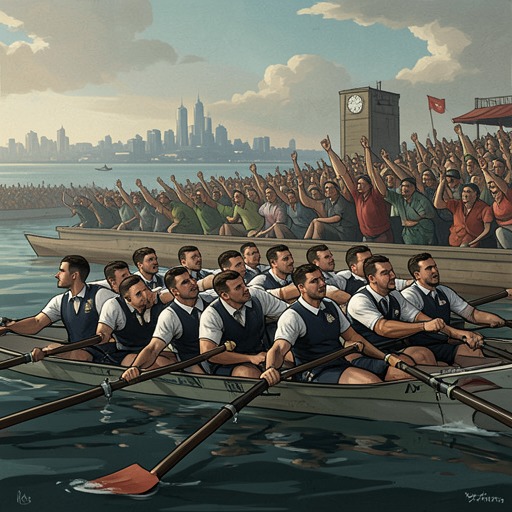
In collegiate rowing, a place in a boat carried consequences beyond the day’s practice. During the 1920s and 1930s, the sport drew enormous crowds and national press, while eastern universities and their traditions dominated the public imagination. The Intercollegiate Rowing Association regatta at Poughkeepsie was a storied institution and a national test. For much of the early twentieth century, eastern crews had controlled it; when western schools did compete, their rowers faced costly travel and a reception that mixed curiosity with condescension. Washington’s 1923 victory had shown that a western crew could prevail, but it did not erase the imbalance in prestige or resources.
By the time Rantz entered the running for the leading boat, the stakes extended toward the 1936 Olympics. The rowing world still treated British tradition and eastern institutions as measures of distinction. At Henley, Australian policemen had been excluded from the Grand Challenge Cup because the rules barred men employed as mechanics, artisans, or labourers; the British Olympic crew, drawn from Oxford and Cambridge rowers associated with the Leander Club, embodied a very different social ideal. Against that background, Washington’s effort to build an Olympic crew from its own competitors was both a sporting campaign and a challenge to assumptions about who belonged in elite rowing.
The chalkboard and the welcome
Rantz had been rowing in the third boat, with little indication that he would reach even the presumed junior varsity lineup. On March 21, he walked into the shell house and found his name written beside seat seven in boat number two—the boat regarded as the strongest candidate for the varsity place. The reason was uncertain to him. George Pocock might have spoken to Ulbrickson; Merton Hatch might have made an error; or Ulbrickson might simply have needed a different rower at number seven that day. Rantz could not know which explanation was right. What mattered was that the opportunity had arrived.
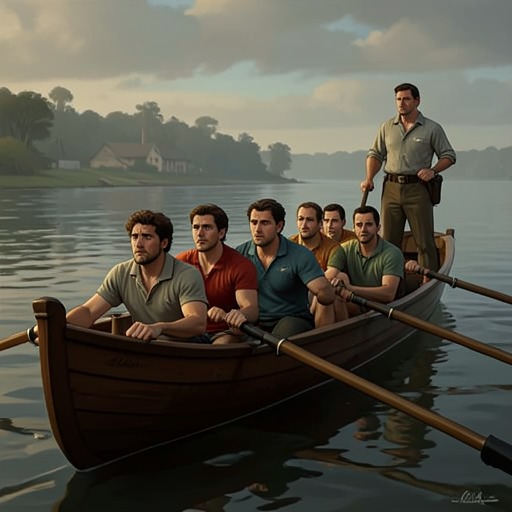
The reception in the boat made the new place feel less like a solitary trial. Don Hume and Gordy Adam welcomed him, while Roger Morris, Rantz’s oldest and most reliable friend in the shell house, called from the bow, “Hey, Joe, I see you finally found the right boat!” Chuck Day and Johnny White, his friends from Grand Coulee, were seated near the front. As Rantz strapped his shoes to the footboard and laced in, Stub McMillin said, “OK, this boat is going to fly now, boys.” Shorty Hunt slapped him on the back and assured him, “Got your back, Joe.” The gestures and words did not remove the competitive pressure, but they made clear that he was being received as a crewmate rather than left to prove himself alone.
From individual effort to shared rhythm
Pocock had urged Rantz to give himself to the crew’s effort. In the shell that afternoon, Rantz followed Hume’s stroke, rowing as an extension of the man ahead of him and the man behind him, and passing the movement on to Hunt in a continuous sequence. The change was bodily as well as tactical: he felt at home in the boat and found it surprisingly easy to row in this way. The nearest experience he could remember was an earlier night on Lake Union, when the crew’s breathing had synchronized in the cold darkness. Now, as he climbed from the shell at twilight, he recognized that the difference was not just that he was trying to obey Pocock’s instruction. These were men with whom he could do it. He trusted them.
Ulbrickson’s logbook captured the lineup change tersely: “Changed Rantz and Hatch and it helped a lot.” The result was larger than that modest entry suggested. The boat began to perform with a fluency that made Rantz’s arrival consequential not merely for his own prospects but for the crew’s. His breakthrough illustrates the distinction at the heart of rowing: individual strength mattered, but could not by itself produce a boat moving cleanly together. In this crew, confidence in one another gave the shared rhythm somewhere to take hold.
Results, promotion, and a boat for Berlin
The new combination quickly established itself. On March 22, the boat led the other crews from start to finish. The next day it won one race by seven lengths and another by three or four. On the morning of March 27, through a heavy late-spring snowstorm, it finished three lengths ahead. That afternoon, in a 2,000-meter sprint, Hume raised the stroke rate to forty and the crew followed him in unison, again crossing well ahead. On March 28, with light snow still falling, Ulbrickson officially elevated the boat to varsity status. He waited several days before announcing the decision to the press, but he had chosen the crew with which he would attempt to reach the Berlin Olympics.
Pocock personally christened the new shell intended for the trials. As Rantz and his crewmates held it aloft, Pocock poured a jar of liquid over the bow and named it Husky Clipper, wishing it success, especially in Berlin. When the boys tried to identify the smell, he revealed that the liquid was sauerkraut juice, meant to get the boat accustomed to Germany. The joke attached the distant Olympic goal to a tangible object they would carry together: the crew’s selection was no longer only an aspiration on a training schedule but a shell being prepared for the journey.
The performances continued to support the decision. In a three-mile time trial on April 4, Bobby Moch raised the beat to thirty-two two miles into the course. The crew finished in 16:20, bettering the existing course record of 16:33.4, and climbed out sitting upright, breathing easily. Rantz’s unexpected seat assignment had thus opened into a place in a boat that Ulbrickson considered capable of pursuing Olympic selection. The significance of the episode lies in the sequence: an uncertain change on the chalkboard, a welcome from the men in the shell, a new capacity for shared rowing, and results strong enough to make that unity the basis of Washington’s Olympic campaign.