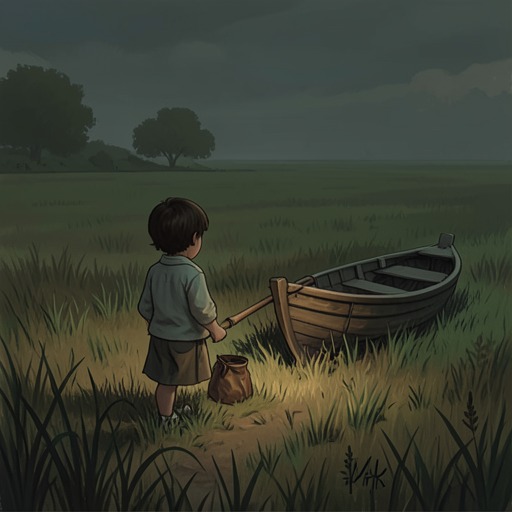
Joe Rantz’s solitary survival in Sequim
The Boys in the BoatJoe Rantz’s solitary survival in Sequim begins with the return of an old fear and becomes a sustained experiment in self-reliance. Left in a cold, unfinished house, he faces hunger, the economic collapse of 1929, and the absence of his family. Over the following months, he learns to feed himself, make money by any means available, and find work across the surrounding farms. The practical skills accumulate; so does the loneliness he carries back each night.
From abandonment to resolve
Rain pounds the roof when Joe wakes in the half-finished house the morning after his family has gone. The wind moans in the fir trees, recalling the days he spent alone in his aunt’s attic in Pennsylvania, listening to distant trains. The familiar weight of fear and aloneness presses him toward the thought that he does not care whether he gets up at all. The turn comes not through sudden rescue but through ordinary acts: he lights the woodstove, boils water, fries bacon, and makes coffee. As he eats, his thoughts begin to clear, and he resolves not to let other people determine his future or his sense of himself.
His decision is not a rejection of human company. Joe recognizes that friends can ease loneliness and that he likes other people too much to become a hermit. What he rejects is dependence on friends or family for his identity. He means to find his own way to happiness and prove to his father—and to himself—that he can manage. The distinction gives his resolve its shape: connection remains desirable, but survival and self-worth must not rest on someone else’s presence.
Learning what the place can provide
The first inventory is meager: a few boxes of oatmeal, pickles, eggs from the chickens that survived the mink attacks, half a head of cabbage, and bologna in the icebox. For a fifteen-year-old already approaching six feet, it is plainly not enough. His father had taught him that problems had solutions, though not necessarily in the places people expected; the memory turns deprivation into a problem to investigate. Joe recalls finding mushrooms on rotten logs in Boulder City and concludes that he can manage if he stays alert to opportunities and refuses to let other people’s ideas dictate his course.
He fortifies the chicken coop by driving iron stakes into the ground and treasures the eggs he gathers each morning. In the wet woods he finds basketfuls of orange chanterelles and meaty king boletes, frying them in bacon grease Thula had saved in a tin can. He gathers the last blackberries of autumn, takes the remaining fish from the pool behind the waterwheel, and picks watercress to make salads with the berries. These are concrete, seasonal supplies, not a dependable income, and he soon understands that he needs money as well as food.
Making a living by ingenuity
Joe drives his father’s old Franklin downtown, parks on Washington Street, and plays banjo and sings from the hood, hoping for coins. But the Wall Street Crash has reached Sequim: the town is desolate, storefronts are boarded up, and even the State Bank of Sequim, still open, will fail within months. Dogs watch from the wooden sidewalks; passing drivers splash through muddy potholes without stopping. Joe’s audience is mostly the man known as the Mad Russian, who wanders barefoot and muttering through town. The scene makes the limits of his first plan plain: there is little spare money to give.
He turns to a resource he has already noticed on the Dungeness River. With his friend Harry Secor, he had discovered a deep, green pool where enormous chinook salmon, some four feet long, waited to spawn. Joe finds a gaff hook in the barn and keeps it concealed in his pocket. One misty Saturday morning, he and Harry slip through the cottonwoods and alders, avoiding the game warden who patrols during spawning season. They cut an alder pole, lash the hook to it, and approach the river. Joe removes his shoes, rolls up his pants, and wades into the shallows upstream. Harry throws large rocks into the pool and beats the surface with a stick, sending the fish upstream toward Joe. Joe thrusts the gaff under one fish’s gills, where it will leave no telltale marks, and drags the thrashing salmon onto the gravel bank.
After feasting on salmon alone in the house, Joe turns the catch into a small business. Each Saturday he hikes three miles into town with one or more enormous fish slung over a willow switch, their tails dragging in the dust. He sells them at the back door of Lehman’s Meat Market and to households around Sequim, accepting cash or bartering for butter, meat, gasoline, or whatever else he needs that week. He solemnly assures customers that he caught the fish with hook and line, fair and square. The claim is part of the transaction’s performance: the fish provide food and value, while his assurance helps make the trade possible.
Later that winter, Joe and Harry Secor exploit another opening in the local economy. With U.S. Prohibition in force and Canada only fifteen miles across the Strait of Juan de Fuca, liquor enters the area in quantity. A bootlegger, Byron Noble, drives into town each Friday night in a sleek black Chrysler and hides flasks behind fence posts for his customers. On frosty nights, Joe and Harry follow his route in dark, heavy clothes. They pour selected flasks into fruit jars, replace the liquor with dandelion wine made in Joe’s barn, and leave the altered bottles for Noble’s customers, hoping the drink will seem like bad liquor rather than stolen goods. They avoid taking from the same spot too often, wary that Noble or a customer might be waiting with a shotgun. Joe then delivers the good liquor to his own discreet clients. The scheme is resourceful but risky, another way to turn watchfulness and local knowledge into the means of getting by.
Work, strength, and the empty house
Illicit ventures are only part of Joe’s effort. He takes whatever legitimate labor he can find: digging beneath stumps and levering them out with iron bars, or placing dynamite under them when prying fails; hand-digging irrigation ditches; splitting fence rails from cedar logs washed down the Dungeness; digging wells and building barns. On dairy farms he hand-cranks cream separators and hauls 120-pound cans of milk and sweet cream to trucks bound for the Dungeness-Sequim Cooperative Creamery. When summer comes, he cuts hay with a scythe, forks it onto wagons, and lifts it into neighbors’ barns. The work is varied and physical, measured in heavy cans, long-handled tools, and hay moved by the ton.
Across these efforts Joe grows stronger and more self-reliant, but he remains in school and earns good grades. His competence does not make the house a home again. At night he returns alone to the place where his family once held boisterous dinners, eats at one end of the large table, and washes the single plate he uses. He dries it and puts it back on top of the dishes Thula left in a kitchen cabinet. The repeated care given to one plate makes the absence visible through routine rather than explanation.
In the front room, Joe sits at his mother’s old piano and picks out simple melodies that travel through the dark, empty spaces. On the front steps he plays his banjo and sings quietly to himself. The music and the work belong to opposite sides of his survival: one supplies practical means, the other fills, however briefly, the silence of the house. Sequim teaches Joe how to act without help, but these nightly rituals show the cost of learning that lesson alone.