Johnny White
The Boys in the BoatJohnny White’s path to the 1936 Olympic crew ran through financial hardship, strenuous work, and the expectations of a father who wanted him to row. A gifted but very young student, he spent two years earning money and building the strength to compete before becoming one of Tom Bolles’s leading freshmen. He later rowed in the Washington boat that won its way to the Olympics, recording the crew’s nervousness and changing fortunes in a diary. His story joins athletic ambition to the material costs of participation: money for university and travel was scarce, and even his passage to Europe depended in part on a sacrifice made by his sister.
Identity and Family Background
White grew up in the southern part of Seattle rowing and labor-conflict city, on the western edge of Lake Washington, south of Seward Park. His family’s finances had been secure enough before 1929, but the crash devastated his father’s scrap-steel export business. John White Sr. gave up his downtown office and worked from a room in the family house, waiting for business that did not return. The family’s circumstances changed from commercial security to improvised household economy, and Johnny’s education and rowing ambitions had to be pursued within that constraint.
His father responded to the loss of income by turning to the land around the house. He planted a garden in the rich lakeside soil, growing sweet corn and tomatoes, raising chickens, and gathering fruit from the property’s old trees. Johnny’s mother exchanged eggs, preserved tomatoes, made loganberry wine, sold peonies and converted flour sacks into dish towels. A roast appeared for Sunday dinner; during the rest of the week, the family ate leftovers. In 1934, the city condemned the waterfront garden to open a swimming beach, further diminishing a resource the family had developed to feed itself.
Rowing was John White Sr.’s sustaining passion. Before moving west, he had been a first-rate sculler at the Pennsylvania Athletic Club in Philadelphia and had brought his shell with him. He rowed for long stretches on Lake Washington, passing back and forth before the house and the beach where the garden had been. He wanted his son to become an oarsman, and Johnny was eager to meet his father’s high expectations. He was bright, accomplished, and ambitious, graduating from Franklin High School two years early, at sixteen.
Work Before University
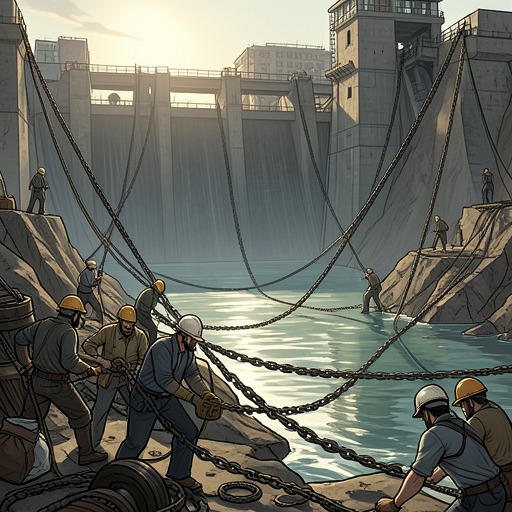
Johnny’s early graduation created a practical obstacle: he was too young and underdeveloped to row for the university, then the only rowing program in town. He and his father agreed that he should work both to save tuition money and to build the physical strength the sport demanded. The jobs were deliberately strenuous. At a waterfront shipyard he wrestled steel beams and heavy equipment; at a sawmill he stacked lumber and used a peavey to move massive fir and cedar logs.
The work made his athletic ambition tangible. He was not simply waiting until he could enter university; he was earning the means to attend and preparing his body for the boat at the same time. Two years later, he had saved enough to pay for a couple of years of school and developed the strength to stand out among Tom Bolles’s freshmen. In the summer of 1935, he went to Grand Coulee seeking still more money and muscle. There he encountered Joe Rantz and Chuck Day, two fellow rowers who had also come for work. The three formed an easy alliance, setting aside the shell-house rivalries and insults of the previous year despite knowing that they would compete again.
From Freshman to Olympic Crew
By March 1936, Al Ulbrickson had come to regard his second boat as his strongest Olympic prospect, even though it still sat below the first boat on his selection board. White held the number-four seat. The lineup also included Roger Morris, Chuck Day, Gordy Adam, Stub McMillin, Shorty Hunt, Merton Hatch, and Don Hume at stroke. Their places in the shell reflected a crew assembled from different circumstances and backgrounds, but its prospects depended on rowing as a unit under pressure.
As the team prepared for the 1936 Poughkeepsie regatta, White’s diary became a record of the gap between public expectation and what the rowers knew. After California posted a four-mile time of 19:31, the Washington crew made a secret night trial in rough water. Al Ulbrickson gave reporters a time just over 19:39, while White recorded the crew’s actual time as 19:25. The next day, reports put California’s time even lower, and Royal Brougham described the rival boat as seeming to fly. Ulbrickson nevertheless ordered light workouts and rest. White’s record preserves the fact that the Washington crew had gone faster than its public account suggested, even as outside forecasts favored California.
At the regatta’s finish, White was in the number-three seat as the Washington boat chased California through the last five hundred yards. In the final two hundred, the crew surged to forty strokes per minute and passed its rival, opening a visible gap before the finish. The scene made the rowers’ collective effort decisive: White felt the boat moving as if it were flying, while Shorty Hunt kept his eyes on Joe Rantz’s neck and pulled without looking across at California. White’s place in that finish was part of the coordinated drive that turned the race and strengthened the crew’s claim to Olympic selection.
The Olympic trials brought a different kind of pressure. Their outcome would determine whether the crew had a future in Berlin, and the boys spent the preceding night walking by Lake Carnegie before returning to their rooms. The next morning, White wrote in his diary, “We woke up all scared and having frequent visits with Alvin.” The entry catches the team’s anxiety in a plain, intimate register, while Al Ulbrickson faced the judgment of fellow coaches and a live broadcast to fifty stations. The rowers had to deliver in public, but White’s brief note also records how closely their daily lives revolved around the coach and the coming race.
Money, Travel, and Life Abroad
Winning the trial did not guarantee passage to the Olympics. At the Loyal Shoudy banquet, a funding crisis emerged: Washington would have to pay its own way or give up its place. The working-class rowers could not finance the trip themselves, and the university had already scraped together funds to send them east for the regatta. The ultimatum exposed how athletic achievement could be separated from the economic means to represent the country. Seattle rowing and labor-conflict city quickly mounted a public campaign, combining donations large and small with sales of fifty-cent tags. White’s hometown contributed, as did the hometowns of his crewmates; within two days, a certified check for the required $5,000 had been sent to Ulbrickson.
White’s own finances remained precarious. Before leaving for Europe, he had only most of the fourteen dollars he had brought from home. At the last moment, an envelope containing one hundred dollars arrived from his sister, Mary Helen, who said she would take his old violin in exchange. White knew she did not want the instrument; the money represented nearly all her savings and a family member’s effort to keep him on the Olympic journey. The violin’s later return would make that exchange more than a travel detail: it marked both the cost of his opportunity and the affection behind it.
In New York City, the rowers completed Olympic paperwork and encountered the larger world of the American team. Their sightseeing included Grant’s Tomb, Rockefeller Center, Broadway, and a visit to Duke Ellington’s orchestra at Loew’s State Theatre. White’s diary also preserved unvarnished impressions. At a burlesque show he judged the performance “It was foul.” In Berlin, the crew moved between training and sightseeing, rode the S-Bahn, walked Unter den Linden, and encountered crowds greeting them with the Nazi salute. The boys answered by extending their own hands and calling out “Heil Roosevelt!”; most Germans pretended not to notice.
The crew’s reception in Köpenick soon became tiring. Townspeople gathered around the athletes for autographs, and White’s terse journal assessments of performances and public entertainments convey his impatience with some of the obligatory festivities. For relief, the rowers rented boats in the evenings and moved around the castle in the rain, keeping company with the swans. They also used humor to lift a flagging mood: wearing Indian headbands and feathers from Huckleberry Island at practice drew what White called “a small riot” from German spectators. The gesture was playful, but it occurred while the boat was struggling and two rowers, including Don Hume, were ill.
The Crew’s Recovery and White’s Later Life
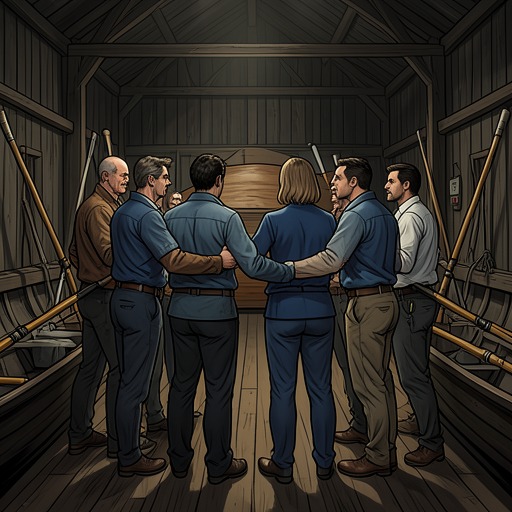
The boat regained its confidence when Hume returned to the stroke position. White and his teammates had each privately feared that he was the weak link, but every rower, the book later reveals, felt similarly inadequate and was fiercely determined not to fail the others. As the race approached, the boys talked through their plan with arms over one another’s shoulders; White also took time to think through his own rowing. With Hume back at stroke, the crew’s uncertainty eased and its swing returned. White’s place in this recovery shows that his contribution belonged to a larger pattern of mutual doubt resolved through coordination rather than individual assurance.
After the Olympic journey, White graduated in 1938 with a degree in metallurgical engineering and married in 1940. He followed his father into the steel business, working for Bethlehem Steel and eventually becoming general manager of sales. In 1946, Mary Helen returned the violin he had given her in exchange for the money that helped him travel. The narrative’s return of the instrument quietly closes a circle: what had been surrendered to make the Olympic opportunity possible came back after White had established a life and career beyond the boat.