Ky Ebright
The Boys in the BoatKy Ebright was the coach who rebuilt the University of California, Berkeley rowing program and made its rivalry with Al Ulbrickson’s Washington crews the central contest of West Coast collegiate rowing. He won national titles with California and helped lead crews to Olympic gold, but his story is not a simple progression from triumph to triumph: he repeatedly confronted puzzling performances, reshaped his lineups, and watched Washington turn a long-running rivalry into a new challenge. His coaching combined hard competition with a deep personal investment in the young men he trained.
Identity and rise at California
In the 1920s and 1930s, collegiate rowing drew extensive press attention and large crowds, although American rowing’s traditional center remained among Eastern colleges such as Harvard, Yale, and Princeton. Western programs had less funding, less recognition, and few affluent patrons. Their position began to change as the University of California, Berkeley and the University of Washington built a rivalry that attracted students, alumni, and local spectators. California’s previous Olympic gold medals gave Ebright’s program particular stature, but the schools’ regular contests also made them one another’s most immediate measure.
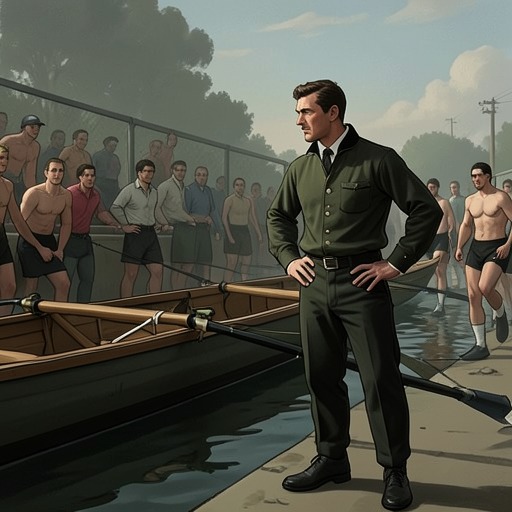
Ebright became California’s head coach in February 1924, when the university’s crew program faced possible abandonment after years of disappointing results and the departure of its coach, Ben Wallis. Washington’s rowing stewards had reason to care: without a strong California rival, they feared their own program would be harder to sustain. California needed an effective coach, Ebright needed a position, and Washington needed a rival. The appointment answered all three needs. Ebright set about rebuilding the program, and the account presents him as a forceful coach whose success became inseparable from the West Coast rivalry he helped intensify.
His work produced Olympic success as well as intercollegiate titles. California won Olympic gold in 1928, and an emotional moment after that victory revealed the relationship behind Ebright’s demanding public reputation. He went to his coxswain, put an arm around him, and expressed how much he valued him as both a student and a crew member. The coxswain later recalled that the praise moved him to tears and that Ebright had been an almost godlike figure to him. The episode shows that Ebright’s authority could inspire fierce affection as well as discipline. The account also notes that several of his rowers went on to public distinction, including Robert McNamara and Gregory Peck.
A coach tested by uncertain lineups
Ebright’s record did not prevent him from being baffled by his crews. On the Oakland Estuary, California’s home water, his 1932 Olympic gold-medal crew had dwindled to one remaining rower, and the varsity was producing indifferent times. Ebright saw that the athletes had size and power but could not reconcile those qualities with what he perceived as an inability to win. The problem grew sharper when the freshmen began beating the varsity in time trials and head-to-head races. His response was not to assume that seniority guaranteed speed: he treated the results as a genuine challenge to his understanding of the boat.
The same willingness to unsettle established lineups appeared in the seasons that followed. As a Pacific Coast Regatta approached, Ebright demoted the varsity that had won the previous year’s national title and favored a mixed boat of sophomores and juniors. Only one former champion remained in the varsity shell, while the older rowers’ disappointing performances continued to perplex him. The decision was unusual but not unprecedented; Ulbrickson was also elevating sophomores. When Royal Brougham asked why the national champions could not outrow a pickup crew of younger and junior-varsity athletes, Ebright had no ready explanation. His choices register a recurring tension in his coaching: proven achievement mattered, but it could not overrule evidence from the water.
Ebright could also shift from silence to a blunt assessment of the contest. During one season when he remained unusually reserved about his own crew, he nevertheless told the New York Times that Washington was likely to win, while acknowledging that his varsity was slower than the previous year’s shell and inexperienced in racing. At another point, the uncertainty seemed to give way to confidence. In 1936, California recorded a three-mile time of 15:34 on the estuary while running with the tide. In slack water, the varsity clocked 16:15—five seconds faster than Washington’s reported 16:20. Ebright guarded against complacency with a terse acknowledgment that the crew had looked good for a change, even as the times gave him grounds to feel optimistic.
California and Washington in direct competition
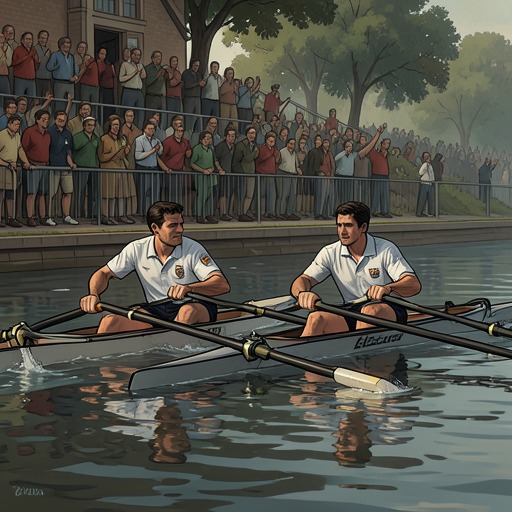
The Poughkeepsie regatta gave Ebright and Ulbrickson a national stage on which the West’s two major programs could contest Eastern dominance. In 1934, California and Washington moved ahead of the Eastern crews over the four-mile varsity course, exchanging the lead through the race. Washington held a narrow advantage beneath the railroad bridge, and the crews remained level for much of the final stretch. In the last quarter-mile, California’s six-foot-five stroke oar, Dick Burnley, powered a decisive surge. California finished three-quarters of a length ahead, giving Ebright a second consecutive Intercollegiate Rowing Association title and answering Washington’s earlier success on Lake Washington.
Burnley’s role remained significant in the next season’s calculations. After Washington’s victories at the Pacific Coast Regatta had made Ebright’s silence conspicuous to Ulbrickson, the Washington coach learned that Burnley had grown another half inch. The detail mattered because it sharpened the image of the powerful stroke who had driven California past Washington at Poughkeepsie. Ebright’s competitive presence could therefore be felt even when he was not speaking: his crew’s previous performance, and the possibility that its strongest rower had become stronger, shaped the expectations of his rival.
Ebright’s lineup decisions also complicated those expectations. Before a later Poughkeepsie regatta, he restored four members of the previous year’s national-champion crew to the varsity shell. Six of the rowers in the reconstituted boat were then veterans of that championship crew. Observers had already begun comparing it with California’s 1932 Olympic gold-medal crew. Ulbrickson wondered whether California’s earlier poor showing in Oakland might have concealed the strength Ebright was assembling, though that remained his suspicion rather than an established account of Ebright’s intent. The episode shows how selection decisions could turn the rivalry into a contest of reading and misreading as well as speed.
The 1936 season made the contrast between the teams’ strengths especially visible. When California arrived at the Montlake Cut, its sun-bronzed rowers stood out beside Washington’s paler crew. Ebright took the coxswain’s seat in the California Clipper, used a megaphone to give commands, and led the varsity on an eight-mile pull far down Lake Washington, beyond the Washington coaches’ view. A subsequent time trial produced reports of an extraordinary 18:46, while the Poughkeepsie Eagle-News reported 18:37. Royal Brougham sent back a report that treated the California rowers as favorites and their speed as almost flight. Such performances helped sustain Ebright’s confidence, even though Washington had beaten California in Seattle and Poughkeepsie races in other seasons.
Defeat, recognition, and the limits of rivalry
At the 1936 Poughkeepsie regatta, Washington beat a strong California crew that was defending its national championship. Afterward, Ebright offered an unusually direct judgment: he identified Joe Rantz and his crewmates as the best crew in America and said they were the boat that should go to Berlin. The praise was not merely a customary attempt to lower expectations. The account presents it as a serious recognition of Washington’s performance—and as a warning to the rest of the field. Ebright saw that the deliberate way Washington rowed had demoralized his own crew; the victory had altered the terms of the rivalry, not just its score.
California nevertheless demonstrated a different kind of strength in a later 2,000-meter varsity contest. Navy, Pennsylvania, and California were initially close, and Pennsylvania moved ahead before California surged past both crews in the final 500 meters. California won by a quarter of a boat length. The result reinforced the belief that California remained the superior sprinting crew even as Washington’s long-race victories in Seattle and Poughkeepsie made it difficult to deny Washington’s broader claim. Ebright’s season thus ended in a rivalry without a single, uncomplicated measure of superiority: the crews’ relative strengths depended on the race and its distance.
The competition also unfolded within a sport marked by unequal resources and class boundaries. Western coaches earned much less than Eastern coaches, and the trip to Poughkeepsie was expensive for western programs. At Henley, Australian rowers who worked for wages were excluded by a rule barring mechanics, artisans, and laborers, illustrating how rowing’s traditions could privilege men in sedentary occupations. Ebright’s crews competed within that larger world of institutional advantage, but their repeated contests with Washington helped move attention westward. His career’s significance lies both in California’s victories and in the sustained rivalry that made Western crews central to the national rowing story.