Let's Go to Berlin
The Boys in the Boat“Let’s Go to Berlin” was the secret ambition encoded in the “L-G-B” chant of nine sophomores on the University of Washington crew. Ostensibly a promise to get better, the phrase named a destination far beyond their standing in the shell house: Berlin, and the Olympic Games. Its force came from the gap between what the boys wanted and what the chalkboard said—and, later, from the money they would need to make the journey possible.
Origins in the shell house
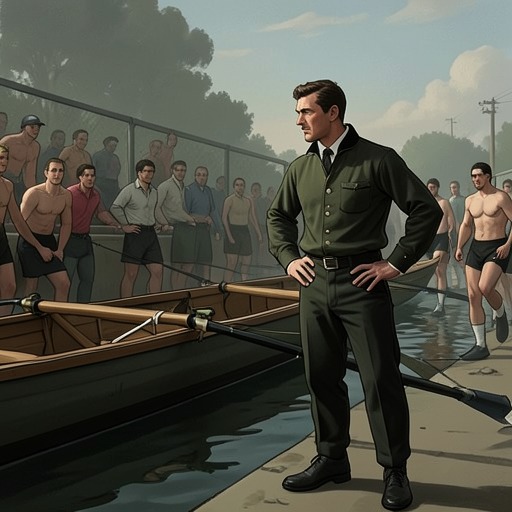
The phrase took shape after Al Ulbrickson spoke about the possibility of going to the Olympics in Berlin. The nine boys in the all-sophomore boat believed his remarks were directed at them. They changed their existing “M-I-B” rowing chant to “L-G-B.” When asked what the letters meant, they offered the harmless explanation “Let’s get better.” The concealed expansion, “Let’s go to Berlin,” made the chant a compact declaration of their own ambitions.
The code belonged to a crew environment already sharpened by rivalry. During the fall, competition between boats had turned into icy stares, pushing matches, slammed locker doors, and grudges; even brothers Sid and George Lund, rowing in different boats, barely greeted each other. Against that atmosphere, the sophomores’ shared abbreviation gave their hopes a form they could repeat among themselves. But the ambition remained private and aspirational: the boys were still listed as boat number four out of five.
A western ambition
Berlin meant more than a prestigious race. In the 1920s and 1930s, collegiate rowing drew large crowds and national press, but the sport’s established center remained in the East, among universities such as Harvard, Yale, and Princeton. Western crews had begun to attract their own followers, especially through the long-running rivalry between the University of California at Berkeley and the University of Washington. Yet western programs had struggled for recognition and funding, had little money for recruitment, and competed mostly against one another.
Washington’s earlier ventures east show why a place at the center of the sport mattered. Transporting a crew and its delicate racing shells to Poughkeepsie was expensive, while western rowers faced condescension and derision from spectators accustomed to seeing the sons of powerful families in the boats. The sophomore chant therefore joined a team’s immediate competitive hopes to a larger western desire for recognition. “Berlin” offered a shared, specific destination for an ambition that otherwise faced both geographic and institutional obstacles.
The cost behind the code
The difference between wanting to go and being able to go became unmistakable after the racing at Princeton. At a banquet, the Washington boys found the customary purple necktie and five-dollar bill at each place setting; later that night, they learned that the winning crew might have to pay its own way to Berlin. Henry Penn Burke told the Washington representatives that they needed to cover the cost or Penn might take their place. The Olympic committee was short of funds, and the working-class Washington rowers could not finance the trip themselves.
The response made the phrase’s stakes concrete. Volunteers sold fifty-cent tags, students and alumni appealed for support, and contributions arrived from the boys’ hometowns. Sequim sent $75 in support of Joe Rantz; by the end of the first day, the tag drive had raised $1,523, and on the second day a $5,000 certified check was sent to Ulbrickson. The boys were then preparing to sail to Germany aboard the SS Manhattan on July 14. Their code had named the destination before the means to reach it were secure; the fundraising effort turned that private ambition into a civic undertaking.
Meaning and limits
“Let’s Go to Berlin” works in the narrative as a phrase with two faces: the public, modest “Let’s get better,” and the concealed declaration of an Olympic goal. The boys’ explanation kept the ambition from being openly proclaimed, while the true expansion made it unmistakable to the group. Yet the chant did not itself change their ranking, guarantee selection, or resolve the cost of travel. Its significance lies instead in how it gave the nine sophomores a shared name for a future they could desire before they had earned a place in the leading boat or secured the fare to Germany.
The expression also connects personal aspiration to the book’s larger account of opportunity in sport. Washington’s crews could attract immense local commitment, but enthusiasm did not erase the unequal access created by money, geography, and established prestige. The path from a hidden chant to the Olympic journey required both performance and collective financial support. In that contrast, the phrase is at once youthful bravado and a precise statement of what remained to be achieved.